
Review · ITALY
Bologna Secrets Quest: Self-Guided Hidden Gems Adventure
Bologna’s best feature is not a single monument. It is the way medieval towers, market lanes, porticos, student hangouts, and grand piazzas fit together in a compact center. This self-guided puzzle walk turns that setting into a game, beginning at the Two Towers and ending near Via Giuseppe Petroni.
I like the low price, about $6.60 per person, and the freedom to stop whenever you want. I also like that this is a private activity for your own group, with no guide hurrying you from place to place. The main caution is the app: setup problems, outdated clues, and incorrect map links have caused trouble for some players.
Key points at a glance
- Fourteen puzzles guide you through Bologna’s medieval center and university quarter.
- Start and pause when you choose, making room for lunch, coffee, shopping, or a rest.
- The route connects major sights with lesser-known details, from the Two Towers to Torre Prendiparte.
- The app can be played without an internet connection after you have set it up.
- Private groups only make this a good choice for families and friends.
- Allow more than the advertised 90 minutes if you stop often or encounter a clue affected by construction.
A city game built around Bologna’s old center
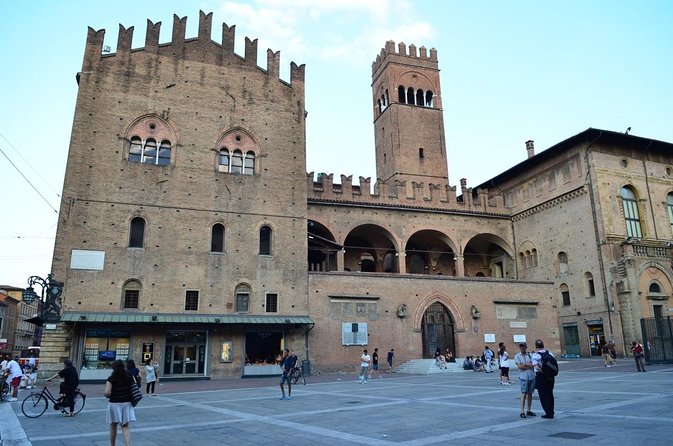
This is not a conventional walking tour with a guide explaining every street corner. You receive a mobile access code and use the Questo app to solve 14 challenges. Each answer sends you to the next place and gives you a piece of Bologna’s story.
That format works well here because the route links several different sides of the city. You begin among medieval towers, pass through ceremonial piazzas and the old market district, then move toward Bologna’s university zone. The experience feels less like ticking off monuments and more like paying attention to details you could easily pass while sightseeing on your own.
The listed playing time is about one hour and 30 minutes. I would treat that as the puzzle time, not necessarily the full time you will spend out. You may stop for food, pause the game, take photographs, or spend longer at a square. One family found the route took more walking than the stated three kilometers, so comfortable shoes are sensible.
The activity is offered in English. Since you play privately, you do not need to match the pace or interests of another group. That is useful for parents, friends, and couples who want to discuss answers together without being overheard by a larger tour party.
More City Exploration Games in Italy
- Siena Medieval Power Quest: Self-Guided Family Feud Game
★ 4.5 · 38 reviews - Florence Inferno: Dante’s Haunted Exploration Game and Tour
★ 4.5 · 33 reviews - Milan Da Vinci Mystery: Self-Guided Puzzle Quest
★ 4.0 · 19 reviews
Begin beneath the Two Towers at Piazza di Porta Ravegnana
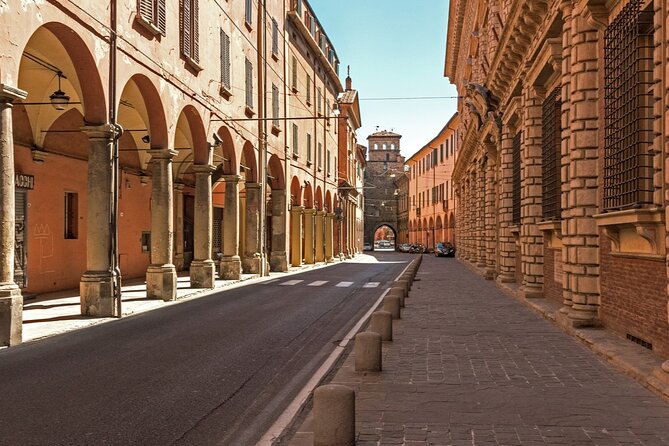
The starting point is Piazza di Porta Ravegnana, just a few blocks east of Piazza Maggiore and the Cathedral of Bologna. The square is home to Bologna’s famous Two Towers, the most recognizable pair of medieval towers in the city.
Your first challenge asks you to look closely around the square. That is a good opening move because the setting has a clear visual focus, yet enough details to make you stop and inspect rather than simply glance at the towers and move on.
The square’s older name was Porta Ravennate, a reminder that Bologna’s streets and gates developed from a medieval city organized around movement, defense, and trade. The game uses the place as a starting point for that wider story.
Plan a few extra minutes here before pressing ahead. The supplied timing gives about five minutes for the stop, but the Two Towers are one of those places where you may want photographs and a quick look at the surrounding streets. Admission to the quest’s outdoor stops is free.
Piazza Santo Stefano and Palazzo Isolani
The route then leads to Piazza Santo Stefano and the Palazzo Isolani area. Piazza Santo Stefano has a different feel from the tight space around the Two Towers. Long porticos frame the square, while the Basilica of Santo Stefano occupies one of its shorter sides.
The square is used for cultural events, flea markets, and concerts, so its character can change depending on the day. The porticos also make it a practical stop in unsettled weather. You can study the architecture without being fully exposed to sun or rain.
Palazzo Isolani faces the square on Via Santo Stefano. Its architecture includes both Gothic and Renaissance elements, and the adjoining buildings are linked with the medieval Isolani family. The challenge here encourages you to inspect the buildings and surroundings for a detail that might be easy to miss during a standard photo stop.
This section is valuable because it gives you more than a famous facade. You are asked to connect the square, the basilica, the porticos, and the powerful family that shaped part of the area. If you are playing with children, this kind of search can keep a historic square from feeling like a passive stop.
Piazza Galvani beside the Archiginnasio
Next comes Piazza Galvani, a space tied to Bologna’s commercial and academic past. From the 15th through the 17th century, the area was used for the silk market. Later, construction of the Palazzo dell’Archiginnasio from 1563 changed the nearby blocks and created the piazza as a more formal setting for the building.
The challenge here asks you to look around and identify the answer rather than simply follow a spoken explanation. That gives you a reason to notice the relationship between the open square and the large historic building beside it.
This is one of the route’s useful transitions. You move from family power and religious architecture into the city’s commercial and educational life. The quest does not require an admission ticket at this stop, and the advertised time is about five minutes, though you can pause if you want to spend longer in the area.
Keep in mind that construction can change what you see. A player lost time because a clue referred to a feature that had been altered by building work. If a physical detail does not seem to match the prompt, do not assume you have made a mistake. Check the app and consider contacting Questo if the problem prevents you from continuing.
Same place, a different puzzle:
- Dark Heart of Rome – Facts, Legend & Mystery Walking Tour
★ 4.5 · 329 reviews - Open Air Escape Game in Villa Borghese !
★ 4.5 · 145 reviews - Mostra Leonardo Da Vinci: Rome Treasure Hunt Game
★ 4.7 · 140 reviews - Angels & Demons Rome Scavenger Hunt: The Illuminati Escape Game
★ 4.5 · 103 reviews
The Quadrilateral’s narrow market lanes
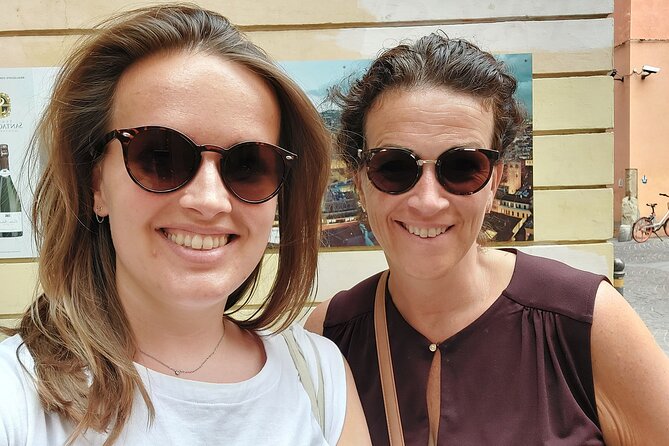
The path continues into the Quadrilateral, Bologna’s old central market district. Tall arcades lead away from the more formal space of Piazza Maggiore and into narrower lanes lined with shops and food businesses.
The area has a trading and craft tradition dating back to the Middle Ages. Some stores still specialize in the kinds of goods associated with their long-standing trade, while others retain older interiors and facades. Historic pharmacies and traditional shops add to the sense that this is a working commercial quarter rather than a museum set.
This is probably the route’s best place to pause for something to eat or drink, although the quest information does not include a food stop or restaurant booking. You are free to take a break and resume later, which is important in a market district where rushing would defeat the point.
The puzzle format works especially well here. The Quadrilateral rewards looking up, down, and into side lanes. You might find that your group spends longer than expected comparing signs, entrances, and architectural details. The narrow streets can also be busier than the open squares, so keep your phone secure and stay aware of people around you while reading clues.
Neptune’s Fountain and the heart of public Bologna
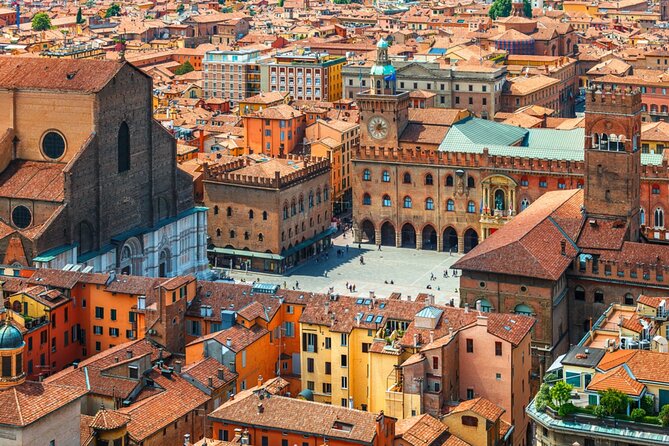
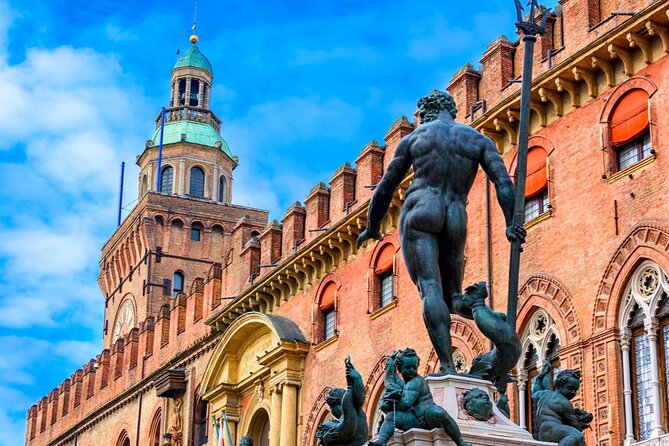
The next featured stop is Neptune’s Fountain, completed in 1565, with its large bronze figure of Neptune added around 1567. The statue was an early design by Giambologna, who had also submitted a model for Florence’s Fountain of Neptune but lost that commission to Baccio Bandinelli.
The fountain gives the game a strong public square setting. Unlike the quieter architectural details earlier in the route, this is a major civic monument with a clear central figure. Your task is still based on observation, so take a moment to inspect the fountain rather than treating it as a quick waypoint.
The listed stop time is five minutes. That is enough to solve a straightforward clue, but you may want longer for photographs and to take in the surrounding buildings. Since the quest is self-guided, you are not blocking a group if you need time to read the prompt or compare answers.
This stop also helps show how Bologna’s public spaces changed over time. The city’s medieval streets and market lanes lead into grander civic settings, where fountains and monumental buildings express public power.
Torresotto, Porta Nova, and the city walls
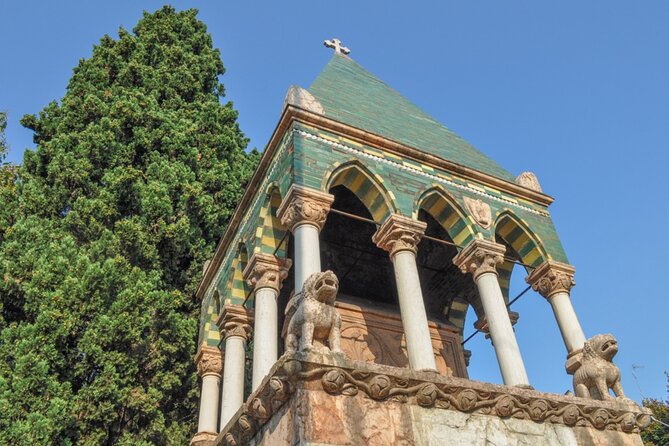
The route then shifts toward the remains of Bologna’s later medieval defenses. The torresotto, also called Porta Nova, belonged to the second ring of walls, completed in 1192.
That ring stretched about four kilometers and included 16 gates and two smaller posterns. Its walls were about eight meters high and finished with brick merlons. Bologna eventually had three rings of walls, built in different periods. The oldest used blocks of local selenite, while the final ring corresponded roughly to today’s inner ring road.
This is a useful stop for understanding the city beyond its famous towers. Bologna was not simply a collection of attractive squares. It was a fortified urban center, and its surviving gates and wall fragments show how people entered, defended, and expanded the city.
The clue may be less instantly obvious here than at Neptune’s Fountain or the Two Towers. Give yourself time to orient yourself. A phone-based game is only as good as its map directions, and incorrect map links have caused frustration on this route. If the indicated location does not fit the clue, check the written information and the nearby street signs before walking farther than necessary.
Torre Prendiparte and medieval family power
Torre Prendiparte, also known as the Coronata Tower, is another strong stop. The Guelph Prendiparte family built it in the 12th century as a defensive structure.
Its red brick and solid selenite blocks give it the heavy appearance of a fortress. The tower is a good reminder that Bologna’s tall medieval buildings were not only symbols of family status. They also served a defensive purpose in a city where powerful families competed for influence.
The quest asks you to find an answer at or near the tower, then continue. You are not paying a separate admission fee for the outdoor challenge, and the suggested time is about five minutes. The value here comes from seeing the tower in its urban setting and learning why it looks so different from a later civic building.
If you are visiting Bologna with children, this may be one of the easiest places to turn the history into a story. Medieval families, fortified towers, city walls, and coded answers give the stop a clear sense of purpose without requiring a long lecture.
Piazza Giuseppe Verdi and the university quarter
The final named stop is Piazza Giuseppe Verdi, located along Via Zamboni in Bologna’s student district. The square is known for its cafes, student activity, concerts, markets, street performances, and evening social life.
This is a noticeable change from the medieval towers and formal central squares. Piazza Verdi shows present-day Bologna, with students and other locals using the area as a meeting point. It can be lively, especially around events and nightlife, so this is not the quietest place to read a clue or manage a phone.
The square is described as a social crossroads where different parts of Italian society meet. That makes it a fitting end to a route that has moved through religious, commercial, defensive, academic, and civic parts of the city.
The final endpoint is on Via Giuseppe Petroni, 37. The game’s route therefore finishes near the university quarter rather than returning you to the Two Towers. Think about that when planning the rest of your day. You can continue toward nearby central streets, but you should not expect to finish exactly where you began.
What the $6.60 price really gives you
At about $6.60 per person, this is inexpensive for a private city activity. You are paying for the mobile access code, 14 puzzle challenges, the story, and the ability to pause and resume. You are not paying for a physical guide, entrance tickets, food, or transportation.
That makes the quest a good add-on rather than a complete introduction to Bologna. A traditional guide can answer questions as they arise and adjust the route for weather, mobility, or interest. This game cannot do that. Its value is in giving your group a reason to explore at your own pace for very little money.
Group discounts may improve the price for larger parties. Since only your group participates, you also avoid the awkwardness of joining strangers for a low-cost tour. Families should note that the puzzles create shared activity, but adults will still need to manage the app and interpret a clue if the wording or map is unclear.
The experience has a 4.1 rating from 24 posted ratings, which suggests a generally positive but not flawless result. The strongest praise centers on the relaxed pace, low cost, and fun way to see parts of Bologna. The main problems involve technology and information that has not kept up with changes on the ground.
App setup, offline play, and practical cautions
The experience is designed to continue without an internet connection, which is helpful if you do not want to rely on mobile data while walking. You still need to arrange the app and access code before you begin. One failed attempt involved being unable to download the Questo app even with hotel internet and help from the company.
I would set up the app before reaching the starting square. Confirm that the code works, make sure the quest appears, and check that your phone has enough battery. If you are playing with a family or group, decide whose phone will run the game and keep a second phone available for maps or emergency contact.
The map links have not always matched the clues, and construction has changed some physical details. If the answer seems impossible, pause rather than wandering randomly. Use the surrounding street names and the written clue to confirm your position.
The activity operates every day from midnight to 11:59 p.m., so you have wide scheduling freedom. Free cancellation is available if you cancel at least 24 hours before the start time. Changes or cancellations inside that window are not refundable.
Who should book Bologna Secrets Quest?
I would recommend it to families with school-age children, friends who enjoy solving puzzles, and independent visitors who want a light structure for exploring central Bologna. It also suits anyone who prefers to stop for lunch or coffee instead of following a fixed one-hour group tour.
It is less suitable if you want a guide with deep explanations at every monument, a perfectly maintained route, or guaranteed technical support at the exact moment a map link fails. Visitors who dislike smartphone activities may find the screen distracting from the city.
The best approach is to treat the quest as a playful walking framework. Look at the buildings first, then use the clue. Allow more than 90 minutes, download and test the app before you go, and keep a flexible attitude if construction has changed a detail.
At this price, the risk is small. If your group likes games and wants to see Bologna through its towers, market lanes, walls, and student streets, I think it is worth booking. If your priority is expert commentary and a flawless route, spend more on a guided walk instead.
FAQ
How long does Bologna Secrets Quest take?
The stated duration is approximately one hour and 30 minutes. You may need longer if you pause for food, coffee, photographs, or extra sightseeing.
Where does the quest start?
It starts at the Two Towers in Piazza di Porta Ravegnana, Bologna.
Where does the quest finish?
It ends at Via Giuseppe Petroni, 37, near Bologna’s university quarter.
How many puzzles are included?
The experience includes 14 puzzle-based challenges.
Is the activity guided?
No. It is self-guided and app-based, with no physical tour guide.
Does the quest require internet access while playing?
The game is designed to play without an internet connection. You should still arrange the app and mobile access code before starting.
Is the activity private?
Yes. Only your own group participates.
Is cancellation free?
You can receive a full refund if you cancel at least 24 hours before the experience start time. Cancellations within 24 hours are not refundable.
More Self-Guided Tours in Italy
- Florence Self-Guided Treasure Hunt & Medici Mystery Walking Tour
★ 5.0 · 69 reviews - Venice Scavenger Hunt and Highlights Self Guided Audio Tour
★ 4.5 · 20 reviews - Verona Scavenger Hunt and Highlights Self Guided Tour
★ 4.0 · 17 reviews - Rome: Scavenger Hunt Self-Guided Tour
★ 4.6 · 15 reviews
Just added around Italy
- Verona Scavenger Hunt and Highlights Self Guided Tour★ 4.0 · 17 reviews
- Verona Scavenger Hunt and Highlights Self Guided Audio Tour★ 4.5 · 7 reviews
- Venice Highlights Self Guided Scavenger Hunt and Walking Tour★ 4.0 · 6 reviews
- CITY QUEST VENICE: reveal the mysteries of this city!★ 3.5 · 4 reviews
- Venice Cannaregio Scavenger Hunt and Sights Self-Guided Tour★ 3.5 · 3 reviews
- Carnival Treasure Hunt & Mask Painting Workshop★ 4.5 · 7 reviews
- Venice: Casanova Charm Carnival Treasure Hunt★ 4.5 · 9 reviews
- Turin Scavenger Hunt and Sights Self-Guided Tour★ 5.0 · 2 reviews
Italy Escape Games, compared.
Dark Heart of Rome – Facts, Legend & Mystery Walking Tour
Read our review →
Mostra Leonardo Da Vinci: Rome Treasure Hunt Game
Read our review →
Angels & Demons Rome Scavenger Hunt: The Illuminati Escape Game
Read our review →
Florence Self-Guided Treasure Hunt & Medici Mystery Walking Tour
Read our review →
Private Venice Family Tour with Saint Mark’s & Doge’s Palace
Read our review →Browse the lists this tour appears in