
Review · FRANCE
Medieval Carcassonne: Interactive Ghost Story & City Game
Carcassonne’s famous walled city becomes a giant puzzle board in this self-guided game. You follow a ghostly story from Square Gambetta across the Aude and uphill toward Château Comtal, stopping to study walls, gates, churches, and old buildings for clues. I like the 3-kilometre route and the freedom to pause whenever you need. I also like that it shows you parts of both the Lower Town and the medieval citadel, rather than keeping you inside the postcard-famous walls.
The main catch is technical. The game depends on the Questo app, and some players have struggled to start it or add other members of their group. It is also not an audio guide and does not include admission to monuments. Bring a charged phone, allow a little patience at the start, and contact Questo support quickly if the game will not open.
Key points before you book
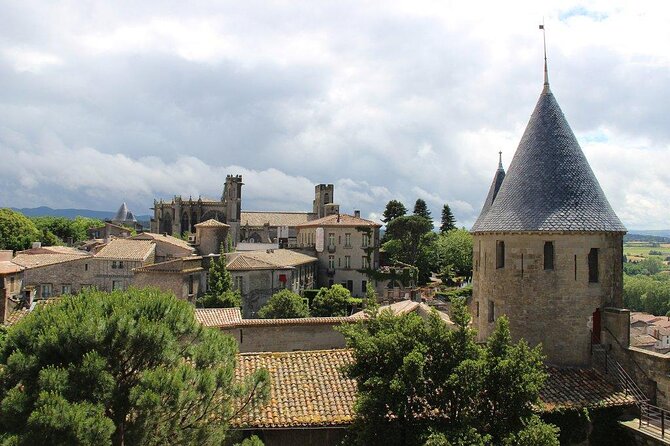
- Ten puzzles over about 3 kilometres: Look closely at buildings, signs, gates, and architectural details to move from one stop to the next.
- A route from modern Carcassonne to the Cité: Begin at Square Gambetta and finish at Château Comtal, crossing the Aude along the way.
- Flexible timing: Start any time between 6:00 a.m. and 11:30 p.m., pause for lunch or sightseeing, then continue later.
- A private phone-based activity: Your group plays alone, with no guide, fixed departure, or strangers joining in.
- Historical themes with a family-game format: Expect stories about plague, persecution, Cathars, the Inquisition, and city architecture, but not a full scholarly lecture.
- Low price, separate admission costs: At $6 per person, it can be good value, though you pay extra to enter attractions such as Château Comtal or the Inquisition Museum.
A ghost story that turns Carcassonne into a puzzle board
This is less a guided tour than a walking game with historical material woven into it. The Questo app sends you from one location to the next and asks you to find answers in the surroundings. You may need to inspect a facade, read a detail on a monument, or notice something that is easy to miss when you are simply walking toward the citadel.
The ghost-story angle gives the route a little drama. It also makes the darker parts of Carcassonne’s past easier to approach. You will encounter references to medieval persecution, plague, the Cathars, and the Inquisition, although the material is presented for a general audience rather than as a detailed historical course.
I would think of the experience as a clever way to get your bearings. It gives you a reason to look up from your phone and pay attention to the city around you. The phone is the tool, not the main attraction.
The activity is offered in English. It is private and contactless, so you do not meet a local guide or join a scheduled group. That makes it a good fit if your party prefers to move at its own speed. It also means you miss the spontaneous questions, local anecdotes, and historical corrections that a strong live guide can provide.
More City Exploration Games in France
- Romantic Montmartre: Paris Lost Lovers Exploration Game and Tour
★ 4.5 · 107 reviews - Paris Murder Mystery: Death on the Seine Quest and Tour
★ 4.0 · 42 reviews - Strasbourg: City game – The Gold of Cagliostro
★ 4.2 · 36 reviews
Starting at Square Gambetta in the Lower Town
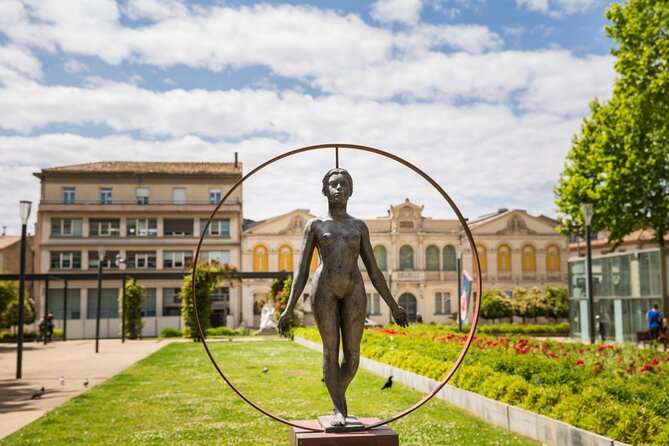
The route begins at Square Gambetta, across the river from the famous Cité. This is an important choice because Carcassonne is more than its medieval walls. Square Gambetta sits in the Bastide de Saint-Louis, the planned Lower Town built under King Louis IX.
The first puzzle asks you to look around the square and find the detail needed to continue. This opening is useful because it eases you into the game before the route becomes more demanding. You are not immediately thrown into a maze of towers and narrow lanes. Instead, you begin in an open urban space and learn how the clues work.
Give yourself time here to get the app running. The starting instructions have caused trouble for some players, particularly when several people tried to join from separate phones. The simplest approach is likely to have one person operate the game on a fully charged phone, with the rest of the group helping solve clues.
That setup also saves money. Since the activity costs $6 per person but one phone can handle the game, you may not need every member of your party to download and operate the app. If your group exceeds 15 people, the booking information says to make multiple bookings.
Notre Dame de la Santé and the old river crossing
The next stop is the small Notre Dame de la Santé chapel near the Pont-Vieux. Built in 1527 with money left by Jean de Saix, it served as a hospital for people suffering from the plague. Its position beside the narrow passage between fortified areas gave it both a practical and symbolic role.
This is one of the stops that gives the game its darker mood. You are not just looking at a pretty chapel. The place connects faith, illness, travel, and defense, all in a tight space near the river.
The puzzle asks you to study the area for an answer. That works well here because the chapel and bridge demand a slower look. If you rush across the Pont-Vieux toward the Cité, you may miss the small details that make this stop worthwhile.
The route’s historical treatment of disease is fairly light. If you book mainly because you want a detailed account of plague medicine or medieval public health, you may find the explanation too brief. The game uses these themes to support the story rather than develop them at length.
The cloth factory and Carcassonne’s later prosperity
At the foot of the Pont-Vieux, a facade recalls a later period of prosperity. The building once belonged to a noble Carcassonne family. In 1694, it was bought by a person connected with Colbert, who founded a cloth factory there. The factory received the title Manufacture Royale in 1696.
Only the owners’ residence remains visible from that period. Its design resembles buildings in the Lower Town from the 18th century. This stop broadens the story beyond medieval knights and fortified walls. Carcassonne’s past also includes commerce, manufacturing, wealthy families, and royal economic policy.
I like this change of focus. The route does not treat the city as if it stopped developing once the stone walls were complete. You get a glimpse of how industry and trade shaped the town after the medieval period.
Again, the challenge depends on observation. You will need to identify the right feature and enter the answer in the app. That can be fun for a group that enjoys small discoveries, but frustrating for anyone who wants the facts delivered clearly without a game mechanic.
Same place, a different puzzle:
- Saw2 vs Squid Game – Escape Game Montpellier
★ 5.0 · 752 reviews - Prison Break – Escape game in Montpellier
★ 5.0 · 583 reviews - School of Magic – Escape game Montpellier
★ 4.5 · 536 reviews - Mission Possible – Escape game Montpellier
★ 5.0 · 437 reviews
Saint-Gimer Church and Viollet-le-Duc’s practical design
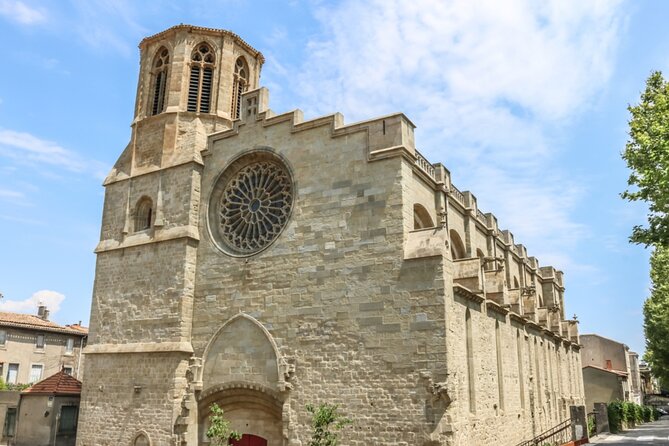
Saint-Gimer Church was built between 1854 and 1859 by Eugène Viollet-le-Duc, the architect closely connected with the restoration of Carcassonne’s medieval citadel. The church is a much later building, and its modest design makes it a useful counterpoint to the grand towers and walls nearby.
The church has a nave, two aisles, a polygonal apse, two vestries, and a porch. Its layout is compact and restrained. The goal was modesty, not spectacle.
This stop may appeal most to people interested in architecture. You get a chance to notice how Viollet-le-Duc worked outside the dramatic fortress setting. If your children are eager to reach the castle, however, this can feel like a pause in the action.
The game format helps keep the stop active. Rather than asking you to stand still while someone speaks, it gives your group a visual task. Still, the experience will not replace a proper architectural explanation. It gives you a useful introduction and a reason to look more carefully.
Porte de l’Aude, the most atmospheric part of the route
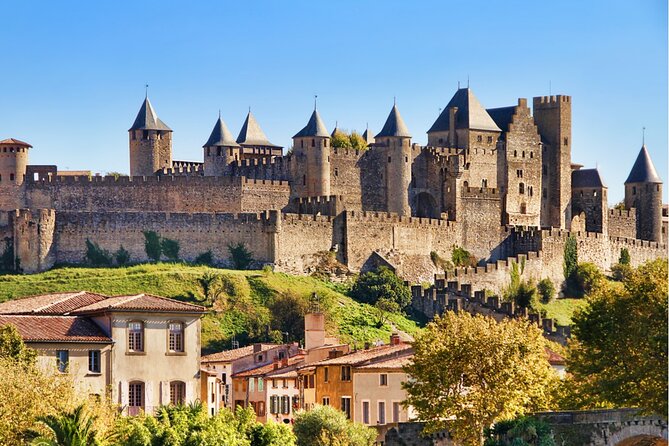
Porte de l’Aude is one of the preserved gates of the medieval walled city. It overlooks the river and offers one of the most memorable approaches to the Cité. The gate is also a practical reminder that entry into Carcassonne was once controlled, narrow, and defensive.
This section should be especially enjoyable for anyone who likes city walls and old gateways. The route has been building toward the citadel, and here the medieval setting becomes much more immediate. You can see how the fortifications relate to the river and the slope.
The puzzle asks you to examine the gate and surrounding area. That is a good match for this location, since the defensive details are easy to miss when you are focused only on getting inside.
Expect some uphill walking as you approach the Cité. The total route is about 3 kilometres, but distance is not the only factor. Uneven surfaces, slopes, and pauses to solve clues can make the outing feel longer than an ordinary walk. Wear shoes you trust, especially if you plan to continue exploring the citadel after the game ends.
The Inquisition Museum and the darker historical material
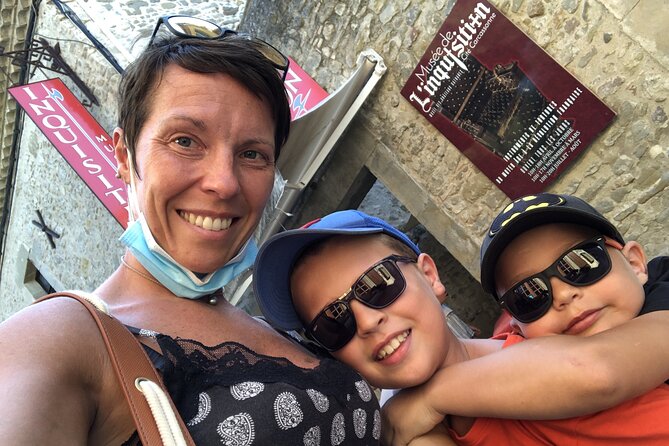
The Inquisition Museum occupies a large 17th-century building and presents instruments of torture dating from the 12th century through the French Revolution. It also covers important figures, their biographies, Cathar castles, and the history of the Inquisition in the region.
The game uses this setting to bring its ghost-story theme into sharper focus. The subject matter is serious, and some of the displays may not suit young children. The material is presented as part of the city’s past, not as light entertainment, so parents should decide if the tone fits their group.
Entry to the museum is not included. You can pass through the area as part of the route without treating the game as an admission ticket. If you want to visit the collection itself, plan and pay for that separately.
One caution: do not expect the game to provide a full explanation of Cathar belief, the Albigensian Crusade, or the legal workings of the Inquisition. It points toward those subjects and gives you a story framework. For serious historical interest, pair it with a museum visit or a proper guided tour.
From the cathedral area to Château Comtal
The final section brings you into the heart of the Cité. The present Romanesque cathedral began in June 1096. A Lady Chapel was added in the early 15th century, beside an infirmary and chapel built by Bishop Radulph in the 1260s.
The Château Comtal dates from the 12th century and was built by Bernard Aton Trencavel over the western part of the Roman walls. This is the natural finish for the route. After crossing the river, studying later buildings, and following the city’s religious and defensive story, you arrive at the main castle.
The game ends at Château Comtal, but admission is not included. That gives you flexibility. You can finish the puzzle and leave, or buy entry and continue with the castle on your own. Just do not assume the game fee covers access to the towers, walls, or interior displays.
The finish also works well for a half-day plan. You can play first, then eat or explore inside the Cité. If you pause the game for more than a short break, the flexible format lets you return later. One player managed to resume after more than 24 hours, which shows why the pause feature can matter when your phone battery or sightseeing plans get in the way.
How much value do you get for $6?
At $6 per person, this is inexpensive for an activity lasting about one hour and 40 minutes. The price is especially fair if you enjoy solving puzzles and would otherwise wander between the Lower Town and the Cité without a plan.
The value is less clear if you want a conventional guided tour. There is no physical guide, no live narration, and no included entry ticket. You are paying for the app, the route design, the ten puzzles, and the historical story.
I would compare it with a self-guided audio tour, but do not expect audio. One French-speaking player assumed the product included an audio guide and felt disappointed. The content is read and followed through the app, so you need to be comfortable using your phone while walking.
For a family or small private group, the price can work well. You get a shared task and a route that keeps the walk moving. The group discount option may improve the value, though the exact discount is not specified. A single phone may be enough for everyone to participate, but confirm the app setup before you begin.
App setup, batteries, and timing
The experience is available daily from 6:00 a.m. to 11:30 p.m., according to the stated hours. You can start at any time within that broad window, stop when you want, and continue later. That is handy if you want to avoid the midday heat or fit the game around a meal and monument visits.
The technical side deserves attention. Several problems have been reported with opening the game, entering the booking details, or adding other players. Keep your confirmation information close, download the Questo app before reaching Square Gambetta, and begin with a well-charged phone.
If the game fails, use the app’s 24-hour chat support or contact Questo at [email protected]. The provider also lists [email protected] for help starting the game or discussing a refund when the activity cannot be used.
The cancellation policy is simple: cancel at least 24 hours before the local start time for a full refund. Cancellations or changes inside 24 hours are not refunded.
Who should choose this Carcassonne game?
I would recommend it to couples, families with older children, and friends who like puzzles, self-guided sightseeing, and a little spooky atmosphere. It is also useful if you have already seen the main walls and want a reason to explore the route between the Lower Town and the Cité.
It may not suit you if you want a live historian, a detailed account of Cathar history, or a tour in Spanish or French. The activity is offered in English, and language limitations have made the app harder for some players. Young children may also lose interest while adults read clues and solve the next step.
The game is private, so you control the pace. That is its best feature and its main limitation. You get freedom, but you also have to manage the map, battery, app, clues, and timing yourself.
Should you book Medieval Carcassonne?
Book it if you want a low-cost way to connect the Lower Town with the Cité, enjoy solving ten location-based puzzles, and prefer not to follow a fixed group schedule. The route includes more than the standard fortress views, and the stop at the plague chapel, the old cloth factory, and Saint-Gimer Church gives the walk useful variety.
Skip it if you expect an audio guide or a guide in person. Also skip it if app problems would ruin your day. At $6, the financial risk is small, but lost time can matter more than the ticket price. Prepare your phone, keep support details handy, and treat the game as a playful introduction to Carcassonne rather than a complete history lesson.
FAQ
Where does the Carcassonne city game start?
It starts at Square Gambetta, in the Bastide de Saint-Louis across the Aude from the famous Cité.
Where does the game finish?
The route finishes at Château Comtal. Entry to the castle is not included in the activity price.
How long is the route?
The route covers about 3 kilometres and takes approximately one hour and 40 minutes.
Can I pause the game and continue later?
Yes. You can start at any time, pause whenever you like, and resume later through the Questo app.
Is a tour guide included?
No. This is a private, self-guided phone experience. It does not include a physical guide or an audio guide.
Are attraction entry tickets included?
No. Admission to places such as Château Comtal and the Inquisition Museum must be paid for separately.
Just added around France
- Historical treasure hunt in the city of Versailles★ 4.0 · 15 reviews
- Escape game outdoor The Walking Dead in Tours★ 3.0 · 2 reviews
- Tours: Magic Team Escape Game in Town★ 3.0 · 2 reviews
- Outdoor escape game | The Minotaur★ 4.5 · 2 reviews
- Discover Toulouse while playing! Escape game – The alchemist★ 3.5 · 4 reviews
- Urban escape game in Toulouse – Crazytopia★ 3.0 · 3 reviews
- Romantic Toulouse: Self-Guided Love Story Puzzle Walk★ 4.0 · 2 reviews
- Strasbourg Highlights Self Guided Scavenger hunt and City Walking Tour★ 4.0 · 9 reviews
France Escape Games, compared.

Who Killed Victor ? Escape Game at Père Lachaise Cemetery
Read our review →
Romantic Montmartre: Paris Lost Lovers Exploration Game and Tour
Read our review →Browse the lists this tour appears in