Review · USA
Jacksonville Jig Scavenger Hunt
Jacksonville Jig turns sightseeing into a timed team game. You start at The Brick Coffee House downtown, receive your digital quest from a live remote host, then work through clues, photo tasks, and playful challenges around the city. It is part city tour, part friendly contest, and part excuse to act a little silly in public.
I like the way the game brings three generations or mixed-age groups into the same activity. I also like the local angle: the route includes places such as Treaty Oak Park and Sweet Pete’s Candy, and one family group discovered Jacksonville spots they had not known despite living in the city for years.
The main caution is logistics. The stops are spread out, and the experience depends on a working phone, text messages, photos, GPS, and data. If your group wants a traditional guided walk with a steady stream of historical facts, this may feel too much like a game and not enough like a standard tour.
Key points to know before you book
- The game starts downtown at The Brick Coffee House, at 214 N Hogan St, and ends back at the same meeting point.
- Four named stops shape the route: Jacksonville Beach, Treaty Oak Park, Sweet Pete’s Candy, and Cancer Survivor’s Park.
- A remote host stays involved by phone, sending challenges, cheering your team on, and helping as you play.
- You get 20 challenges, including clues, photo tasks, bonus activities, and playful dares.
- The route may require driving, since the game allows you to walk or drive between checkpoints.
- Bring a fully charged smartphone, with GPS, mobile data, and the ability to send texts, photos, and videos.
How the Jacksonville Jig works

This is not a guide-led march from one monument to the next. Your team begins at The Brick Coffee House, where the remote host sends the first part of the quest to your phone. From there, you follow instructions, solve clues, complete tasks, and submit proof of your progress.
The host is live and interactive rather than simply sending an automated list. You text photos and updates as you go, and the host responds with encouragement or help. That human connection matters. It gives the game a referee, a cheerleader, and a point of contact when a clue leaves your group scratching its head.
The activity lasts about two hours. In that time, you may walk or drive between checkpoints, switch between indoor and outdoor settings, and take on extra bonus challenges. The exact pace depends on your team. A group that enjoys stopping for photos and debating clues may use the full time, while a competitive group may move quickly.
You are not expected to be a Jacksonville expert. Some tasks may involve paying attention to your surroundings or speaking with local people to solve a clue. That makes the experience more social than simply following a phone map.
More Scavenger Hunts in the USA
- An Epic Scavenger Hunt: New York City Central Park Adventure
★ 4.5 · 244 reviews - Creative Soul Scavenger Hunt of Santa Fe
★ 5.0 · 62 reviews - Keep Austin Weird Scavenger Hunt
★ 4.0 · 51 reviews
Starting at The Brick Coffee House downtown
The Brick Coffee House at 214 N Hogan St is the official meeting point and the place where the activity ends. It gives your team a clear start and finish, which is useful when several people are arriving separately.
Before you set off, make sure at least one person on your team has a fully charged smartphone. The phone must have GPS and mobile data, and it must send and receive text messages, photos, and videos. This is not a minor detail. The game depends on that connection.
You must also provide a correct, working domestic phone number when booking. If you use an international number, you need to arrange WhatsApp or email contact ahead of time through a message to the operator. I would handle this before the day of the hunt, not while your group is standing at the meeting point.
The game can accommodate up to 30 people, but that does not mean one large group is always the best setup. A very large party may have more fun splitting into smaller teams and comparing scores, though the supplied details do not specify how teams are arranged. If competition matters to you, ask about team setup before booking.
Jacksonville Beach brings the city and coast together
Jacksonville Beach is one of the named stops, and it gives the hunt a change of setting from the downtown starting point. The stop may ask you to notice something around you, complete a photo challenge, or solve a clue tied to the area.
The important practical point is distance. Jacksonville Beach is not next door to The Brick Coffee House, so you should not assume this is a compact downtown walking tour. The activity specifically allows you to walk or drive between checkpoints, and this route makes a car or a clear transport plan worth considering.
That spread can be a strength. You see more than one small pocket of Jacksonville in a short game, and the trip between stops becomes part of the outing. It can also be a weakness if your group dislikes moving around or if traffic, parking, or navigation slows you down. Since no precise transport plan is provided, ask the operator how the current route works on your date.
For families, the beach setting may offer an easy way to burn off extra energy. For adults on a birthday or friend trip, it adds a little public spectacle to the photo and challenge tasks. Just remember that the game is not presented as a beach tour with extended time for swimming or sunbathing.
Treaty Oak Park adds a local pause
Treaty Oak Park is another named checkpoint. The park is known for its large oak tree, making it a natural place for a scavenger hunt task that depends on observation and photography.
You should expect to use the setting as part of the game rather than receive a long talk about its background. The supplied details promise clues, local secrets, and learning through play, but they do not promise a formal history lesson at each stop. That distinction is important.
I like this sort of stop because it gives the group something concrete to look for. A park also provides room for a team to regroup, read the next instruction, and decide who will handle the photo, clue, or challenge. The tradeoff is that your attention will be divided between the game and the place itself. If you want quiet time under the oak, the hunt’s clock and competitive format may get in the way.
Same place, a different puzzle:
- Branson Murder Mystery- Branson’s Original #1 Murder Mystery
★ 5.0 · 1,513 reviews - The Escape Game Orlando: Epic 60-Minute Adventures on I-Drive
★ 5.0 · 730 reviews - The Escape Game Pigeon Forge: 60-Minute Adventures on The Island
★ 5.0 · 646 reviews - The Escape Game Nashville Berry Hill
★ 5.0 · 546 reviews
Sweet Pete’s Candy keeps the route playful
Sweet Pete’s Candy is a particularly fitting checkpoint for a game built around odd challenges and family participation. The name alone suggests a lighter stop, and it should suit groups with children, adults with a sweet tooth, or anyone who enjoys a colorful change of pace.
The activity does not state that candy, food, or purchases are included. Plan on treating the stop as a location for a clue or task, not as an included tasting. If your group hopes to buy something, carry the cost separately and allow for the possibility that the game’s schedule leaves little time for browsing.
This is also a good example of the hunt’s style. Instead of limiting you to major landmarks, it sends you to places connected with local life and leisure. One of the strongest parts of the format is this chance to notice places you could easily miss on a standard sightseeing loop.
Cancer Survivor’s Park brings a different tone
Cancer Survivor’s Park is the fourth named stop. Unlike a candy shop or beach, it may give the route a more reflective setting. The park honors cancer survivors and offers a place where the game’s playful tone may need a little sensitivity.
The supplied details do not explain the exact challenge at this stop, so I would avoid assuming it is simply another photo backdrop. Follow the host’s instructions and treat the setting respectfully. A good scavenger hunt asks you to engage with a place without turning every location into a joke.
This stop also shows why the game is more than a list of random errands. The route moves through different kinds of public spaces, and each one can change the mood of your group. You may laugh at one challenge, slow down at another, and learn something about the city by paying closer attention.
Twenty challenges, not just a list of places

The operator specifies 20 challenges. They include clues, wacky tasks, photo submissions, bonus challenges, and activities that may push you outside your comfort zone. You may also need to interact with local people to solve some clues.
That number matters because a scavenger hunt can feel thin if it simply sends you to six places and calls the stops a game. Here, the stated format is more active. Your group is meant to do something at each checkpoint, not merely arrive, take a quick look, and leave.
Still, the experience will depend on how much your team commits to the silliness. If everyone hangs back and treats each challenge as an inconvenience, the game may feel like a phone-based checklist. If your group takes photos, argues over answers, accepts the odd tasks, and competes for points, the same activity should feel much more engaging.
The international leaderboard adds another layer. You can compare your score beyond your own group, which will appeal to competitive teams. If you do not care about rankings, the leaderboard is easy to treat as a side feature. The real prize for a relaxed group is having a shared activity that gives everyone a role.
Family groups, dogs, and mixed-age teams
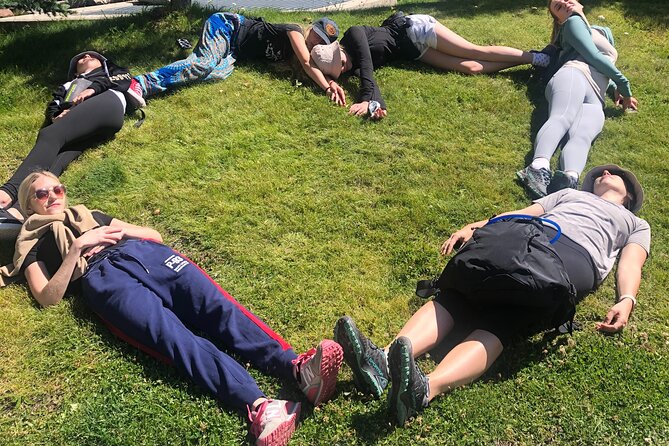
The hunt is family-friendly and dog-friendly. Service animals are allowed, and the activity is described as suitable for most people. Those details make it flexible for a family day or a friend group with different ages and interests.
I can see why this worked well for a three-generation group. A child can look for visual details, an adult can handle navigation, and an older family member can help solve a clue or direct the photo challenge. You do not need everyone to enjoy museums, shopping, or formal tours.
Dogs can take part, but the route alternates between indoor and outdoor settings. The details do not specify which indoor locations allow pets, so you should confirm that point before bringing a dog. The same advice applies to weather planning. The activity includes outdoor stops, but no weather details or alternate route are provided.
The game also suits birthdays, bachelor or bachelorette groups, corporate groups, local friends, and curious residents. Custom experiences and virtual team-building options are available from the operator, but those are separate products. Do not assume a custom route is included in this standard booking.
Phone rules are part of the experience
Your phone is not just a ticket. It is your map, camera, message box, and link to the host. Bring a fully charged device with GPS, data, and the ability to send and receive photos, videos, and texts.
I would bring a backup charging method if you have one, although the supplied information does not require it. The key point is to avoid starting with a nearly empty battery. A dead phone could stop your team from receiving clues or submitting proof.
International phone users need extra planning. The operator can use WhatsApp or email when an international number or technical problem makes standard texting difficult, but you need to provide that contact information in advance. Near public transportation is listed, yet the route itself may include driving, so public transit access at the start does not guarantee that every checkpoint is easy to reach without a car.
Value, group size, and the two-hour format
No tour price is provided here, so I cannot judge the exact cost. The value depends on what your group wants. If you are paying for a conventional sightseeing tour, this may seem light on factual commentary. If you are paying for a shared activity with a live host, 20 challenges, photo tasks, and a route across several parts of Jacksonville, the comparison is different.
The two-hour format is long enough to create a real outing without taking over an entire day. That suits a birthday schedule or a family visit with other plans. It also limits how much background information you should expect. The activity is built around play and teamwork, not a full survey of Jacksonville.
A maximum of 30 participants keeps the total size from becoming enormous, although your personal team size is not given. Larger parties should contact the operator with questions in advance. The provider specifically welcomes questions, and this is the kind of activity where route and phone details are worth clarifying.
Cancellation is free if you cancel at least 24 hours before the local start time. Cancellations or changes inside that window are not refunded or accepted. That policy is reasonable for a remotely hosted event, but it makes your transport and phone plans worth settling early.
Who should book the Jacksonville Jig
I would choose this for a group that enjoys solving things together and does not mind looking a little ridiculous in public. It is especially suitable for families with several age groups, friends celebrating an occasion, local residents who want a fresh way to see town, and work groups seeking an informal team activity.
I would be more cautious if you are traveling alone, dislike phone-based activities, want a quiet cultural tour, or need a fixed walking route with no driving. The experience may also disappoint you if your main goal is detailed Jacksonville history at every stop.
The strongest reason to book is the combination of local places and active challenges. One family group found that even long-time Jacksonville residents encountered locations they did not know. That is a useful promise for locals and repeat visitors, provided you approach the outing as a game rather than a formal tour.
Should you book it?
Book the Jacksonville Jig if your group will compete, take photos, attempt the odd challenges, and enjoy working out clues together. Bring a charged phone, confirm how your team will move between Jacksonville Beach, Treaty Oak Park, Sweet Pete’s Candy, and Cancer Survivor’s Park, and ask ahead about WhatsApp, email, or pet arrangements if needed.
Skip it if you want a guide speaking continuously about architecture, history, and local politics. The attraction here is the shared puzzle, the remote host, the leaderboard, and the chance to see Jacksonville through playful tasks. For the right group, that can create better memories than another standard sightseeing loop.
FAQ
Where does the Jacksonville Jig start?
It starts at The Brick Coffee House, 214 N Hogan St, Jacksonville, Florida 32202.
Where does the activity end?
The activity ends back at the meeting point at The Brick Coffee House.
How long does the scavenger hunt last?
It lasts approximately two hours.
What places are included in the route?
The named stops are Jacksonville Beach, Treaty Oak Park, Sweet Pete’s Candy, and Cancer Survivor’s Park.
Do I need a smartphone?
Yes. Each team must bring at least one fully charged smart phone with GPS and the ability to send and receive data, photos, videos, and text messages.
Can I use an international phone number?
If you have an international number or technical problems with texting, you must use WhatsApp or email. Provide that contact information through a message to the operator before the hunt.
Is the experience family-friendly?
Yes. The activity is described as family-friendly, and most people can participate.
Are dogs allowed?
The activity is dog-friendly, and service animals are allowed. Because the hunt includes indoor and outdoor locations, confirm the current pet arrangements before booking.
What is the cancellation policy?
You can cancel at least 24 hours before the local start time for a full refund. Cancellations or changes made less than 24 hours before the start are not refunded or accepted.
Just added around the USA
- Ventura Scavenger Hunt Walking Tour and Game★ 4.0 · 4 reviews
- Vail Venture Scavenger Hunt★ 3.5 · 8 reviews
- Save the Mountain Escape Room Adventure★ 5.0 · 4 reviews
- Tybee Island, Georgia Scavenger Hunt★ 4.0 · 7 reviews
- A Spectacular Scavenger Hunt: Center of the Universe★ 4.0 · 4 reviews
- Tucson Scavenger Hunt by Wacky Walks★ 4.5 · 2 reviews
- Amazing Scavenger Hunt: Desert Oasis★ 3.5 · 3 reviews
- Thrilling Traverse City Scavenger Hunt★ 4.0 · 7 reviews
USA Escape Games, compared.

Branson Murder Mystery- Branson’s Original #1 Murder Mystery
Read our review →
The Escape Game Orlando: Epic 60-Minute Adventures on I-Drive
Read our review →
The Escape Game Pigeon Forge: 60-Minute Adventures on The Island
Read our review →
The Escape Game Cincinnati: 60-Minute Adventures at The Banks
Read our review →