
Review · GERMANY
e-Scavenger hunt Koblenz: Explore the city at your own pace
Koblenz turns sightseeing into a self-guided game, sending you through its old town, along the Rhine and Moselle, and past major landmarks such as Deutsches Eck, St. Kastor’s Basilica, and the Electoral Palace. I like the freedom to pause for lunch or extra exploring, and the private group format works well when six friends or family members want one low-cost activity.
The main caution is the app itself. Some questions and translations may feel too simple or awkward, and one poor experience reported trouble with GPS and registration. You need your own smartphone and mobile data, plus enough patience to navigate if the app does not point you cleanly to every stop.
Key points to know before you book

- A city walk with game mechanics: Answer questions, complete challenges, and locate objects rather than simply following a guide.
- A strong Koblenz route: The activity connects Deutsches Eck, the riverside, major churches, old-town squares, and the Old Castle.
- Flexible timing: Plan on roughly two to four hours, with a pause function that lets you stop and continue later.
- Best value for groups: The price is $37.33 for up to six people, making the per-person cost low when your group is full.
- No live guide included: You receive an online game and city walk for your phone, not a person leading you through the city.
- Bring your own connection: A smartphone and data are not included, and the app has received mixed feedback about navigation and translations.
A game that makes you look twice at Koblenz
The clever part of this experience is its route. Instead of asking you to stand at one monument and listen, it moves you through several layers of Koblenz: Romanesque churches, Prussian government buildings, riverfront engineering, medieval defenses, and lively old-town squares.
You use the app to answer questions, complete challenges, and find objects. That gives you a reason to study a facade or look for a detail that you might otherwise walk past. I like this approach for families and friend groups because everyone has something to do.
There is no named live guide provided, so you should think of this as an independent city game, not a guided tour. The app supplies facts and prompts, but you control the pace, route between points, and amount of time spent at each place.
The advertised duration is about two to four hours. That range is useful rather than precise. If you solve clues quickly and keep moving, you may finish toward the shorter end. If you stop for photographs, church visits, food, or additional sightseeing, the pause function gives you room to stretch the outing.
More Scavenger Hunts in Germany
- Hamburg: Scavenger Hunt Self-Guided Tour for Children
★ 4.5 · 319 reviews - Dresden: Old Town Self-Guided Scavenger Hunt Tour
★ 4.5 · 151 reviews - Berlin: Self-Guided Family and School Class Scavenger Hunt
★ 4.6 · 128 reviews
Starting at Münzplatz and entering the old town
The activity begins at Münzplatz 15, in Koblenz’s old town, and ends back at the meeting point. Münzplatz is a sensible starting place because it puts you in the middle of the historic center rather than at a remote edge of town.
The square’s name recalls the former electoral mint, or Münze. That small fact tells you something about Koblenz before the game gets moving: this was not just a river crossing, but an important seat of power, trade, administration, and church life.
From here, the route takes you through compact old-town streets and toward several of the city’s best-known buildings. You should expect to use your own phone for both the prompts and navigation. One useful tip is to make sure your group has a charged phone and working mobile data before you begin.
The navigation feedback is mixed. Some people have found the process easy and enjoyed the clear route. Another experience described the registration as complicated, the GPS as unreliable, and several places as hard to locate. I would treat the map and clues as helpful aids, not as a replacement for your own sense of direction.
St. Florin, the Church of Our Lady, and Koblenz’s church skyline
The route includes St. Florin’s Church, an evangelical church built around the year 1100 for the Florinusstift. Its long history and central position make it a good stop for understanding how church institutions shaped old Koblenz.
You also visit the Church of Our Lady, a Roman Catholic church at the highest point of the city. Along with St. Kastor’s Basilica and St. Florin’s, it helps define the old center’s skyline. Even if you are not making a special church tour, these buildings give the walk a strong sense of place.
The app’s information is designed to be short. That suits a moving city game, but it also sets a limit. You will get useful facts and prompts, not a full architectural lecture or a detailed account of every period represented in the churches.
One positive feature is that the questions are generally kept easy. That is good for children, casual sightseeing, and groups that want a light activity rather than a test. If you are already well read in Koblenz’s history, you may find the questions too basic.
St. Kastor’s Basilica and the road to Deutsches Eck
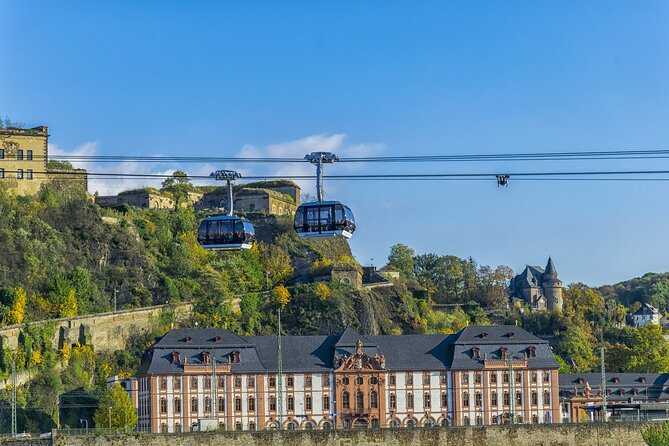
St. Kastor’s Basilica is one of the key stops. The Roman Catholic church was built between 817 and 836 and sits near the point where the Moselle meets the Rhine. Its age gives the walk a major historical anchor, and its position makes it a natural link between the old town and Deutsches Eck.
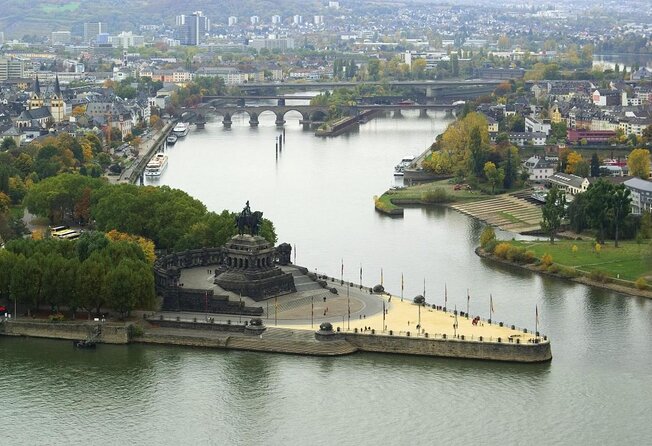
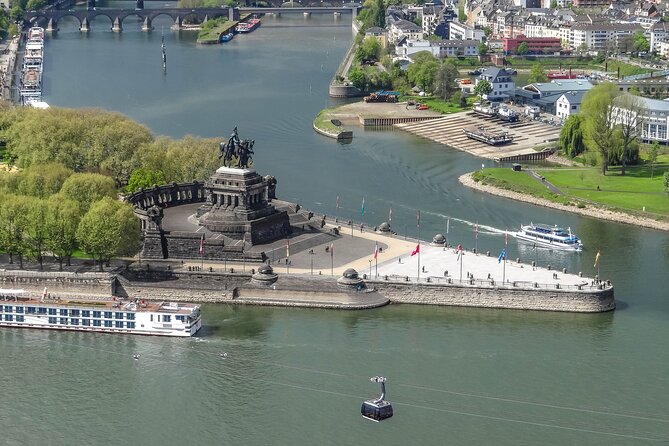
The route then reaches Deutsches Eck, the artificial headland at the mouth of the Moselle. This is Koblenz’s most famous public landmark, with a national monument dedicated to German unity. The meeting of the two rivers also gives the stop a clear visual purpose: you can see why this point became such an important symbol of the city.
The area attracts many visitors, including people arriving on large riverboats. That means it can feel more public and open than the narrow streets of the old town. The game format helps you look beyond the standard photograph by asking you to locate details and answer questions.
This is one of the places where I would use the pause feature. Take time for the river views, then resume the game when you are ready. The flexible timing is one of the experience’s best ideas because you do not have to choose between completing the activity and enjoying Koblenz properly.
Same place, a different puzzle:
- Hamburg: Treasure Hunt Game through HafenCity
★ 4.7 · 364 reviews - Treasure Hunt through Hamburg’s Hafencity
★ 5.0 · 234 reviews - Escape Room Adventure in Berlin Solve the Mystery
★ 5.0 · 222 reviews - Escaping and spying on the Berlin Wall Scavenger hunt
★ 4.5 · 128 reviews
The history column and the Electoral Palace
Another stop is a fountain with a large column that presents 2,000 years of Koblenz’s past. It is a popular sight, including with passengers from river cruise boats, so it gives the route a broad historical summary in a single public monument.
Do not expect the app to replace the column itself. The attraction works best as a visual checkpoint where you can examine the monument, read its story, and then tackle the prompt. The activity encourages you to connect the object in front of you with the larger story of the city.
The Electoral Palace offers a different look at power. It was the residence of the last Archbishop and Elector of Trier, linking Koblenz to the political and religious system that once governed the region.
The palace is a good contrast to the churches and medieval structures. You move from religious foundations to the formal world of electors and court life. For a short self-guided walk, the range is impressive, though the app’s brief explanations may leave you wanting more if palace history is your main interest.
Small monuments, fountains, and the Level House
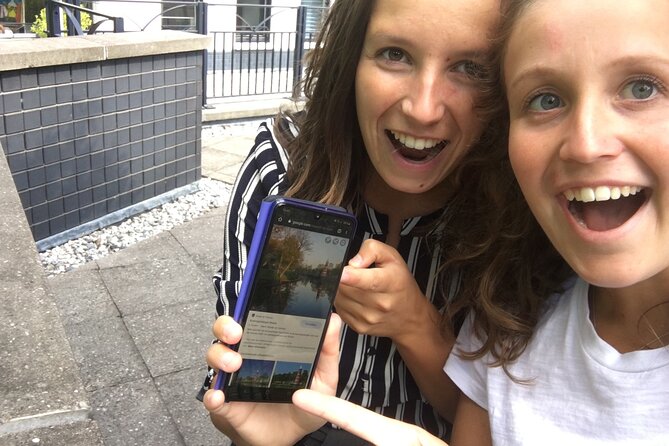
The route includes a fountain with a bronze statue of a boy, created by Carl Burger and dedicated to the poet Josef Cornelius. This is the sort of smaller stop that gives a scavenger hunt its character. You are not only checking off famous buildings. You are also looking for public art and local details.
The Level House brings you to the Rhine waterfront and to the practical side of river life. Built around 1609, it first served as a Rhine crane. In 1839, it became a gauge-house station, and the crane on its roof was removed around 1900. The building later gained another floor for the 2011 Federal Horticultural Show.
That long sequence of uses makes the building more interesting than its modest appearance might suggest. It shows how the river shaped work, measurement, construction, and public improvements in Koblenz.
This is also a good example of why the game format can work. A live walking tour might pass the building quickly. A prompt asking you to inspect it gives you a reason to notice what it was built to do.
Squares, facades, and the Four Towers
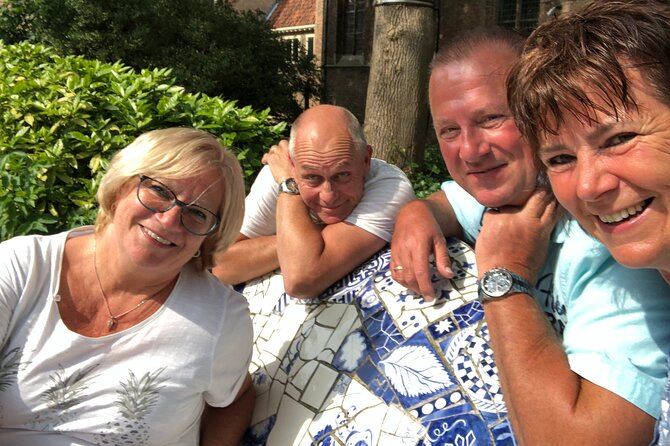
At one point, you reach a photogenic square with attractive facades, terraces, and a comfortable atmosphere. The exact appeal here is less about one famous monument and more about the way Koblenz feels at street level.
I like having a stop like this in the route. A city is not only its grand churches and official buildings. It is also the place where you pause for a drink, study the surrounding facades, and watch the old center function as a real neighborhood.
The Vier Türme, or Four Towers, are an ensemble of four historic buildings at the crossing of Am Plan, Löhrstraße, and Altengraben. This intersection is a useful place for the challenge format because the buildings are visually distinctive and stand close together.
You may need to look carefully to match the app’s clues with the correct architectural details. That can be fun when the prompts work well. It can also become frustrating if the wording is unclear or if the navigation fails, so allow a little extra time rather than assuming every stop will be obvious.
Münzplatz, the town hall, and the Old Castle
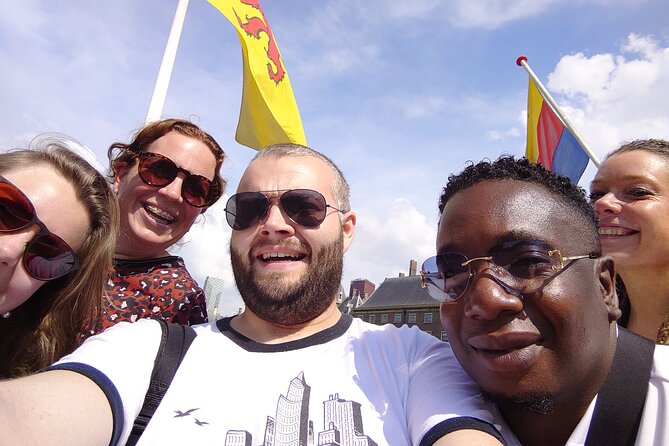
The route returns to important civic buildings in the old town. Koblenz’s town hall is located in the former Jesuit college, giving you a chance to see how an older religious institution was adapted for modern city administration.
The Old Castle began as a substantial moated castle owned by the Elector in the 13th century. Today, only the later Burghaus remains, and it houses the city archive. This stop connects medieval defense with the quieter work of preserving documents and records.
Together, the town hall and Old Castle give the walk a useful civic thread. You see how authority changed hands and how old buildings found new purposes. The app may only offer a short explanation, but the sequence of stops helps you read Koblenz as a city that has repeatedly adapted its old structures.
The Romanesque church and Balduin Bridge
The final major sights include one of Germany’s important Romanesque church buildings, which has been on the World Heritage List since 2002. The supplied information does not identify the church by name, but its inclusion adds an important international layer to the route.
You also reach a 14th-century stone bridge over the Moselle. It is the oldest surviving bridge in Koblenz and connects the old town with the Lützel district. This is a practical structure with real historical weight, not simply a photo stop.
A bridge is a fitting part of this activity because the whole walk links different parts of Koblenz. You move between river banks, old streets, churches, official buildings, and public squares. The route makes the city easier to understand as a meeting point shaped by the Rhine and Moselle.
What the $37.33 price really means
The price is $37.33 per group of up to six people. If six people share it, the cost is about $6.22 each, which is good value for two to four hours of activity. A group of four pays about $9.33 per person, while a solo participant pays the full group price.
That pricing makes the experience most attractive to families, couples traveling with friends, and small private groups. It is less appealing if you are alone and mainly want expert historical interpretation.
You also need to provide your own smartphone and data. Those are small but real costs to keep in mind. The activity includes the online game and city walk, but not a guide, transport, meals, entry tickets, or phone use.
The private format matters. Your group does not have to keep up with strangers or follow a fixed guide’s schedule. You can stop for extra sights and resume later, which adds value if you want a relaxed day in Koblenz rather than a tightly timed tour.
Who will enjoy this Koblenz activity most
I would recommend it most to people who like a little structure but do not want a traditional guided walk. You get a planned route and prompts, while still choosing your speed and pauses.
It is also a good fit for families. The questions are fairly easy, and the challenge element gives children a reason to pay attention to buildings, statues, and public spaces. The activity is not limited to a particular group size, though the stated price covers up to six people.
Friends can also make good use of it. Shared problem-solving is more engaging than each person reading the same text on a phone, and the low group price improves the value.
I would be more cautious if you want detailed scholarship, polished translations, or dependable turn-by-turn navigation. One serious complaint described incorrect translations, shallow information, location mismatches, a clumsy app, and non-working GPS. The provider’s response pointed to its round-the-clock helpdesk, but you should still be prepared to use your own navigation if needed.
The activity is offered in English. It is also listed as suitable for most participants, service animals, and people who are hearing impaired. Public transportation is nearby.
Booking, timing, and cancellation
The activity is listed as available Monday through Sunday from 12:00 AM to 11:59 PM, with dates extending through December 13, 2026. That gives you broad flexibility, though you should still confirm the start details when booking.
Confirmation is provided at the time of booking. Free cancellation is available if you cancel at least 24 hours before the local start time. Cancellations or changes made within 24 hours are not refunded or accepted.
The activity is often booked around 11 days ahead. That is not a rule, but it suggests that planning more than a few days in advance is sensible if your Koblenz visit has fixed dates.
Should you book the Koblenz e-scavenger hunt?
Book it if you want an affordable, private way to cover many of Koblenz’s main sights without a fixed guide. The route is well suited to groups, and the pause function lets you combine the game with lunch, photographs, church visits, or extra time by the rivers.
I would skip it if your main goal is a deep historical explanation or flawless digital navigation. The app content is short, the questions may be too easy for history fans, and the mixed technical feedback means you should not depend on the GPS alone.
For a full group of six, the price is hard to argue with. For one person, it is less attractive. Bring a charged phone, mobile data, and a willingness to solve a few navigation problems yourself, and you will get a flexible introduction to Koblenz’s rivers, old town, churches, monuments, and civic buildings.
FAQ
How long does the Koblenz e-scavenger hunt take?
The activity takes approximately two to four hours, depending on how quickly you complete the challenges and how often you pause to explore.
How much does the experience cost?
The price is $37.33 per group, with up to six people included.
Where does the activity start and finish?
It starts at Münzplatz 15, 56068 Koblenz, Germany, and ends back at the meeting point.
Is a guide included?
No live guide is listed. The experience is an online game and city walk that you use on your smartphone.
What language is offered?
The activity is offered in English.
Do I need my own phone and mobile data?
Yes. Smartphone use and data are not included, so you need to provide both.
Can I cancel for a full refund?
Yes. You can receive a full refund if you cancel at least 24 hours before the local start time. Cancellations within 24 hours are not refunded.
Just added around Germany
- Stuttgart Self Guided Sherlock Holmes Murder Mystery Game★ 5.0 · 4 reviews
- Stuttgart Scavenger Hunt and Highlights Self Guided Audio Tour★ 5.0 · 2 reviews
- Private: Outdoor Escape Game Schluchsee: The Lost Village★ 4.5 · 11 reviews
- Rothenburg Scavenger Hunt and Sights Self-Guided Tour★ 4.5 · 11 reviews
- Schwerin Self Guided Sherlock Holmes Murder Mystery Game★ 3.0 · 3 reviews
- e-Scavenger hunt Paderborn: Explore the city at your own pace★ 5.0 · 4 reviews
- Digital scavenger hunt around Wittringen Castle in Gladbeck★ 4.0 · 9 reviews
- Private scavenger hunt around the Ruhrfestspielhaus Recklinghausen★ 4.5 · 3 reviews
Germany Escape Games, compared.

Escape Room Adventure in Berlin Solve the Mystery
Read our review →
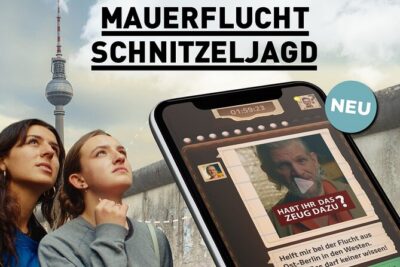
Escaping and spying on the Berlin Wall Scavenger hunt
Read our review →
Browse the lists this tour appears in