
Review · NETHERLANDS
e-Scavenger hunt Utrecht: Explore the city at your own pace
Utrecht is made for walking, and this self-guided scavenger hunt gives you a reason to wander beyond the obvious sights. Starting at Domplein, you follow a phone-based trail through canals, churches, courtyards, markets, and old neighborhoods, answering questions as you go. You can finish in two hours, or stretch the route into a relaxed half-day.
I like the freedom to stop for lunch, drinks, or photos without waiting for a guide. I also like the route’s range: you’ll see the famous Dom Tower, but you’ll also reach places such as De Zeven Steegjes and the Sterrehof courtyard. The main drawback is that some map pins and hints may be unclear, and the historical explanations are brief.
Key points before you book

- A full Utrecht circuit: The route links the Dom Tower, Oudegracht, flower market, Neude, old churches, courtyards, and the Railway Museum area.
- You control the clock: Plan on roughly two to four hours, with time to pause for food, photos, or extra exploring.
- One team, up to six people: The price is $37.21 per group, not per person, making it good value for a small group.
- Game play adds purpose: Questions, bonus points, and a final score turn sightseeing into a light competition.
- Bring your own phone and data: These are not included, so check that your device is charged and connected.
- Expect short explanations: The activity gives useful facts, but it is not a substitute for a detailed guided history tour.
Starting at Domplein with Utrecht’s tallest landmark
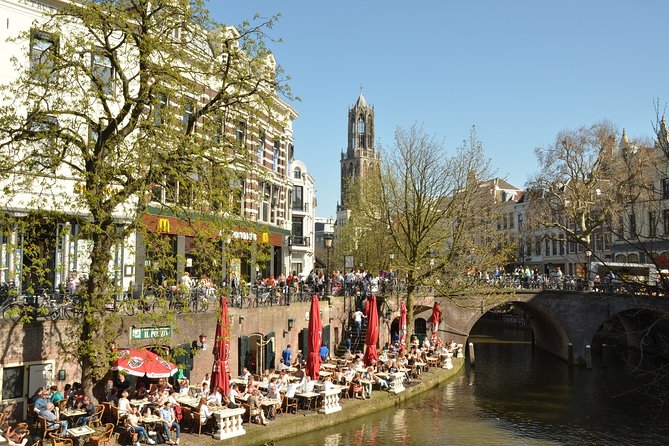
The activity begins at Domplein 20, right beside the Dom Tower. At 112.5 metres, it is the tallest church tower in the Netherlands and the symbol of Utrecht. That makes the square a sensible starting point: you get your bearings beside the city’s most important landmark before setting off through the center.
The route is private to your group, with no strangers added to your team. Up to six people can share the experience, and the group format matters because the questions work best when you discuss possible answers together. If you split into several teams, the scoring system can add a friendly contest, though each group must have its own access and phone setup.
The Dom Tower itself is a sight on the route, not a promise of a tower climb. The supplied details do not include admission or a guided visit inside, so plan to admire it from the square unless you arrange another visit separately. That distinction is useful if you are comparing this with a dedicated Dom Tower tour.
More Scavenger Hunts in Netherlands
- e-Scavenger hunt Maastricht: Explore the city at your own pace
★ 4.5 · 110 reviews - e-Scavenger hunt Middelburg: Explore the city at your own pace
★ 4.5 · 55 reviews - e-Scavenger hunt Den Bosch: Explore the city at your own pace
★ 4.5 · 37 reviews
The first stops: music, churches, and old Utrecht
One stop focuses on a collection of self-playing musical instruments. It includes music boxes, clocks, pianolas, and barrel organs. This gives the trail a welcome change of pace. Utrecht is not presented only through grand buildings and dates; you also get a look at the city’s mechanical music tradition.
The church stops add some of the city’s oldest buildings. One church began construction in 1039 and was inaugurated on May 1, 1048. Another is the Janskerk, founded shortly after 1040 by Bishop Bernold and dedicated to John the Baptist. These dates are useful reminders that Utrecht’s center is not simply an attractive collection of later Dutch buildings. Its religious roots reach back almost a thousand years.
The Nicolaïkerk, also known as the Nicolaaskerk, is another stop. It is located at Nicolaaskerkhof 8. The activity gives you a reason to notice the building and its setting, even if you will want to research further afterward for a fuller account of its art and architecture.
That is the pattern of this city trail. You receive a prompt, a question, or a short piece of information, then look closely at the place in front of you. If you want long explanations at every stop, this may feel thin. If you enjoy collecting small facts while walking, it works better.
The flower market and Oudegracht
The flower market is one of the more colorful stops. Expect cut flowers and plants in a setting that is comfortably busy rather than overwhelming. It is an easy place to slow down, take photographs, and see a familiar Dutch scene without making the market the sole purpose of your visit.
The route then brings you to the Oudegracht, Utrecht’s old canal. This is one of the city’s defining spaces, with restaurants along the water and a layout that feels different from a typical canal street. You can pause here for a meal or drink, which is one of the best reasons to choose a self-guided format instead of a fixed walking tour.
The route is not a race. You can stop at the canal, leave the trail briefly, and return to the next prompt. One group took its time, made detours, stopped for lunch and drinks, and walked about 10 kilometres overall. That figure is not a promised distance, but it shows how easily the activity can grow into a substantial day on foot.
Wear comfortable shoes and keep your route open. The listed duration is about two to four hours, but your actual outing will depend on how often you pause and how directly you follow the trail.
Fort history at Utrecht University’s botanical garden

The botanical garden is set on the Utrecht University campus around a former fort. It forms part of the Holland Water Defence system, a defensive line that used water and fortified positions to protect the Netherlands.
This stop gives the route a useful change of scenery and subject. You move from the dense center, with its churches and canals, toward a place where plants, university life, and military history meet. The supplied information does not promise entry to every garden area or include admission, so treat the garden as a featured location on the route rather than assuming that a full botanical visit is included.
Still, this is one of the places that makes the hunt feel broader than a standard old-town walk. You are not simply moving from one famous building to another. You are also seeing how Utrecht connects to Dutch engineering and defense.
Same place, a different puzzle:
- Amsterdam Treasure Hunt: The Mystery of a Secret Sender
★ 5.0 · 149 reviews - Amsterdam: Treasure Hunt Walking Tour “A Secret Sender”
★ 4.7 · 71 reviews - Utrecht Old Town: Medieval Monster Hunt & Walking Tour
★ 4.0 · 62 reviews - Discover Utrecht with a self-guided Outside Escape city game tour
★ 4.5 · 51 reviews
The Railway Museum and the city’s transport story

The Railway Museum is described as much more than a museum, with the surrounding stop pointing to Utrecht’s major role in Dutch rail travel. The route calls it one of the country’s most exciting railway locations, but admission is not included in the activity details.
That means you should decide in advance how you want to use this stop. If you only have two or three hours, you may simply note the museum and continue. If you have extra time and want a separate indoor attraction, you could make it an additional visit, but you should arrange that independently.
The museum stop also helps vary the experience for mixed-age groups. Churches and architecture may interest some people more than others, while trains and transport displays can give younger participants another reason to stay engaged. The hunt is described as suitable for people of different ages, and this mix of subjects is part of why.
Neude, Paushuize, and Utrecht’s civic center
Neude is a large city square with an unexpectedly earthy name. It comes from node, meaning swamp, and the square was once much lower than it is today. A question about this place connects the modern square to the wet ground beneath Utrecht’s urban development.
The city hall is another central stop. Its oldest parts date from 806, and after five centuries of changes, the building became the city hall you see today. That very early date makes it one of the more striking facts on the route, though the activity gives only a short introduction rather than a full architectural lecture.
Paushuize, built at the start of the sixteenth century, sits on Pausdam. It is an important historic building and adds another layer to the walk through Utrecht’s civic and religious center. The stops around Neude, the city hall, and Paushuize work well together because they show how public power, church influence, and everyday city life occupy the same compact area.
You may find the sequence more useful if you pause to look up details after the game. The activity’s questions are designed to keep you moving, not to provide a long reading session at every building.
De Zeven Steegjes and the quieter side of the center
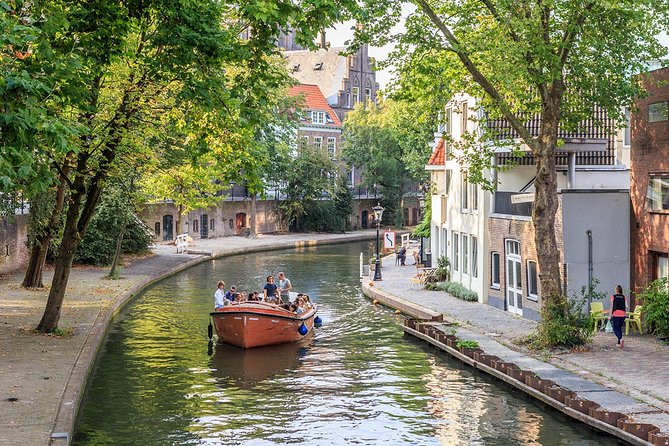
De Zeven Steegjes is one of the last working-class neighborhoods in central Utrecht. Its characteristic workers’ houses sit near the Oudegracht, offering a more intimate view of the city than the main canal, square, and church stops.
This is exactly the sort of place a self-guided route can bring into your day. You might pass nearby on a standard city walk without realizing what kind of neighborhood you are seeing. Here, the prompt encourages you to notice the narrow streets and modest homes as part of Utrecht’s social story.
The stop is also a reminder to behave thoughtfully. These are residential streets, not an outdoor stage. Keep your group quiet, avoid blocking doorways, and treat the neighborhood as a lived-in part of the city.
Rococo detail at the Agnietenstraat building
The foundation building on Agnietenstraat was completed in 1761. It was originally built as a boarding school for orphaned boys and is considered one of the highlights of rococo architecture in the Netherlands.
This stop adds an eighteenth-century chapter to a route that otherwise reaches much further back. The building’s original purpose also brings a human detail to the architecture. You are not only looking at decorative design; you are seeing a place built for a particular social role.
Again, the activity will give you an observation point and a question rather than a full museum-style explanation. That is enough to make the building memorable, but if rococo design or the building’s institutional history interests you, plan to do extra reading afterward.
Ending at the Sterrehof courtyard
The Sterrehof is a courtyard in the city and a national monument. It is described as atmospheric, which makes it a fitting late stop on a long walk through streets, squares, canals, and churches.
Courtyards reward a slower pace. You can look at the layout, notice the contrast between private homes and shared space, and enjoy a quieter pause before returning to the start. The activity ends back at the meeting point, so you do not need to arrange transport from a distant finish.
The route’s return to Domplein also makes the experience easy to fit around other plans. You can begin near the center, complete the loop, and then continue to dinner or another Utrecht attraction without solving a one-way transport problem.
How the phone game works in practice
You need your own smartphone and mobile data. Neither is included, so make sure the phone is charged and that the person running the activity has a reliable connection. A second phone can be useful for taking photos or checking information, but the supplied details do not require one.
The app is designed for navigation and questions, with bonus points available when you reach a location. Do not forget to tap the bonus option at each stop. That small detail affects your score and is easy to miss if you are focused on the next clue.
Some prompts may feel like a genuine search rather than a simple walk to a pin. That can be entertaining, but the map points are not always perfectly placed, and hints may not solve every problem. If an answer seems impossible, check the location carefully and use common sense rather than spending too long in one spot.
The scoring system is useful for groups that enjoy competition. For everyone else, you can treat the points as a light game layer and concentrate on the city itself. The route does not require you to maintain a fast pace.
Price, group size, and overall value
The cost is $37.21 per group of up to six people. For six participants, that works out to a little over $6 each, before any currency conversion or booking charges. That is good value if you want a private activity with a route, questions, and a few hours of structured sightseeing.
For one or two people, the per-person cost is less impressive. You are paying for the group package, not a personal guide, museum tickets, transport, or a meal. The price makes the most sense for friends, families, or a small private group that wants an activity to organize the day.
The main value is flexibility. You can pause for lunch, make detours, and decide how seriously to take the competition. If you want expert storytelling, detailed historical context, or entry to attractions, a guided walk or separate admission tickets may serve you better.
The overall rating is 4.3 from 28 published ratings, which fits the experience’s strengths and limits: the idea is popular, the route introduces lesser-known places, and the app can be enjoyable, but execution and explanation are not perfect.
Who should choose this Utrecht scavenger hunt
I would choose this activity for a group that likes walking with a purpose. It suits friends who want a playful afternoon, families with mixed interests, and people who have already seen Utrecht’s main square but want help finding less obvious corners.
It is also useful if you dislike fixed tour schedules. The activity operates every day from midnight to 11:59 p.m. according to the supplied schedule, and you select your own start time within that availability. Confirmation is received at booking, and free cancellation is available up to 24 hours before the start time.
I would not choose it as your only source of Utrecht history. The facts are interesting but short, and some questions may seem loosely connected to the exact location. Think of it as a sightseeing framework with game elements, not as a replacement for a specialist guide.
The activity is near public transportation, service animals are allowed, and most people can participate. It is also described as user-friendly for people with hearing impairments. The route may still involve substantial walking, so consider your group’s needs before booking.
Should you book it?
Book it if you want to see Utrecht at your own pace, share a private activity with up to six people, and enjoy questions, bonus points, and a final score. The route covers an unusually broad mix of places, from Domplein and Oudegracht to De Zeven Steegjes, the botanical garden, and Sterrehof.
Skip it if you want a polished, deeply researched explanation at every stop or if unclear map points would frustrate you. For the best value, bring a charged phone with data, travel with a group of several people, allow four hours, and build in time for lunch along the canal.
FAQ
Where does the e-Scavenger hunt start?
It starts at Domplein 20, 3512 JD Utrecht, Netherlands.
Where does the activity finish?
The activity ends back at the meeting point.
How long does the Utrecht city trail take?
The estimated duration is two to four hours.
How many people can join one group?
One group can include up to six people.
What is included in the price?
The price includes a city trail for a team of up to six people.
Do I need to bring a smartphone?
Yes. A smartphone and mobile data are not included, so you need to provide them yourself.
Is the activity available in English?
Yes. The activity is offered in English.
Can I choose my own start time?
The activity is available Monday through Sunday from 12:00 a.m. to 11:59 p.m., allowing you to choose a start time within those hours.
Is this a private tour?
Yes. Only your group participates in the activity.
What is the cancellation policy?
You can cancel at least 24 hours before the start time for a full refund. Cancellations or changes made within 24 hours are not accepted for a refund.
Just added around Netherlands
- Utrecht Scavenger Hunt and Highlights Self Guided Audio Tour★ 4.0 · 10 reviews
- Discover Utrecht’s Zocherpark in this Outside Escape game tour!★ 5.0 · 2 reviews
- The Hague Scavenger Hunt and Highlights Self Guided Audio Tour★ 3.5 · 8 reviews
- e-Scavenger hunt The Hague: Explore the city at your own pace★ 3.5 · 10 reviews
- Discover The Hague’s scenic courtyards in an Outside Escape game!★ 4.0 · 16 reviews
- Delft Self Guided Sherlock Holmes Murder Mystery Game★ 4.5 · 2 reviews
- The Blue’s Clues in Delft Exploration Game and Tour★ 3.5 · 10 reviews
- 90 minutes Self Guided Walking Tour with puzzles in Den Haag★ 4.5 · 7 reviews
Netherlands Escape Games, compared.
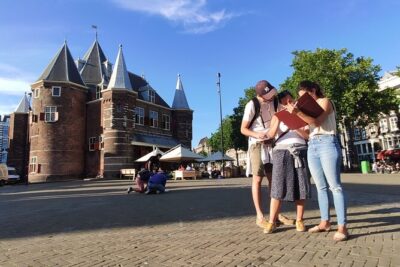
Amsterdam Treasure Hunt: The Mystery of a Secret Sender
Read our review →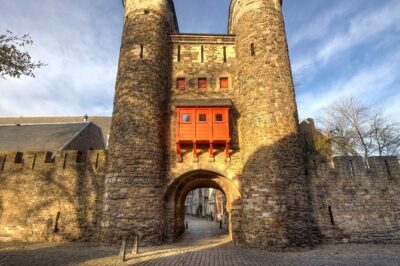
e-Scavenger hunt Maastricht: Explore the city at your own pace
Read our review →
Utrecht Old Town: Medieval Monster Hunt & Walking Tour
Read our review →
e-Scavenger hunt Middelburg: Explore the city at your own pace
Read our review →
Rotterdam Highlights & Spies: Interactive City Game
Read our review →
Discover Utrecht with a self-guided Outside Escape city game tour
Read our review →
Amsterdam Red Light District Treasure: Self-Guided Tour & Quest
Read our review →Browse the lists this tour appears in