
Review · GERMANY
Stuttgart: Outdoor Escape Game – exciting puzzle tours about the city’s history
Stuttgart’s past becomes your game board in this outdoor escape adventure, where clues lead you through streets, squares, and historic sites rather than into a locked room. I like the personal welcome from historian Michael Mezger and the way the puzzle book mixes city facts with hands-on challenges. I also like the freedom to pause for coffee, cake, or ice cream without falling behind.
The main thing to consider is the language: instruction is in German, and the outdoor format means weather matters. The puzzles are designed for shared problem-solving, so this suits a group that enjoys thinking together more than one looking for a fast, competitive race.
Key points at a glance
- Two difficulty levels: Choose the family-friendly Wilhelm Case or the more demanding Case of Max von Bulsenberg.
- A historian-led start and finish: Michael Mezger welcomes you at Schlossplatz, explains the game, and discusses the answers with you afterward.
- Stuttgart as the puzzle board: Follow clues through famous sights and less familiar corners of the city center.
- No ticking clock: Stop for a drink, take a break, and continue at your own pace.
- A handmade puzzle book: Your booklet combines logic tasks, codes, creative challenges, and facts about Stuttgart and Württemberg.
- Good for private groups: Play alone, as a pair, or in groups of up to 30, with larger groups divided into teams.
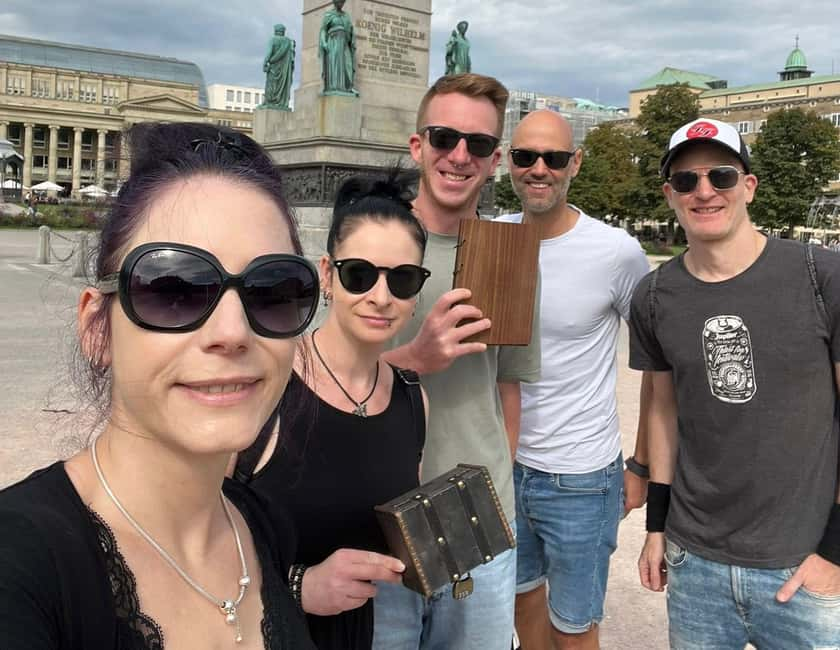
Starting at Schlossplatz with a historian
Your game begins and ends at the Jubilee Column on Schlossplatz, Stuttgart’s central square. This is a practical meeting point, easy to reach by public transport, with several parking garages nearby.
Michael Mezger gives you a personal introduction before you set out. That small touch changes the feel of the activity. You are not simply handed a worksheet and sent into town. You get an explanation of how the puzzle works, what to watch for, and how the materials fit together.
The opening also gives you a chance to ask questions before the group scatters into the city. Since the instructor speaks German, you should be comfortable following German explanations, or attend with someone who can help translate.
You receive the puzzle book and the other game materials at the start. The booklet is more than a list of riddles. It includes historical information, so the places you visit have context instead of serving as random backdrops for a scavenger hunt.
At the end, you return to Schlossplatz and meet Michael again. He goes through the solved puzzles, talks about the history behind them, and answers questions. I value this closing discussion because it gives the activity a clear shape: introduction, independent exploration, then a chance to check what you learned.
More Outdoor Escape Games in Germany
- Bamberg: Outdoor Escape Game with a Puzzle Backpack
★ 4.8 · 101 reviews - Bremen: Outdoor Escape Game in the Old Town
★ 4.4 · 41 reviews - Dresden: Krimi Outdoor Escape Game “Mord am Elbufer”
★ 4.9 · 29 reviews
Choosing between the Wilhelm and Max cases
The two games are aimed at different kinds of puzzle solvers.
The Wilhelm Case is the gentler choice. It is recommended for beginners, families, and anyone who wants a relaxed introduction to the series. The puzzles are designed to be manageable for children when adults work alongside them, and the available feedback describes them as entertaining without being too hard.
That makes this the safer pick for a mixed-age group. You can keep younger players involved without turning the outing into a long struggle over one difficult code. It also works well if your main goal is to see central Stuttgart while adding a playful layer.
The Case of Max von Bulsenberg is the tougher option. It is intended for experienced puzzle fans who want a more involved challenge. This game requires a cell phone, so bring one with a full charge and an internet connection.
The harder case may suit a group of adults or older teenagers who enjoy working through a problem before asking for help. If you are new to outdoor escape games, the Wilhelm option is likely the better introduction. If your group regularly tackles escape rooms and wants more mental work, the Max case should provide the stronger test.
The precise puzzle sequence is not fixed here in advance, which is part of the appeal. You move from clue to clue, using both the book and the city around you. Some tasks are printed in the booklet. Others relate directly to buildings and public squares, so you need to look carefully rather than simply read from the page.
Walking through Stuttgart’s city center
The route takes you around central Stuttgart, combining familiar sights with smaller details that even local residents may overlook. The activity does not treat the city as a museum corridor. Instead, each stop asks you to connect something visible in the present with an event, person, or detail from the past.
You should expect a mix of logic puzzles, code-breaking, and creative tasks. That variety matters. A group may have one person who spots patterns, another who remembers facts, and someone else who notices a detail on a building. The best part is often the discussion between clues, when everyone tries a different approach.
The route includes well-known places, but the game also directs your attention to less obvious features. You might pass a site many visitors photograph without asking why it matters. The puzzle book gives you a reason to stop, inspect, and think.
The activity is completely outdoors. That means you get fresh air and a changing view of the city, but you also need to dress for Stuttgart’s weather. Wear comfortable shoes and clothing suited to the forecast. The tour lasts about two to three hours, so footwear matters more than it might for a short guided walk.
Most of the route is barrier-free and suitable for strollers. Individual steps can be bypassed. If someone in your group has specific mobility needs, it is still sensible to ask about the route when booking, since the activity takes place across public streets and squares.
Why the no-time-limit format matters
Many escape games push you toward a final countdown. This one does not. You can pause the game and continue at your own pace, which makes a major difference for families and casual groups.
You can stop for coffee and cake, grab an ice cream, or take a drink break without feeling that the clock is punishing you. One of the useful details from the feedback is that the game left enough room for exactly this kind of pause.
The relaxed timing also lets you give the history a fair hearing. If a fact in the booklet catches your attention, you can stop and discuss it. If a puzzle needs more thought, you do not have to rush past a place simply to stay on schedule.
The tradeoff is that the experience may feel less intense to people who love the pressure of a timed escape room. There is no dramatic race against the final seconds. The reward comes from noticing more of Stuttgart and solving the problems with your companions.
Same place, a different puzzle:
- Hamburg: Treasure Hunt Game through HafenCity
★ 4.7 · 364 reviews - Hamburg: Scavenger Hunt Self-Guided Tour for Children
★ 4.5 · 319 reviews - Treasure Hunt through Hamburg’s Hafencity
★ 5.0 · 234 reviews - Escape Room Adventure in Berlin Solve the Mystery
★ 5.0 · 222 reviews
A puzzle book that does more than give clues
The puzzle book is one of the strongest parts of the format. It holds the tasks, historical facts, and instructions in one portable package, so you can work without constantly checking a guide.
Its design is described as careful and lovingly made, and that matters because the booklet is the thread tying the whole route together. You are not just walking from one point to another. You are building a story through the questions and answers.
Expect different types of mental work:
- Logic tasks that require you to compare information
- Codes that need to be cracked
- Creative challenges that ask you to look at a place in an unusual way
- Clues printed in the book
- Tasks connected to buildings, squares, and details in the street
This mix helps prevent the game from becoming repetitive. If one sort of puzzle is not your strength, the next may suit you better.
You return the puzzle book and game materials after the activity. Bring a charged smartphone, and remember that the Max case specifically requires a cell phone. An internet connection is also requested, so check your battery and data access before meeting at Schlossplatz.
A useful activity for families and private groups
The game is aimed at teenagers and adults, but children can take part when the group chooses the easier case and works together. The available feedback points to puzzles that children could solve while still keeping adults entertained.
Families should think of this as a shared activity rather than a children’s tour. Younger participants may enjoy searching for clues and spotting details, while adults handle some of the more complex logic. That division can work well, provided everyone gets a role.
It also suits friends who want something more active than sitting in a café but less formal than a standard guided tour. The private-group format lets you stay with your own companions. You can play alone or as a pair, and groups of up to 30 people can take part.
Large groups are divided into teams. Everyone follows the same adventure at the same time, which creates a little friendly competition without requiring strangers to join your team. Companies and school classes may find this useful because the game gives people a shared task and a reason to communicate.
Still, group size affects the feel. Two or three people can discuss every clue closely. A large group will need to divide responsibilities and make sure quieter players do not get left behind.
The value of $17 per person
At $17 per person, the price is reasonable for a two to three hour activity in central Stuttgart. You are paying for the game materials, a personal introduction, the historian-led closing discussion, and an organized route through the city.
The value is strongest if you want both sightseeing and an activity. A standard walk may give you more historical explanation in one continuous stream, while this game gives you more control and participation. You spend time looking at the city instead of simply following someone else’s pace.
Food and drinks are not included, but the no-time-limit format makes that less of a problem. You can add your own coffee or ice cream stop without building a separate break into a tight schedule. Travel to Schlossplatz and parking also cost extra.
For a family, the price can be easier to justify because one booking fills a substantial part of an afternoon. For an experienced escape-room fan, the value depends on how much you enjoy historical setting and outdoor play. If you want elaborate rooms, special effects, or a strict countdown, this is a different product.
Language, weather, and practical planning
The instructor speaks German, and some content appears in its original language. German speakers should have the smoothest experience. If your German is limited, consider attending with someone who can translate the instructions and historical passages, since understanding the wording is part of solving the puzzles.
Plan for two to three hours outside. Comfortable shoes are essential, and weather-appropriate clothing is not optional. The game continues through the city center rather than moving indoors when conditions change.
Bring:
- A charged smartphone
- Comfortable walking shoes
- Clothing suited to the weather
- An internet connection, especially for the Max case
The meeting point at the Jubilee Column is easy to reach by public transport. Several parking garages are close by, though parking fees are not included.
The activity is wheelchair accessible, and most paths are barrier-free. Some steps can be avoided. Since this is an outdoor route, you should still confirm any detailed access needs before booking.
Cancellation is free up to 24 hours before the start for a full refund. You can also reserve now and pay later, which helps if your Stuttgart schedule is still taking shape.
Who should book this Stuttgart puzzle tour?
I would choose The Wilhelm Case for families, first-time players, and groups with mixed puzzle skills. It offers a gentler entry point while still giving you a reason to explore the city closely.
I would choose The Case of Max von Bulsenberg for people who already enjoy escape games and want a harder challenge. The phone requirement and more demanding design make it less suitable for a casual group that mainly wants a sightseeing walk.
This activity works especially well when you want time outdoors and prefer discovering a city through small tasks. It is also a good choice for anyone who likes to stop and talk, since there is no forced pace.
I would skip it if your group does not understand German, dislikes walking outside in uncertain weather, or wants a traditional guide speaking continuously about every sight. The historical material is there, but you uncover it through puzzles rather than receive it all in a lecture.
Should you book it?
Book this outdoor escape game if you want to see Stuttgart actively, solve problems with your own group, and learn historical details without racing a stopwatch. The personal welcome and final discussion with Michael Mezger give the activity more substance than a self-guided puzzle sheet.
Choose the Wilhelm Case for a relaxed family outing. Choose the Max case for a more serious puzzle challenge. At $17 per person, the combination of a two to three hour route, custom materials, and historian-led contact offers solid value, provided German and outdoor walking work for your group.
FAQ
Where does the Stuttgart outdoor escape game begin?
It begins at the Jubilee Column on Schlossplatz in Stuttgart. The same location is used for the finish.
How long does the activity take?
The activity lasts about two to three hours. You can pause and continue at your own pace.
Is the game available in English?
The instructor speaks German, and some content is shown in its original language. The provided information does not list an English version.
Which game is best for beginners?
The Wilhelm Case is designed as the introduction to the series and is recommended for beginners, families, and people who enjoy solving puzzles together.
Which game is harder?
The Case of Max von Bulsenberg is the more challenging option and is intended for experienced puzzle lovers. It requires a cell phone.
What should I bring?
Bring a charged smartphone, comfortable shoes, and clothing suitable for the weather. An internet connection is needed for the Max case.
Can children take part?
The games are suitable for teenagers and adults. The Wilhelm Case can also work well for families, with puzzles that can be solved together with children.
Is the route wheelchair accessible?
The activity is wheelchair accessible. Most paths are barrier-free, and individual steps can be bypassed.
More Heritage Tours in Germany
- The Anatomist – Award Winning Historical Escape Room Experience
★ 5.0 · 151 reviews - Private city discovery tour – A Historical Treasure Hunt
★ 5.0 · 146 reviews - Queer Lisbon – A Treasure Hunt in LGBT History
★ 5.0 · 71 reviews - Fort Worth Stockyards History, Food, and Puzzle Tour
★ 5.0 · 38 reviews
Just added around Germany
- Stuttgart Self Guided Sherlock Holmes Murder Mystery Game★ 5.0 · 4 reviews
- Stuttgart Scavenger Hunt and Highlights Self Guided Audio Tour★ 5.0 · 2 reviews
- Private: Outdoor Escape Game Schluchsee: The Lost Village★ 4.5 · 11 reviews
- Rothenburg Scavenger Hunt and Sights Self-Guided Tour★ 4.5 · 11 reviews
- Schwerin Self Guided Sherlock Holmes Murder Mystery Game★ 3.0 · 3 reviews
- e-Scavenger hunt Paderborn: Explore the city at your own pace★ 5.0 · 4 reviews
- Digital scavenger hunt around Wittringen Castle in Gladbeck★ 4.0 · 9 reviews
- Private scavenger hunt around the Ruhrfestspielhaus Recklinghausen★ 4.5 · 3 reviews
Germany Escape Games, compared.

Escape Room Adventure in Berlin Solve the Mystery
Read our review →

Escaping and spying on the Berlin Wall Scavenger hunt
Read our review →
Browse the lists this tour appears in