
Review · GERMANY
e-Scavenger hunt Münster: Explore the city at your own pace
Münster turns sightseeing into a GPS scavenger hunt, sending you between its cathedral, Peace of Westphalia town hall, churches, museums, market, and palace. You solve clues on your phone instead of following a guide, so your group can stop for coffee, browse a museum, or take a wrong turn without holding anyone up.
I like the private format, which keeps the game relaxed, and the low group price, about $36.07 for up to six people. I also like the chance to see Münster in an unexpected order. The trade-off is that some questions may feel too easy or may not require you to be standing at the location, and the app does not provide standard turn-by-turn navigation.
Key points to know
- A self-guided route through central Münster: The game links major sights including St. Paul’s Cathedral, the Historical City Hall, St. Lambert’s Church, and the City Museum.
- Best for groups of up to six: You pay per group, not per person, making the price more attractive when shared.
- Two to four hours at your pace: You can pause, stop for food, and decide how quickly to move between clues.
- Your phone is the equipment: The online app is included, but your smartphone and mobile data are not.
- The route is not a standard guided walk: GPS helps you find locations, but you must work out the route yourself.
- A useful first look at Münster: It gives you a shortlist of places to revisit, though it offers less historical explanation than a live guide.
Münster sightseeing with a game instead of a guide
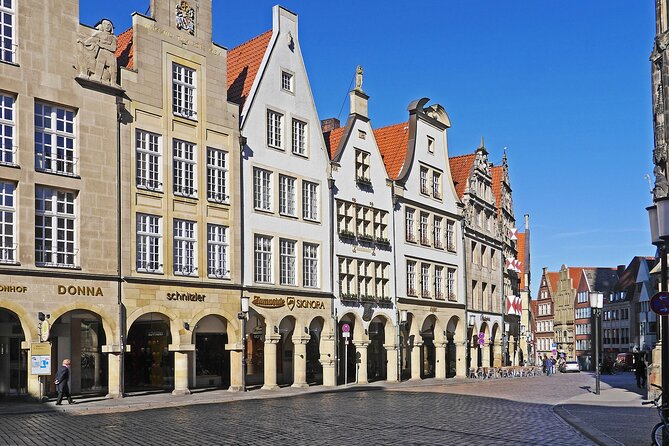
This activity begins at Berliner Platz 25, in central Münster, and ends back at the same meeting point. The location is listed as Münster throughout the route details, even though one general summary names Dortmund, so use the Münster meeting point and Münster sights when planning.
You receive access to an online game for your smartphone. GPS helps you reach the next location, then you answer questions or complete assignments to continue. You do not collect a booklet, radio, or physical clue pack. That keeps the start simple, but it also means your phone battery and data connection matter.
The game is private for your group. Up to six people can play together, which makes it a natural fit for families, friends, or a small party that wants to explore without joining strangers. You set the pace, and you can stop along the way. The stated duration is about two to four hours, a wide range that makes sense for a route with many possible pauses.
One important point: this is not a narrated city tour. You should expect prompts, tasks, and fun facts, not a guide explaining every building in depth. One participant found the game easy to start and clear about what to do. That is useful for anyone who dislikes complicated apps. At the same time, the background information may feel thin if you want a proper lesson in Münster’s past.
More Scavenger Hunts in Germany
- Hamburg: Scavenger Hunt Self-Guided Tour for Children
★ 4.5 · 319 reviews - Dresden: Old Town Self-Guided Scavenger Hunt Tour
★ 4.5 · 151 reviews - Berlin: Self-Guided Family and School Class Scavenger Hunt
★ 4.6 · 128 reviews
What the route reveals about Münster
The route covers a surprising spread of central sights. The exact order can vary, and the game may send you along a less direct path. That is part of the fun, since you may see streets or corners you would skip on a simple point-to-point walk. It can also make the walk less efficient if you want to visit the main sights in the most logical order.
Here is what each listed stop adds.
St. Paul’s Cathedral and the weekly market
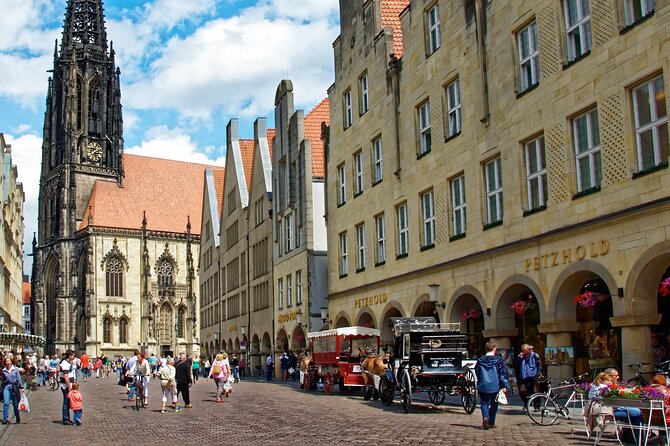
St. Paul’s Cathedral, often called Münster Cathedral, is one of the city’s key symbols. Together with the historic town hall, it helps define Münster’s central identity. The cathedral is a worthwhile anchor for the game because it gives you a large, unmistakable place to find while also placing you near several other stops.
The weekly market takes place directly in front of the cathedral. Its stalls carry vegetables, fruit, plants, flowers, and regional specialties. If your game takes you through the square on market day, you get a more everyday view of Münster than monuments alone can provide.
The market may also make a clue harder to locate. Temporary stalls can block a particular view or cover a point used by a question. That is not a serious problem, but you may need to look around carefully or return to the clue after moving a little away from the crowd.
The Historical City Hall and the Peace of Münster
The Historical City Hall is one of the most meaningful stops on the route. The building was connected with the negotiations that ended the Thirty Years’ War and the Eighty Years’ War. The Peace of Münster was concluded in 1648, making this a place where European history was negotiated rather than simply displayed in a museum.
The game can point you toward this story through a question or fact, but do not expect a full explanation of the wars or the peace settlement. I would treat the clue as an introduction, then make a note to return if this part of Münster interests you.
This stop also pairs well with the cathedral. The two buildings are close enough to form a useful central core, though the random order of the game may send you elsewhere before or after them.
Same place, a different puzzle:
- Hamburg: Treasure Hunt Game through HafenCity
★ 4.7 · 364 reviews - Treasure Hunt through Hamburg’s Hafencity
★ 5.0 · 234 reviews - Escape Room Adventure in Berlin Solve the Mystery
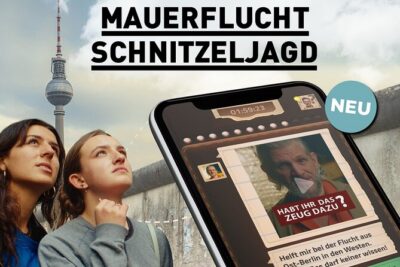
★ 5.0 · 222 reviews - Escaping and spying on the Berlin Wall Scavenger hunt
★ 4.5 · 128 reviews
Art museums and city history
The route includes a museum focused on Münster’s city history. Its permanent exhibition covers the city from its earliest beginnings to the present. That makes it a good follow-up stop if the outdoor clues leave you wanting more context.
Another listed museum presents art from late Gothic painting and sculpture through the Cranachs, with a focus on movements such as Der Blaue Reiter and Die Brücke. These are substantial subjects, and the game can only offer a brief taste of them. If you enjoy art, allow extra time outside the basic two-hour pace, though the activity itself does not state that museum admission is included.
The Kunstmuseum Pablo Picasso Münster adds a different angle. It holds a large collection of Picasso graphics and work by contemporaries. Together, these museum stops give the route more range than a walk limited to churches and monuments.
You should think of the game as a way to identify places worth revisiting. It helps you notice the City Museum, Picasso museum, and other cultural stops, but it does not replace time inside their exhibitions.
The Botanical Garden
The Botanical Garden covers about five hectares and includes roughly 2,000 square meters of greenhouse space. Five of its ten greenhouses are open throughout the year. The garden also receives about 200,000 visitors annually.
This is a welcome change from the tight streets of the historic center. It gives the route a calmer, greener stop and may appeal to anyone who needs a break from church facades and museum entrances. Still, the activity information does not say how long the game expects you to spend there or whether every part of the garden is involved in a task.
If your group wants to explore the garden properly, the two-to-four-hour estimate may not cover every possible detour. Use the game as a guide to the area, then decide if you want to return for a longer visit.
St. Lambert’s Church and the Dominican Church
St. Lambert’s Church is Münster’s most important sacred building from the Westphalian Late Gothic period. It sits in the historic center and gives the game a strong architectural stop.
The Dominican Church is also central, on Salzstrasse and not far from St. Lambert’s. Its location makes the route feel connected to Münster’s old streets and shopping area. These churches are especially useful for players who want visual clues. Distinctive buildings are easier to identify than small plaques or hidden details.
The activity may ask you to find something visible on or around a building. That said, the questions are not always dependent on your exact position. If you want every clue to demand close observation, you may find the game less satisfying than a more demanding treasure hunt.
St. Clement’s Church and the Erbdrostenhof
St. Clement’s Church was built between 1745 and 1753 as a monastery and hospital church. Its design is associated with Johann Conrad Schlaun. The building adds an 18th-century Baroque note to a route otherwise filled with medieval churches and modern museum subjects.
The Erbdrostenhof, on Salzstrasse in the historic center, is another 18th-century highlight. It is an impressive palace and an easy place to appreciate Münster’s grander side. Because both stops relate to the city’s architectural past, they give the game more depth than a string of unrelated photo points.
The limitation is the same as at the other monuments: the app may give you a fact, but not a long interpretation. If you want to know why Schlaun’s work matters or how the palace functioned, plan to read more afterward.
Kiepenkerl and the city library
The Kiepenkerl statue sits on the terrace between two Kiepenkerl restaurants. You can eat well there, according to the supplied description, making it a practical place for a meal break. The statue also connects the walk with a local image of the traveling peddler, giving you a lighter stop between more serious historical sites.
The Münster City Library is included as another point on the route. It offers non-fiction, specialist books, novels, and books for children and young people. It may not be a headline sight for a short visit, but it shows a working part of the city rather than only its monuments.
These two stops underline the route’s broad approach. You are not simply marching from one famous building to another. You are seeing restaurants, public services, museums, markets, churches, and gardens. Some players will enjoy that wider look. Others may prefer a tighter list of major landmarks.
St. Liudger Church
St. Liudger Church is one of Münster’s oldest Roman Catholic church buildings. Its first construction dates to 1173, giving it an early place in the city’s religious history.
As with the other churches, the value here is partly visual and partly historical. The clue can direct your attention to an old building you might otherwise pass without understanding its age. It also helps show how many layers of Münster’s past fit inside a compact central area.
How the clues and GPS work in practice

The app is designed to be easy to start. You follow the instructions, use GPS to locate the next point, and answer the question or complete the task. The route does not come with a separate navigation option, so you should be comfortable finding your own way between points.
That detail matters. This is a scavenger hunt, not a guided route with arrows at every turn. GPS tells the game where you are, but it may not act like a full map application. Keep a regular map available if you want reliable walking directions, though the supplied information does not promise compatibility with any particular mapping service.
The random order of locations is both a strength and a weakness. I like that it prevents the walk from feeling like a dull checklist and can lead you to unexpected streets. If you are short on time, though, the route may not be the quickest way to see Münster’s core sights.
Photo tasks are part of the experience. One response makes clear that a selfie question can be skipped, and your photo is not used without permission. That is helpful if you dislike taking pictures of yourself or do not want to share an image.
A Christmas market can make some questions harder to find, and winter may make a selfie spot less appealing. Those are good reasons to allow patience around seasonal events and bad weather. The game can still work, but outdoor tasks are less pleasant when stalls, crowds, or cold obscure the intended location.
Is $36.07 good value for a group?
At about $36.07 for up to six people, the price works out to roughly $6 per person for a full group. That is attractive if you are traveling with family or friends. For two people, the per-person cost is higher, but you still receive a private activity lasting about two to four hours.
The price includes access to the online game and city walk. It does not include your smartphone or data use. You should check that the person running the game has a charged phone and a suitable connection before starting.
Value depends on what you want. If you want a flexible way to see many parts of Münster, the price is fair. If you expect a live guide, detailed history, polished navigation, or highly original questions at every stop, the value is weaker.
The public score is 3.4 out of 5 from five ratings, which suggests a mixed but useful picture. The strongest points are the clear setup, easy questions, good route, fun facts, and friendly group format. The main complaints concern questions that do not always require being at the location, limited originality, and the lack of a navigation function.
That balance feels important. I would not book this as your only source of information about Münster. I would book it as a casual first pass through the city, especially if you want to turn sightseeing into a shared activity.
Who should choose this Münster game?

This suits you if you like solving simple clues, moving at your own pace, and making decisions as a group. Families and friends can divide up the questions, stop for food, or pause the game when a museum or market catches their attention.
It also works well for people who dislike fixed group tours. No guide is setting the pace, and only your own group participates. The activity is user-friendly for people with hearing impairments, service animals are allowed, and most people can participate. It is near public transportation, which makes the central meeting point practical.
You may want a different format if you prefer a detailed historical narrative. The game provides fun facts and points you toward important places, but it does not promise a full explanation of Münster’s art, architecture, or role in European history.
Booking details worth knowing

You can book for any day within the stated operating period, from January 27, 2022 through June 17, 2026. The listed hours run from midnight to 11:59 p.m. daily, so the format is highly flexible rather than tied to a scheduled departure.
Confirmation is provided when you book. Free cancellation is available if you cancel at least 24 hours before the start time. Cancellations or changes inside that 24-hour window are not refunded or accepted, and cut-off times use Münster’s local time.
The activity is often booked about 18 days ahead. That does not mean you must reserve that early, but it is a useful planning signal if you have a fixed date.
Should you book the e-Scavenger hunt Münster?

Book it if you want an affordable, private way to get oriented in Münster and you enjoy a little game with your sightseeing. The cathedral, Peace of Münster town hall, churches, museums, market, botanical garden, and palace give you plenty of variety, while the flexible timing lets you shape the outing around your group.
Skip it if you want a guide’s full explanation at every stop or expect every clue to be original and location-specific. Bring mobile data, allow extra time for a wandering route, and treat the game as a lively introduction rather than a complete history lesson. For a group of six, the price is especially appealing.
FAQ
Where does the Münster e-scavenger hunt start?
It starts at Berliner Pl. 25, 48143 Münster, Germany.
Where does the activity end?
The activity ends back at the meeting point.
How long does the game take?
The estimated duration is two to four hours.
How many people can join one booking?
The price covers one group of up to six people.
Is this a private activity?
Yes. Only your group participates.
What is included?
Online access to the app-based game and the city walk are included.
Do I need my own smartphone?
Yes. You must provide your own smartphone. Smartphone use and data are not included.
Does the activity include a guide?
No live guide is listed. You use the online app, GPS, clues, and assignments independently.
What sights are included?
The route includes St. Paul’s Cathedral, the Historical City Hall, the City Museum, the weekly market, the Botanical Garden, St. Lambert’s Church, the Picasso museum, the Kiepenkerl statue, the Dominican Church, St. Clement’s Church, the Erbdrostenhof, the City Library, and St. Liudger Church.
Can I cancel for a refund?
Yes. You can receive a full refund if you cancel at least 24 hours before the scheduled start time. Cancellations within 24 hours are not refunded.
Just added around Germany
- Stuttgart Self Guided Sherlock Holmes Murder Mystery Game★ 5.0 · 4 reviews
- Stuttgart Scavenger Hunt and Highlights Self Guided Audio Tour★ 5.0 · 2 reviews
- Private: Outdoor Escape Game Schluchsee: The Lost Village★ 4.5 · 11 reviews
- Rothenburg Scavenger Hunt and Sights Self-Guided Tour★ 4.5 · 11 reviews
- Schwerin Self Guided Sherlock Holmes Murder Mystery Game★ 3.0 · 3 reviews
- e-Scavenger hunt Paderborn: Explore the city at your own pace★ 5.0 · 4 reviews
- Digital scavenger hunt around Wittringen Castle in Gladbeck★ 4.0 · 9 reviews
- Private scavenger hunt around the Ruhrfestspielhaus Recklinghausen★ 4.5 · 3 reviews
Germany Escape Games, compared.


Escape Room Adventure in Berlin Solve the Mystery
Read our review →
Escaping and spying on the Berlin Wall Scavenger hunt
Read our review →

Browse the lists this tour appears in