
Review · ITALY
Escape from Pompeii: Self-Guided Mystery Puzzle Adventure
Pompeii becomes a story-driven puzzle on this self-guided walk. Instead of simply following a guide from one ruin to the next, you use your phone to solve clues that send you through temples, houses, streets, shops, theaters, and the amphitheater. It is a clever way to give shape to a large archaeological site.
I like the low price of $7.24 per person, and I like that the route covers many of Pompeii’s main sights without tying you to a group or a fixed guide. The catch is important: the game is offered in English, entry tickets are not included, and the phone-based format may feel tiring in hot sun or confusing if you prefer spoken explanation.
Key points to know
- A two-hour puzzle walk runs from Porta Marina Superiore to the Amphitheatre of Pompeii.
- The game is in English, even if your app or booking interface appears in another language.
- Pompeii admission is not included, so you must arrange entry separately.
- The route includes major sights such as the Temple of Jupiter, House of the Faun, Forum, Teatro Piccolo, and Garden of the Fugitives.
- You move at your own pace, with no guide or other group joining your activity.
- The strongest value is the format, not detailed historical commentary: you pay a small fee for a game that gives structure to your visit.
A Pompeii visit with clues instead of a guide
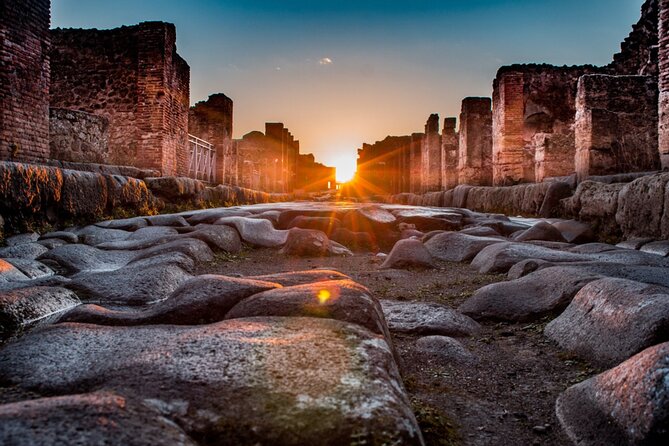
This experience uses the Questo app to turn Pompeii into a city exploration game. At each stop, you read a clue, solve a short challenge, and receive directions to the next part of the route. The story gives you a reason to look closely at details that you might otherwise pass without noticing.
You should expect roughly one hour and 45 minutes to two hours and 15 minutes. The listed stops are often timed at about five minutes each, but that is only a guide. You can pause at several locations and continue exploring at your own speed, which matters at a site as large and open as Pompeii.
This is a private activity in the sense that only your group takes part. You do not join a walking party, wait for a guide, or keep pace with strangers. The tradeoff is that nobody is there to explain a wall painting, answer a historical question, or help if a clue seems unclear.
More Puzzle Walks in Italy
- Milan Da Vinci Mystery: Self-Guided Puzzle Quest
★ 4.0 · 19 reviews - The Magic of Navigli: Self-Guided Puzzle Quest in Milan
★ 5.0 · 7 reviews - Love in Pisa: Self-Guided Romantic Puzzle Adventure
★ 5.0 · 6 reviews
Starting at Porta Marina Superiore
The game begins at the ticket office at Porta Marina Superiore, listed at Via Villa dei Misteri, 2. This is your first practical task: arrive with the app ready and locate the starting point before you begin the story.
The first clue sets the pattern for the rest of the activity. You examine the information on your phone, solve the challenge, and follow the directions to the next location. Since the experience is self-guided, you should allow a little time to get oriented rather than expecting a staff member to lead you through the entrance.
Pompeii can be confusing at first, with several gates, roads, and large sections of ruins. A route-based puzzle is useful here because it gives your visit a clear line. Still, keep your attention on signs and the actual site as well as the phone. It would be a shame to walk through Pompeii staring only at a screen.
From the archaeological park to the Centaur statue

The early part of the route includes the Archaeological Park of Pompeii and the Centauro di Igor Mitoraj. The Mitoraj sculpture provides an unusual contrast to the ancient ruins. You move from a modern artistic figure to the remains of a Roman city, and the clue asks you to study the statue before continuing.
This kind of stop is one reason the game works better than a simple list of directions. You are encouraged to look at a particular object, not just rush toward the next famous building. The challenge is brief, but it can help younger participants stay involved.
The itinerary gives each early stop about five minutes. I would not treat that as a strict limit. If a statue or nearby ruin catches your attention, pause the game and look around. The route is designed to continue at your pace.
The Temple of Jupiter and the House of the Tragic Poet
The Temple of Jupiter brings you into the Forum area, one of the most important public spaces in Pompeii. The clue here helps connect the large open setting with the story you are following. You are not simply checking off another ruin. You are using the space to work out the next move.
The House of the Tragic Poet offers a different kind of stop. Roman houses can be easy to skim if you do not know what to look for, so a clue gives you a specific reason to study the building. The route then continues to the House of the Faun, one of the better-known residences in Pompeii.
You should expect the experience to point your attention in a particular direction, but not to provide a full lesson in Roman domestic life. If you want dates, architectural terms, and detailed explanations of frescoes, mosaics, or household customs, a live guide or a separate audio guide would suit you better.
Same place, a different puzzle:
- Dark Heart of Rome – Facts, Legend & Mystery Walking Tour
★ 4.5 · 329 reviews - Open Air Escape Game in Villa Borghese !
★ 4.5 · 145 reviews - Mostra Leonardo Da Vinci: Rome Treasure Hunt Game
★ 4.7 · 140 reviews - Angels & Demons Rome Scavenger Hunt: The Illuminati Escape Game
★ 4.5 · 103 reviews
The House of the Faun and the Fountain of Silenus
At the House of the Faun, you receive another challenge and can stop for as long as you like. This flexibility is useful because the house is one of the places where you may want extra time to examine the layout and surviving decoration.
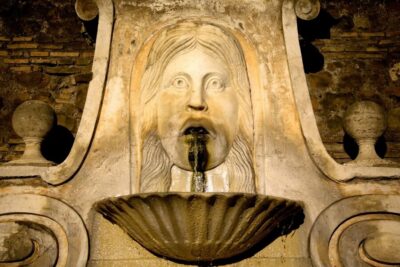
The next stop is the Fountain of Silenus, described as a fountain with a relief of Silenus resting on a wineskin. This is a small detail with a strong visual identity, and the game uses it as a clue point. It is exactly the sort of object that can disappear into the larger site if you are not looking for it.
The game’s route is strongest when it takes you to a specific feature such as this. You get a simple reason to pay attention, and the hunt adds some energy to a long visit. The limitation is that the app cannot adjust its explanation to your interests. If you want to linger, you can. If you want more context, you will need another source.
Bakery, Forum, and Teatro Piccolo
The stop at Via Roma, 36 takes you to a bakery, where you receive another clue. Ancient bakeries are a useful reminder that Pompeii was not only a collection of grand temples and wealthy houses. It was also a working town with food shops, public places, and daily routines.
From there, the route leads to the Foro di Pompei. Take time here to enjoy the view and understand the scale of the central public area. The Forum is one of the places where a rushed puzzle visit could feel too quick, so I would pause the game for a few minutes and take in the surrounding ruins.
The Teatro Piccolo follows. You can explore at your own pace while looking around the small theater. The route does not require a guide to keep you moving, which lets you stop when you want. That freedom is a real benefit for families and private groups, though it also means you must manage your own time carefully.
House of the Ceii and the Thermopolium

At the Casa dei Ceii, the next clue asks you to solve another challenge. This house helps keep the route focused on the private side of Pompeii, after the public spaces of the Forum and theater.
The Casa e Thermopolium di Vetutius Placidus is one of the more distinctive stops. A thermopolium was a Roman food and drink shop, and the site gives you a glimpse of commercial life rather than elite domestic life. The clue sends you onward after you examine the location.
These stops are valuable because they break up the route. You are not walking from one monumental building to another. You see homes, a shop, public spaces, a bakery, and a theater. That variety makes the game feel more like a guided path through a town.
Garden of the Fugitives and the Fontana plaque
The Garden of the Fugitives is an archaeological site where you can stop and take in the setting. The name points to one of Pompeii’s most sobering locations, so this part of the route may feel less playful than the earlier puzzle stops.
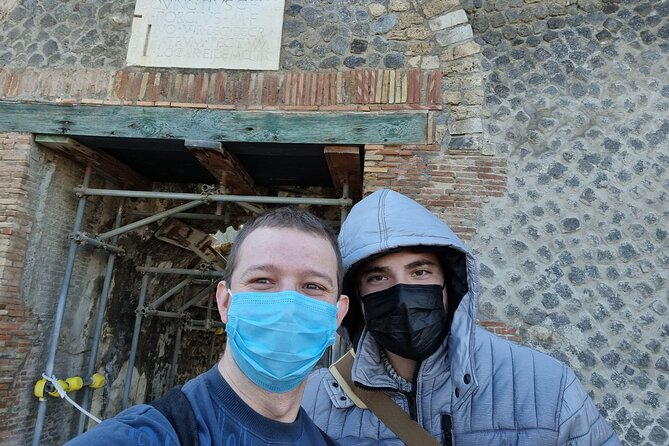
The itinerary also includes the plaque of Domenico Fontana in Pompei. Here, another clue helps you identify the location and continue toward the final stage. The route brings together ancient ruins and a later historical reference, giving you a wider view of how Pompeii was rediscovered and understood over time.
The game does not promise long explanations at either stop. Think of them as visual waypoints within a larger story. If you want to study the site in depth, use the game as a framework and give yourself more time than the stated two-hour average.
Finishing at the Pompeii Amphitheatre
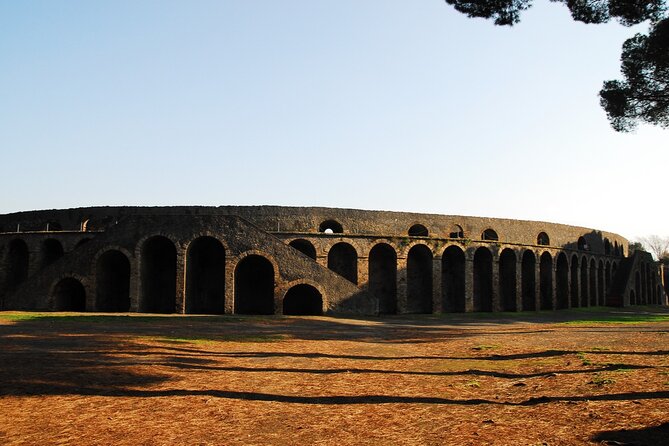
The final stop is the Amphitheatre of Pompeii at Piazza Immacolata. This is where both the story and the city exploration game end. Finishing at the amphitheater gives the route a clear endpoint instead of sending you back to the starting gate.
The end point is useful for planning, but check your onward route before you begin. The start is at Porta Marina Superiore, while the finish is at the amphitheater. The activity does not include transport back to the starting point, and the supplied details do not promise a return transfer.
The listed operating hours are 9:00 a.m. to 3:30 p.m., Monday through Sunday, for the stated operating period. Since Pompeii is open-air and the game involves reading on a phone, an earlier start is likely more comfortable than tackling the route in the strongest midday heat. That is practical advice rather than a separate tour feature, but it can make a real difference.
What the $7.24 price really buys
At $7.24 per person, this is an inexpensive add-on to a Pompeii visit. You are paying for access to the phone game and 24/7 customer support, not for admission, a guide, transportation, or a full historical lecture.
That makes the value easy to judge. If you already plan to enter Pompeii and want a structured activity, the price is modest. It can be especially useful for a private group that wants to explore together without paying for a private guide.
The value is weaker if you expect an expert-led tour. The game supplies clues and directions, but it does not replace a person who can explain the Forum, identify architectural details, or answer questions as they arise. You may also find the format less appealing if you prefer to wander freely.
Group discounts are available, though the exact savings are not specified. Since only your group participates, the activity can work well for friends or families who enjoy solving puzzles together. The price may be low enough to try without making it the main expense of your Pompeii day.
The English-language warning matters
The game is offered in English. This point deserves attention because the booking or app interface may not make the distinction obvious. A Spanish-speaking user could see Spanish in the app or purchase process and assume that the actual game would also be in Spanish, but the supplied information confirms that the game itself is in English.
That is not a minor detail. You need to read clues and understand word-based challenges. If your English is limited, solving the game in hot weather could become frustrating rather than fun. Check the language before paying, especially if the person using the phone is not comfortable reading English.
The strongest positive feature of the experience is its ability to make Pompeii feel active. A direct description of the game praised its fun way of reaching the main attractions, and that is the central appeal. Just be clear about what you are buying: a self-guided puzzle route in English, not a multilingual guided tour.
Who should choose this Pompeii game
I would recommend it most to families with older children, couples, friends, and independent visitors who enjoy a challenge. The private format lets you talk, pause, take photos, and explore without worrying about a guide’s schedule.
It is also a good fit if you have already read about Pompeii and want a route that gives your visit momentum. The game touches many familiar highlights while also sending you to smaller points such as the Fountain of Silenus and the bakery.
I would hesitate to recommend it as your only source of information if Pompeii is a major historical priority. You will get directions and puzzle prompts, but the provided details do not include a live historian, audio narration, or detailed explanations at every stop. In that case, consider pairing the game with another guidebook or an official information source.
You should also be comfortable using a smartphone for nearly two hours. Phone battery, mobile access, and your ability to read in bright sun all matter, though the experience details do not specify technical requirements beyond using the Questo app.
Should you book Escape from Pompeii?
Book it if you want an affordable, private way to add structure and play to a Pompeii visit. The route covers a strong range of sights, runs for about two hours, and lets you move at your own pace. The main praise is deserved: solving clues can make the major attractions feel connected rather than scattered across a huge ruin field.
Skip it if you want a guide, a detailed history lesson, or a game in Spanish or another language. Buy your Pompeii entry ticket separately, confirm that English works for everyone in your group, and try to start within the listed 9:00 a.m. to 3:30 p.m. window. With those points clear, the low price makes this a sensible choice for puzzle fans and a less suitable one for visitors seeking traditional guided commentary.
FAQ
How long does the Pompeii mystery game take?
The estimated duration is about one hour and 45 minutes to two hours and 15 minutes.
Where does the activity begin?
It begins at the ticket office at Porta Marina Superiore, listed at Via Villa dei Misteri, 2, 80045 Pompei, Italy.
Where does the game finish?
The activity finishes at the Amphitheatre of Pompeii at Piazza Immacolata, 80045 Pompei, Italy.
Is a tour guide included?
No. This is a self-guided city exploration game played through the Questo app.
Is the game available in Spanish?
The supplied tour information says the game is offered in English. The app or booking process may appear in another language, so confirm the game language before booking.
Are Pompeii entry tickets included?
No. Entry tickets are not included in the price.
How much does the experience cost?
The listed price is $7.24 per person. Group discounts are available, but the exact discount is not specified.
Can I explore at my own pace?
Yes. At several stops, including the House of the Faun and Fountain of Silenus, you can stop as long as you like and continue when ready.
Can I cancel for a full refund?
Yes, if you cancel at least 24 hours before the experience start time. Cancellations made less than 24 hours before the start time are not refunded, and changes within that period are not accepted.
More Self-Guided Tours in Italy
- Florence Self-Guided Treasure Hunt & Medici Mystery Walking Tour
★ 5.0 · 69 reviews - Siena Medieval Power Quest: Self-Guided Family Feud Game
★ 4.5 · 38 reviews - Florence Inferno: Dante’s Haunted Exploration Game and Tour
★ 4.5 · 33 reviews - Bologna Secrets Quest: Self-Guided Hidden Gems Adventure
★ 4.0 · 24 reviews
Just added around Italy
- Verona Scavenger Hunt and Highlights Self Guided Tour★ 4.0 · 17 reviews
- Verona Scavenger Hunt and Highlights Self Guided Audio Tour★ 4.5 · 7 reviews
- Venice Highlights Self Guided Scavenger Hunt and Walking Tour★ 4.0 · 6 reviews
- CITY QUEST VENICE: reveal the mysteries of this city!★ 3.5 · 4 reviews
- Venice Cannaregio Scavenger Hunt and Sights Self-Guided Tour★ 3.5 · 3 reviews
- Venice: Casanova Charm Carnival Treasure Hunt★ 4.5 · 9 reviews
- Carnival Treasure Hunt & Mask Painting Workshop★ 4.5 · 7 reviews
- Turin Scavenger Hunt and Sights Self-Guided Tour★ 5.0 · 2 reviews
Italy Escape Games, compared.
Dark Heart of Rome – Facts, Legend & Mystery Walking Tour
Read our review →

Mostra Leonardo Da Vinci: Rome Treasure Hunt Game
Read our review →
Angels & Demons Rome Scavenger Hunt: The Illuminati Escape Game
Read our review →

Florence Self-Guided Treasure Hunt & Medici Mystery Walking Tour
Read our review →

Private Venice Family Tour with Saint Mark’s & Doge’s Palace
Read our review →Browse the lists this tour appears in