
Review · UK
Glasgow Ghost Hunt: The Soul That Got Away Exploration Game
Glasgow’s Soul That Got Away turns the city center into a puzzle board. You follow clues by phone from Glasgow Central to George Square, passing grand buildings, shopping streets, old commercial districts, and a few spots with darker stories. It is part ghost tale, part walking tour, and part scavenger hunt.
I like the very low price and the freedom to start whenever you wish, stop for a drink, and carry on later. I also like the route, which gives you a reason to notice places you might otherwise hurry past, including the old station area, the Lighthouse, and Merchant City.
The main catch is the app-dependent format. Some players have had trouble signing in or entering correct answers, while others found the ghost material lighter than expected. Bring a charged phone, allow patience for the puzzles, and think of this as a history walk with a supernatural wrapper rather than a traditional ghost tour.
Key points at a glance

- Start at Glasgow Central Station: Begin beneath the station’s impressive glass roof and investigate stories tied to its former vaults, catacombs, and disused platforms.
- Follow an eight-stop city route: Walk from Central Station through the Lighthouse, House of Fraser, Tron Theatre, Merchant City, Buchanan Street, the City Chambers, and George Square.
- Use your phone as the guide: The Questo app supplies directions, clues, puzzles, and customer support, so no guide leads the group in person.
- Set your own pace: The game is listed at about 90 minutes, but a pub stop, shopping break, weather, or wrong turns can make it longer.
- Expect history more than frights: The ghost theme adds mood and riddles, but the actual content often focuses on buildings, streets, local stories, and Glasgow’s past.
- Pay about $6 per person: That is strong value for a private activity, though you should factor in the need for a working phone and a willingness to solve clues.
Starting beneath Glasgow Central’s great roof
Your first checkpoint is Glasgow Central Station on Gordon Street, the city’s busiest railway station. Its Victorian architecture and broad glass roof give you an immediate sense of Glasgow’s scale, but the game asks you to look below the polished public areas.
The opening story points toward the hidden world beneath the station: old vaults, catacombs, and disused platforms. You are not required to enter restricted areas or buy a train ticket. Instead, you examine your surroundings and search for the first clue.
This is a smart starting point because Glasgow Central is easy to reach by public transport and simple to identify. It also gives the game a proper sense of place from the first few minutes. You are not merely walking from one random coordinate to another. You are being asked to notice how a working railway station contains layers of older city life beneath it.
The first puzzle sets the tone. You need to read, look around, and enter an answer into the app. That can be fun for families and small groups, but it also reveals the game’s weak point. The answer system may be exacting. One incorrect entry, such as adding an extra word after the intended answer, has caused trouble for some players.
More City Exploration Games in the UK
- Bristol Street Art: Banksy Exploration Game and Tour
★ 3.5 · 39 reviews - Birmingham Ghost Hunt: Haunted Self-Guide Tour & Quest
★ 4.5 · 37 reviews - Manchester Haunt Quest: Solve the Mystery of the Pusher
★ 4.0 · 34 reviews
The Lighthouse and Glasgow from above
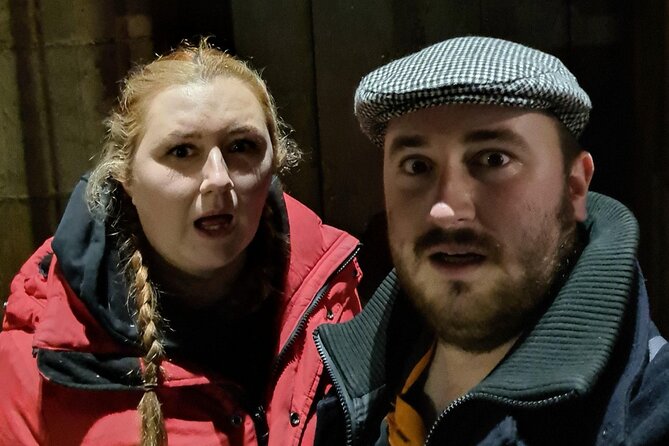
The route next leads to the Lighthouse, Scotland’s Centre for Design and Architecture. It is not a maritime lighthouse, despite the name. This building promotes design and architecture and offers views across central Glasgow from its upper levels.
The stop gives the walk a welcome change of mood. At the station, your attention is directed downward toward what once lay below the city. At the Lighthouse, you look outward and upward. If you can access the viewpoint during your visit, the city view helps you connect the next streets and landmarks.
The puzzle here uses the building’s setting and asks you to search your surroundings for a less cheerful secret. You do not need an entry ticket to complete the game, so the tour does not depend on going inside every attraction. That matters if you are visiting at a closed time or prefer to keep moving.
Still, do not expect a long architectural visit at each checkpoint. The app gives you a prompt, a story, and a task. You then continue along the route. If you want detailed information about Glasgow architecture, plan to read more elsewhere or visit the Lighthouse separately.
House of Fraser and the first shopping detour
House of Fraser brings the game into a very different setting. The department store began in Glasgow as a small drapery business founded by Hugh Fraser and James Arthur in 1849 before growing into a national chain.
The clue here plays with the idea of shopping in the afterlife. You may need to inspect the building or nearby surroundings and answer a question about ghosts still looking for retail therapy. It is a lighter moment, and that helps prevent the walk from becoming a string of gloomy tales.
One practical point is worth noting. A route issue has sent some players toward the back of the building when the clue seemed to require the front. Keep an eye on the actual building and street layout rather than following the map blindly. If the location appears wrong, step back and check the surrounding streets before submitting an answer.
This stop also shows why the activity works best with two or more people. One person can read the app while another checks the building, signage, or nearby details. With a family, children can take turns spotting clues, though younger players may need help with the history and exact answer wording.
Tron Theatre brings a playful mid-route challenge
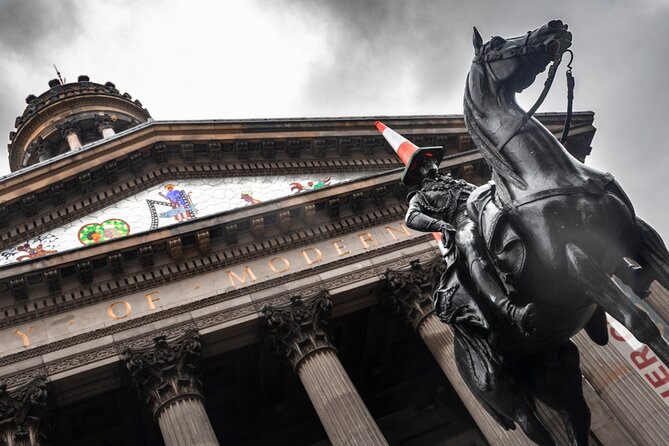
At the Tron Theatre, the game shifts from shopping and architecture to performance. The Tron has played an important part in Glasgow’s cultural life for more than two decades, with theatre, dance, comedy, music, and new writing on its programme.
The challenge here encourages you to warm up your voice, prepare your moves, and interact with the surroundings in a playful way. This is not a guided performance, so you will not be watching a show as part of the ticket. Instead, the theatre provides the setting for a small task in the app.
I like this kind of variety. A walking game can become repetitive when every checkpoint asks you to read a paragraph and type an answer. The Tron stop gives your group a chance to do something different, even if you keep the antics fairly low-key in a public street.
It also makes clear that this is not designed as a solemn historical lecture. The tone can be silly, theatrical, and occasionally spooky. If you want serious accounts of Glasgow’s supernatural past at every stop, you may find the approach too light.
Same place, a different puzzle:
- Fun, Flexible Treasure Hunt Around Manchester with Cryptic Clues & Hidden Gems
★ 5.0 · 253 reviews - Fun, Flexible Treasure Hunt Around York with Cryptic Clues & Hidden Gems
★ 5.0 · 248 reviews - Fun, Flexible Treasure Hunt Around Bath with Cryptic Clues & Hidden Gems
★ 5.0 · 208 reviews - York Treasure Hunt Adventure: The Mystery of The Gunpowder Snitch
★ 5.0 · 203 reviews
Merchant City and Glasgow’s tobacco-lord past
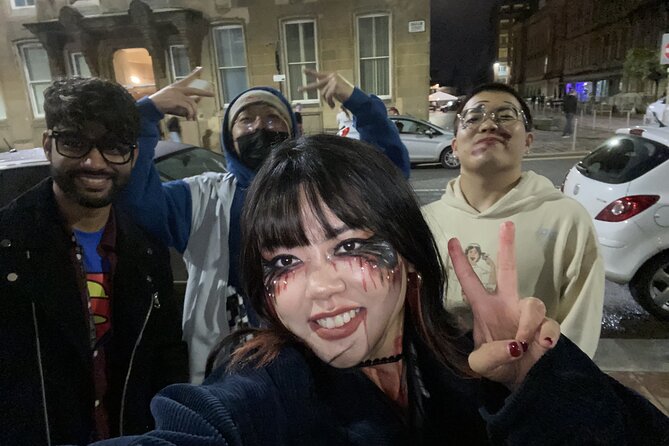
The route then reaches Merchant City, one of the most atmospheric parts of central Glasgow. In the 18th century, merchants traded goods such as tobacco, sugar, and tea, and wealthy tobacco lords helped shape the area.
Today, Merchant City has bars, restaurants, boutiques, galleries, festivals, street art, dance, comedy, and live music. The game uses the contrast between its commercial past and modern social life to ask you to search for its unspoken stories.
This is one of the strongest parts of the route for ordinary sightseeing. Even if you lose interest in a particular riddle, you are walking through an area with plenty to notice. You can pause for food or a drink, then continue when ready. The flexible format makes that possible without a guide waiting for the group.
A stop here can also change the final duration. The advertised time is about 90 minutes, but a pub break has stretched the walk closer to two hours for some groups. That is not a problem if you plan an open evening. It matters more if you have a train, dinner booking, or theatre seat soon afterward.
Buchanan Street adds architecture, shops, and street life
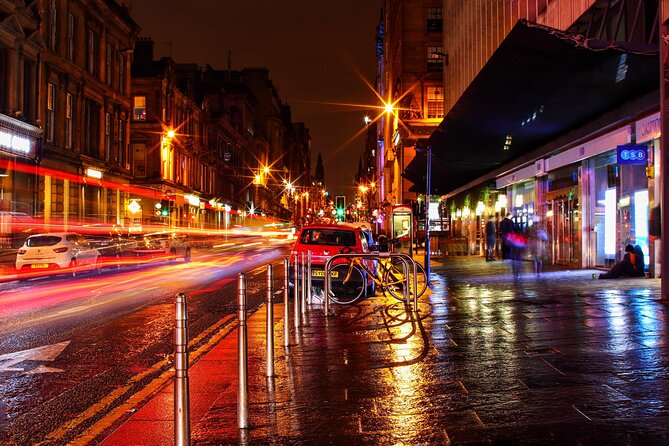
Buchanan Street is Glasgow’s main pedestrian shopping boulevard. It dates from 1777 and takes its name from Andrew Buchanan, a wealthy tobacco merchant who later lost his property during difficult financial times.
The street now combines grand architecture, upmarket shops, restaurants, and street performers. Its open pedestrian layout makes it an easy section for a self-guided activity. You can walk at a relaxed pace without worrying about traffic in the central stretch, though you should still watch for crowds and crossings at the ends.
The clue here asks you to answer questions about the street and its past. This is a good example of the game’s basic formula: the app sends you to a real place, gives you a small historical detail, then turns observation into a puzzle.
Do not expect the ghost story to dominate. Buchanan Street is more about the city’s commercial character and its public life than about a frightening encounter. If you enjoy learning why a street looks and functions as it does, you will get more from this stop than someone seeking theatrical scares.
The City Chambers and its grand public rooms
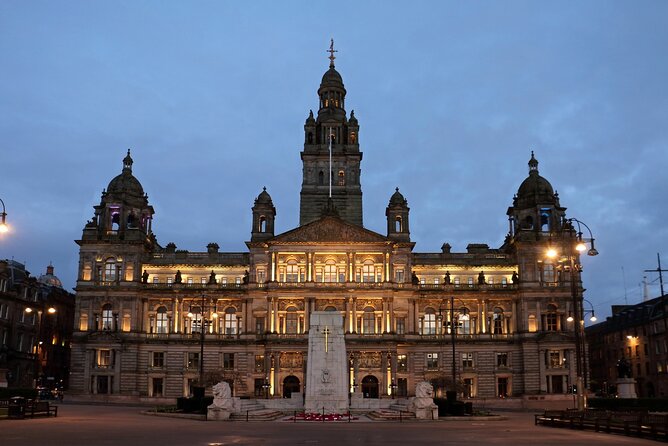
The City Chambers at George Square is one of Glasgow’s most important civic buildings. Queen Victoria inaugurated it in 1888, and the building is associated with elaborate interiors, public ceremonies, and Glasgow’s civic identity.
The stop draws attention to the statue of Queen Victoria outside, sometimes called Glasgow’s own Statue of Liberty. It also references the building’s large marble staircase and Banqueting Hall, where Nelson Mandela received the Freedom of the City award in 1993.
You can complete the game without buying entry tickets, so the activity does not require a formal interior visit. That keeps the price low and the timing flexible. If the building is open and you want to see more, you can treat that as a separate part of your Glasgow visit.
The puzzle here is a useful reminder to read the app carefully. You may be walking near a major landmark, but the answer could depend on a specific statue, architectural detail, or fact in the surrounding area. Take a moment before entering your response. Guessing quickly can cost time if the system is strict.
George Square provides a fitting finish
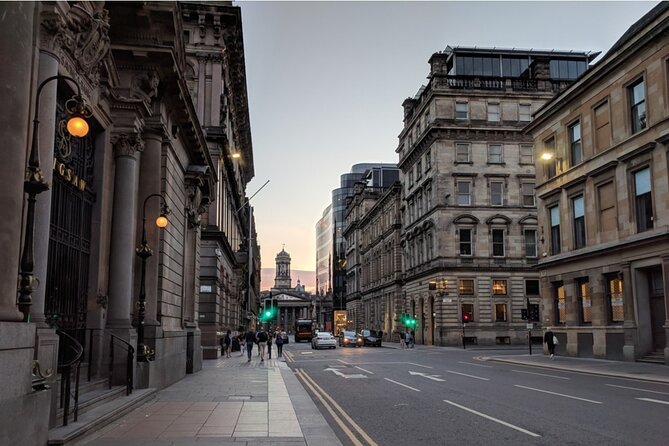
The final checkpoint is George Square, named for King George III. The square contains monuments to figures including Robert Burns, James Watt, Sir Robert Peel, and Sir Walter Scott.
It is an effective ending because the route finishes in a broad civic space rather than a side street or obscure corner. You can pause, look back at the route, and decide where to go next. West George Street is the stated endpoint, close to central transport, shops, restaurants, and other city sights.
The final question completes the story of Glasgow changing from a muddy hollow into a major civic and commercial center. The game’s supernatural thread remains present, but the larger subject is the city itself and the people, buildings, and trade that shaped it.
If you are hoping for a dramatic final scare, keep your expectations modest. The reward is more likely to be the satisfaction of solving the last clue and seeing how the route connects the city center than a staged ghostly event.
What the $6 price really gives you
At about $6 per person, this is one of the cheaper ways to add structure to a Glasgow walk. Your payment covers the mobile game, route directions, puzzles, and customer support. You are not paying for a physical guide, a vehicle, or entry to attractions.
That low cost makes the activity especially useful for:
- Families wanting a simple challenge around central Glasgow
- Couples looking for a short evening activity
- Friends with spare time between bookings
- Independent visitors who dislike fixed tour schedules
- Groups who want to see several central areas without joining a public tour
The value drops if the app does not work properly or if your group has little patience for puzzles. Several technical problems have been reported, including difficult sign-in, access problems on one phone, and answers being marked wrong because of wording. Download and open the app before you reach the start point, and make sure the person using it has a charged phone and a reliable data connection.
Only one phone may be needed to play as a group, but the booking information is priced per person. If you are booking for several people, check the current group terms before paying. Groups larger than 15 should make multiple bookings.
Timing, weather, and practical planning
The game can be started at any time after booking and does not require rescheduling for a particular departure. That is its biggest practical advantage. You can begin after breakfast, pause for lunch, or hold it for an evening when your plans change.
The listed duration is about one hour and 30 minutes. I would allow closer to two hours if you expect to stop at a pub, browse shops, take photos, or solve clues slowly. Heavy rain can also end the activity early, since this is an outdoor walking route.
The route starts at Glasgow Central Station, Gordon Street, Glasgow G1 3SL, and finishes on West George Street, Glasgow G1 2AF. It is near public transport, and most people can participate. Service animals are allowed.
The activity is private to your group, which is useful if you do not want to solve clues in front of strangers. It also lets you set the tone. A family can treat it as a gentle riddle walk, while friends can make the theatrical prompts as silly as they like.
Who should book the Soul That Got Away?
I would choose this for someone who wants an inexpensive way to see central Glasgow while doing more than following a list of landmarks. The strongest parts are the route, the freedom to pause, and the way the puzzles encourage you to inspect buildings and streets.
Families can get good value from it. The clues are generally suitable for children, and a ten-year-old can take an active role in solving them. It also works for adults who enjoy scavenger hunts and city games.
I would not make it my first choice for someone seeking a traditional ghost tour with a storyteller, a strong atmosphere, and detailed supernatural accounts. The ghost theme is present, but much of the content concerns local history, architecture, shopping streets, theatres, and civic buildings.
You should also avoid booking it in a rush before a fixed appointment. App problems, exact answer entry, weather, and optional stops can all make the route take longer than expected.
Should you book this Glasgow ghost hunt?
Book it if you want a cheap, flexible city walk with puzzles and a spooky theme. At $6, the risk is small, and the route covers several central areas that are worthwhile even without the game.
Skip it if you dislike smartphone-led activities, expect a professional guide, or want ghost stories at every stop. For the best chance of a smooth outing, test the app before starting, use one fully charged phone, read each clue closely, and leave extra time for breaks.
The Soul That Got Away is best understood as a Glasgow sightseeing game with ghosts around the edges. Take it on those terms, and it can turn a spare hour and a half into a playful look at the city center.
FAQ
How long does the Glasgow Ghost Hunt take?
The advertised duration is approximately one hour and 30 minutes. Your group can take longer if you stop for a drink, browse shops, pause for photos, or need extra time with the clues.
Where does the activity start and finish?
It starts at Glasgow Central Station on Gordon Street, Glasgow G1 3SL. The final checkpoint is on West George Street, Glasgow G1 2AF, near George Square.
Is there a physical tour guide?
No. This is a self-guided activity played through the Questo smartphone app. The app provides directions, clues, and customer support.
Do I need to pay entry fees at the stops?
No entry tickets are needed to complete the game. Attraction admission is not included, but the route can be completed without entering the attractions.
Can I pause and restart the game?
Yes. You can start after booking, take a break, and continue at your own pace without rescheduling the activity.
What happens if I need to cancel?
You can receive a full refund if you cancel at least 24 hours before the scheduled start time. Cancellations or changes made within 24 hours are not refunded or accepted.
More Self-Guided Tours in the UK
- Houdini’s Golden Handcuffs Leeds Self-Guided Treasure Hunt
★ 5.0 · 29 reviews - Liverpool Ghost Hunt: Paranormal Detective Self-Guided Game
★ 4.5 · 26 reviews - Ghosts of Edinburgh: Bloody Past Exploration Game and Tour
★ 4.0 · 25 reviews - Scholars & Secrets of Cambridge: Self-Guided Puzzle Adventure
★ 3.5 · 19 reviews
Just added around the UK
- Stratford-upon-Avon: Self-Guided Walk & Interactive Treasure Hunt★ 5.0 · 2 reviews
- Pedal & Puzzle, Outdoor Escape Room E-Bike Adventure★ 5.0 · 2 reviews
- Immersive Murder Mystery in Sheffield – Outdoor Escape Experience★ 4.5 · 15 reviews
- Adventurous Scavenger Hunt in Exeter by Operation City Quest★ 3.0 · 2 reviews
- Operation City Quest Scavenger Hunt – Peterborough, UK★ 3.0 · 4 reviews
- Oxford’s Famous Alumni: Self-Guided Story Puzzle Walk★ 4.0 · 2 reviews
- Oxford Scavenger Hunt and Sights Self-Guided Tour★ 4.5 · 3 reviews
- Fun and Flexible Treasure Hunt Around Nottingham with Hidden Gems★ 5.0 · 10 reviews
UK Escape Games, compared.

Fun, Flexible Treasure Hunt Around Manchester with Cryptic Clues & Hidden Gems
Read our review →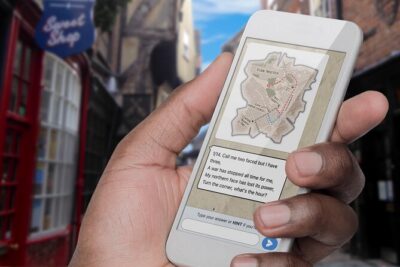
Fun, Flexible Treasure Hunt Around York with Cryptic Clues & Hidden Gems
Read our review →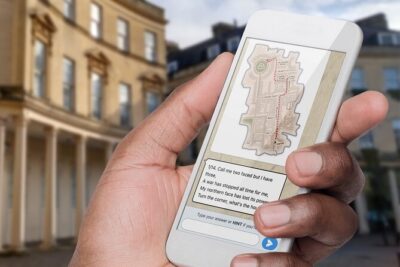
Fun, Flexible Treasure Hunt Around Bath with Cryptic Clues & Hidden Gems
Read our review →York Treasure Hunt Adventure: The Mystery of The Gunpowder Snitch
Read our review →
Fun, Flexible Treasure Hunt Around Oxford with Cryptic Clues & Hidden Gems
Read our review →
Interactive Jack the Ripper Night Walk: London’s Murder Mystery
Read our review →
Fun, Flexible Treasure Hunt Around Birmingham with Cryptic Clues & Hidden Gems
Read our review →Browse the lists this tour appears in