
Review · ITALY
Trieste Exploration Game and City Tour on your Phone
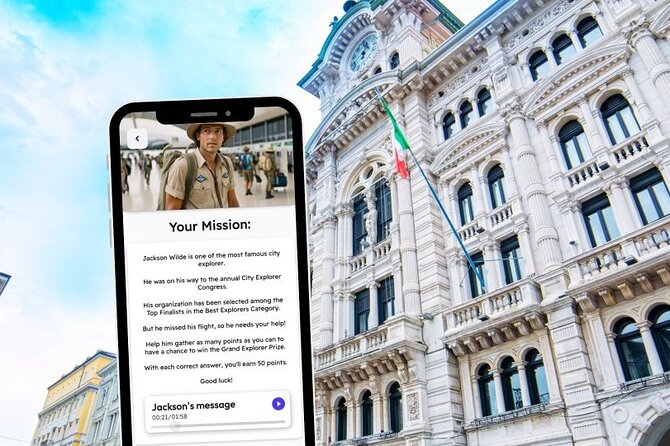
Trieste’s story is packed into a compact walk, and this phone-based exploration game links Roman ruins, Habsburg-era squares, an Orthodox church, and the waterfront in one clear route. You begin near Saint Giusto Cathedral and finish back at the same meeting point.
I like the very low price, which gives you a useful route and background notes for $9.66. I also like the quizzes. They turn a simple city walk into a small challenge, especially when you want more structure than wandering with a map.
The catch is simple: this is not a guided tour and not an audio tour. You read the material on your own device, and entry fees for the castle, theater, and church are not included, so you need to plan for a self-directed visit.
Key points at a glance
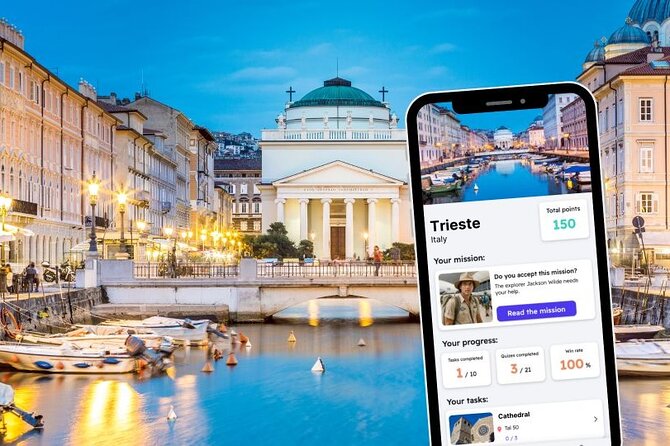
- Eight central Trieste stops: See Saint Giusto Castle, Roman remains, grand civic squares, an Orthodox church, and Canal Grande.
- Quiz-led sightseeing: Short questions help you pay attention to the buildings and monuments around you.
- Flexible start time: The activity is listed as available daily from midnight to 11:30 p.m.
- Four language choices: Use the experience in English, French, German, or Spanish.
- Low-cost planning help: At $9.66 per person, it costs far less than most in-person city tours.
- No guide or audio narration: You need your own phone and must read the content as you go.
Starting at Saint Giusto above the city
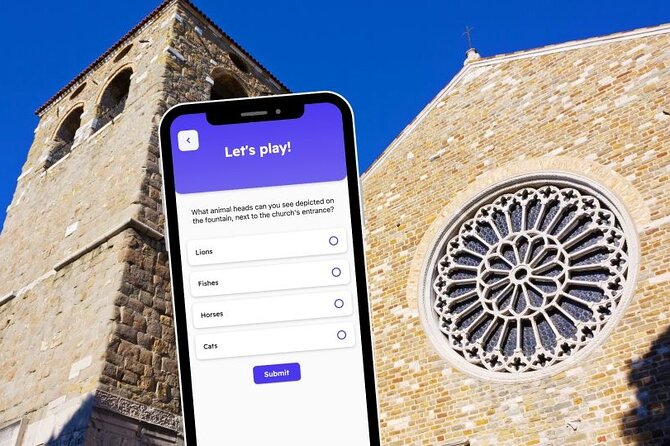
The activity begins at Cattedrale di San Giusto Martire, at Piazza della Cattedrale 2. That puts you beside one of Trieste’s most important historic areas and near the first stop, Saint Giusto Castle.
The castle was built in stages from the 15th through the 17th century on the site of earlier Roman fortifications. That layering gives you a quick lesson in how Trieste developed: Roman defenses came first, then later rulers reshaped the hill for military use.
The suggested time here is 15 minutes, which is enough for a short look and some photos. It is not enough for an unhurried visit to every part of the site. Admission is not included, so check the cost before you decide how much time to give the castle.
I like beginning here because the route starts with Trieste’s oldest defensive setting rather than dropping you straight into modern streets. You get the city’s high ground first, then move down toward Roman remains, civic buildings, and the canal.
More City Exploration Games in Italy
- Siena Medieval Power Quest: Self-Guided Family Feud Game
★ 4.5 · 38 reviews - Florence Inferno: Dante’s Haunted Exploration Game and Tour
★ 4.5 · 33 reviews - Bologna Secrets Quest: Self-Guided Hidden Gems Adventure
★ 4.0 · 24 reviews
Roman Trieste in two brief stops
The Arco di Riccardo is one of the oldest surviving structures in Trieste. It dates to the Roman period, around the 1st century BCE, and the stop gives the city’s later squares a useful point of comparison.
The arch is a short visit, listed at 15 minutes, and admission is free. The app’s quiz format should work well here because a small monument can be easy to pass without noticing. A question or two gives you a reason to stop and look closely.
Next comes the Roman Theatre of Trieste, built in the 1st century AD during the reign of Emperor Augustus. It could hold between 3,500 and 6,000 spectators, a reminder that Roman Trieste was not a minor outpost with only a few scattered buildings.
Again, the suggested visit is 15 minutes and admission is free. You should think of this as a focused stop rather than a full archaeological visit. The route gives you the basic setting and prompts you to inspect the remains, but it does not replace an extended visit with a specialist guide.
Together, the arch and theater make one of the best parts of the activity. They are free to see, close enough to fit into a walking route, and different enough to keep the first part from feeling repetitive.
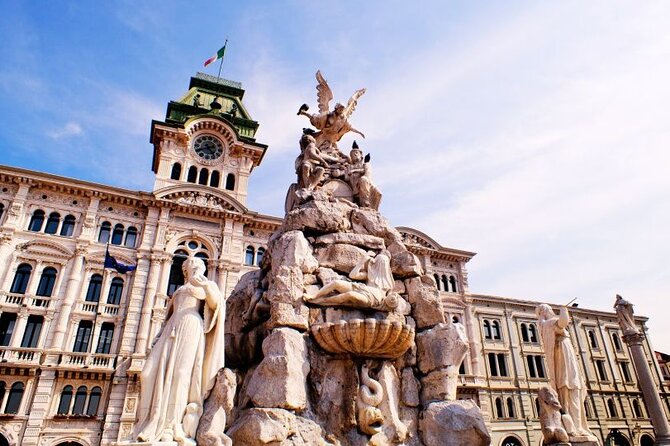
Piazza dell’Unita d’Italia and the city’s grand face
Piazza dell’Unita d’Italia shifts the mood from ancient stone to imperial city planning. The square has been part of Trieste’s urban life since the 19th century, and its name refers to the unification of Italy and Trieste’s incorporation into the Kingdom of Italy in 1918.
The stop is listed at 15 minutes, with no admission fee. That is a sensible amount of time for taking in the square and reading the app’s notes, though you may want longer if you enjoy architecture or people-watching.
This is where the route helps you connect Trieste’s political story with its physical setting. The city was shaped by Roman rule, the Habsburg period, Italian unification, and its role as a major port. You do not need a long lecture to see those layers, but a few well-placed facts make the square more meaningful.
The game format also keeps the stop from becoming a passive photo break. You are asked to notice details, then answer questions. That small task can help you remember the square after the walk is over.
Teatro Lirico Giuseppe Verdi and Piazza della Borsa
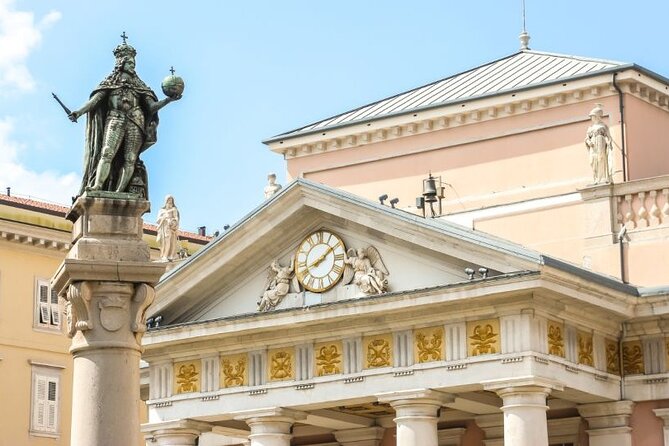
The Teatro Lirico Giuseppe Verdi opened in 1801 as the Teatro Nuovo. It was renamed for Giuseppe Verdi in 1901 and is one of Italy’s oldest opera houses.
The route allows 15 minutes here, but theater admission is not included. The activity gives you a city-center introduction, not a performance or a behind-the-scenes visit. If you want to attend a show, you would need to arrange that separately.
This is a useful stop for understanding Trieste’s cultural links with Italy and the wider Habsburg world. An opera house of this age points to a city with money, trade, and a strong public life. The app can give you the basic facts without asking you to commit to a formal theater visit.
Piazza della Borsa follows, also with a 15-minute suggested stop and free admission. The square has been a center of economic and social activity since the 19th century. Its name comes from the Borsa Vecchia, or Old Stock Exchange, building.
I like the pairing of these two stops. The theater shows the city’s cultural ambitions, while Piazza della Borsa shows its commercial side. You get a fuller picture of Trieste by moving between them instead of treating the center as a collection of unrelated buildings.
Same place, a different puzzle:
- Dark Heart of Rome – Facts, Legend & Mystery Walking Tour
★ 4.5 · 329 reviews - Open Air Escape Game in Villa Borghese !
★ 4.5 · 145 reviews - Mostra Leonardo Da Vinci: Rome Treasure Hunt Game
★ 4.7 · 140 reviews - Angels & Demons Rome Scavenger Hunt: The Illuminati Escape Game
★ 4.5 · 103 reviews
Saint Spyridon and Trieste’s wider identity
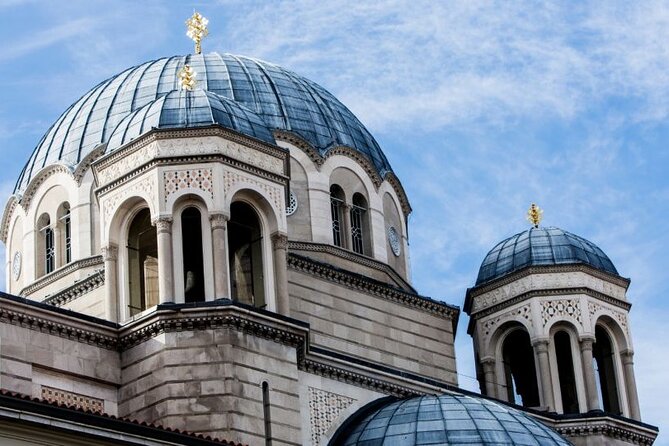
The Serbian Orthodox Church of Saint Spyridon adds another important voice to the route. It was built between 1861 and 1869 for Trieste’s Serbian Orthodox community, which played a major role in the city’s commercial and cultural life during the 18th and 19th centuries.
The church stop lasts about 15 minutes, and entry is not included. That matters if you want to go inside. The app can introduce the building and its community, but a short self-guided stop may not provide the same detail as a specialist visit.
Still, this is one of the most valuable parts of the route because it moves beyond the usual Roman and Italian highlights. Trieste’s position as a major port brought different communities into the city. Saint Spyridon helps you see that the city’s identity was shaped by trade and migration as well as by rulers and monuments.
The stop also gives the route a useful change of pace. After castles, ruins, squares, and an opera house, the church asks you to think about faith, community, and the people who helped build Trieste’s economy.
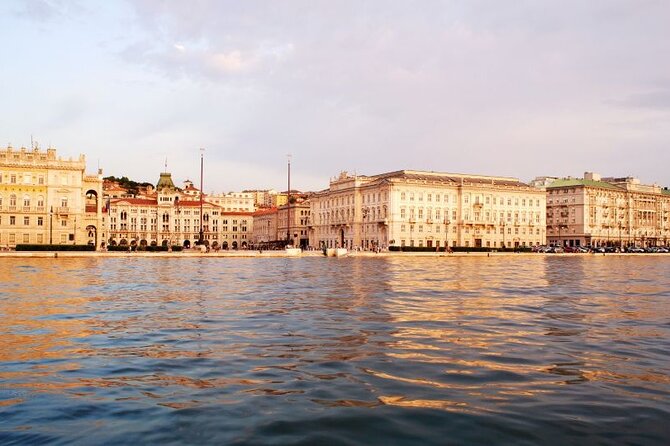
Canal Grande closes the route by the water
The final stop is Canal Grande, constructed between 1754 and 1756 when Trieste was a free port under the Habsburg Empire. Admission is free, and the suggested visit is 15 minutes.
Ending here makes good sense. The canal brings the route back to Trieste’s port-city character after the earlier stops have explained its military, Roman, political, cultural, and religious past. It is a simple final chapter: the city grew because ships, merchants, and goods came through this part of the Adriatic world.
The activity ends back at the original meeting point. Since the route is listed at roughly one to two hours, the timed stops give you a brisk framework. If you enter the paid sites, pause for photographs, or stop for food, your outing will take longer. One useful way to treat the game is as a compact route that can also guide a longer half-day walk.
How the phone game works
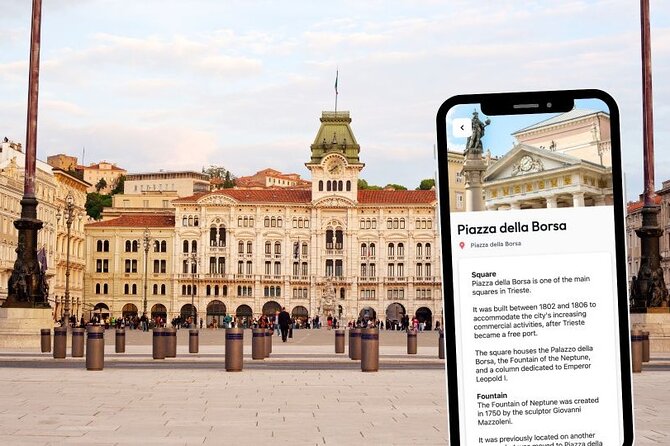
You can use the activity through an Android or iOS app, or in a browser. That choice is practical. If you do not want another app on your phone, the browser option may be enough, though you should make sure your phone is ready before setting off.
The material includes guides and quizzes for each monument. This is different from an audio tour. You will read the information and answer questions yourself, so headphones are not required, but your attention is.
The quiz element is the main reason to choose this over a basic route map. A map tells you where to go. A quiz asks you to notice what is in front of you. The questions are also useful for families, couples, or friends who want a little competition without joining a large group.
The content is available in English, French, German, and Spanish. That makes the activity more useful for international visitors, though the supplied information does not identify individual guides or describe the length of each written explanation.
What $9.66 buys you
At $9.66 per person, this is priced as a low-cost city orientation rather than a full guided experience. You are paying for a ready-made route, monument information, and interactive questions. You are not paying for a person to lead you, an audio recording, transportation, or entrance tickets.
That is good value if you already prefer independent sightseeing. You can cover eight carefully chosen stops without spending much time deciding where to go next. The route also saves you from piecing together Roman sites, civic squares, and religious buildings on your own.
The value is weaker if you want detailed interpretation, spontaneous questions, or help entering the paid monuments. A local guide could explain the city’s mixed Italian, Roman, and Habsburg past in greater depth. This activity gives you structure, but you must supply the pace and curiosity.
The low price also means you can use it as a first walk around Trieste, then decide which places deserve a second visit. That may be the smartest approach if you have limited time and want to get your bearings before choosing where to spend admission money.
Timing, meeting point, and practical details
The activity is available Monday through Sunday from 12:00 a.m. to 11:30 p.m. The broad time window gives you plenty of freedom, though daylight and opening hours matter for the sites that require admission.
Your confirmation arrives at booking. The experience is private, meaning only your group participates. That does not mean you get a personal guide. It means you complete the route with your own group, using the phone-based material.
Most people can take part, and service animals are allowed. The route is near public transportation, which is useful if you are approaching the cathedral from elsewhere in Trieste.
Free cancellation is available if you cancel at least 24 hours before the scheduled start time. Cancellations inside that window are not refunded, and changes made within 24 hours are not accepted. The cut-off follows Trieste local time.
Who will get the most from this activity
I would choose this for an independent visitor who wants a clear plan but does not need someone walking beside them. It suits solo visitors, couples, families, and small private groups who enjoy short challenges and do not want to commit to a fixed guided departure.
It is also a good match for anyone watching costs. The price is modest, the free stops make up much of the route, and you can decide for yourself if the paid sites are worth entering.
You may want something else if you prefer spoken commentary, detailed historical discussion, or help with local questions. Since this is not an audio tour, you need to look at your phone during the walk. That can be less convenient on busy streets or when you want to focus fully on the architecture.
Should you book the Trieste exploration game?
Book it if you want an inexpensive, flexible route through Trieste’s main historic center, with enough information to make the walk more than a checklist. The Roman theater, Saint Giusto Castle, Piazza dell’Unita d’Italia, Saint Spyridon, and Canal Grande give you a strong range of subjects in a short outing.
Skip it if you need a live guide or expect entrance tickets to be covered. For everyone else, $9.66 is a reasonable price for a self-guided introduction, especially if the quiz format sounds more appealing than simply following a map.
FAQ
Where does the Trieste exploration game start?
It starts at Cattedrale di San Giusto Martire, Piazza della Cattedrale 2, 34121 Trieste, Italy.
Where does the activity end?
The activity ends back at the original meeting point.
How long does the activity take?
The estimated duration is approximately one to two hours.
Is a personal guide included?
No. This is a self-guided phone activity, and only your group participates.
Is this an audio tour?
No. The experience provides written guides and quizzes on your phone, but it is not an audio tour.
Which languages are available?
The activity is available in English, French, German, and Spanish.
Are entrance tickets included?
No. Admission fees are not included for Saint Giusto Castle, Teatro Lirico Giuseppe Verdi, or the Serbian Orthodox Church of Saint Spyridon. Free admission is listed for the Arco di Riccardo, Roman Theatre of Trieste, Piazza dell’Unita d’Italia, Piazza della Borsa, and Canal Grande.
More Self-Guided Tours in Italy
- Florence Self-Guided Treasure Hunt & Medici Mystery Walking Tour
★ 5.0 · 69 reviews - Venice Scavenger Hunt and Highlights Self Guided Audio Tour
★ 4.5 · 20 reviews - Milan Da Vinci Mystery: Self-Guided Puzzle Quest
★ 4.0 · 19 reviews - Verona Scavenger Hunt and Highlights Self Guided Tour
★ 4.0 · 17 reviews
Just added around Italy
- Verona Scavenger Hunt and Highlights Self Guided Tour★ 4.0 · 17 reviews
- Venice Highlights Self Guided Scavenger Hunt and Walking Tour★ 4.0 · 6 reviews
- Verona Scavenger Hunt and Highlights Self Guided Audio Tour★ 4.5 · 7 reviews
- CITY QUEST VENICE: reveal the mysteries of this city!★ 3.5 · 4 reviews
- Venice Cannaregio Scavenger Hunt and Sights Self-Guided Tour★ 3.5 · 3 reviews
- Venice: Casanova Charm Carnival Treasure Hunt★ 4.5 · 9 reviews
- Carnival Treasure Hunt & Mask Painting Workshop★ 4.5 · 7 reviews
- Turin Scavenger Hunt and Sights Self-Guided Tour★ 5.0 · 2 reviews
Italy Escape Games, compared.
Dark Heart of Rome – Facts, Legend & Mystery Walking Tour
Read our review →
Mostra Leonardo Da Vinci: Rome Treasure Hunt Game
Read our review →
Angels & Demons Rome Scavenger Hunt: The Illuminati Escape Game
Read our review →
Florence Self-Guided Treasure Hunt & Medici Mystery Walking Tour
Read our review →
Private Venice Family Tour with Saint Mark’s & Doge’s Palace
Read our review →Browse the lists this tour appears in