
Review · FRANCE
Louvre Guided Treasure Hunt for Families and Kids
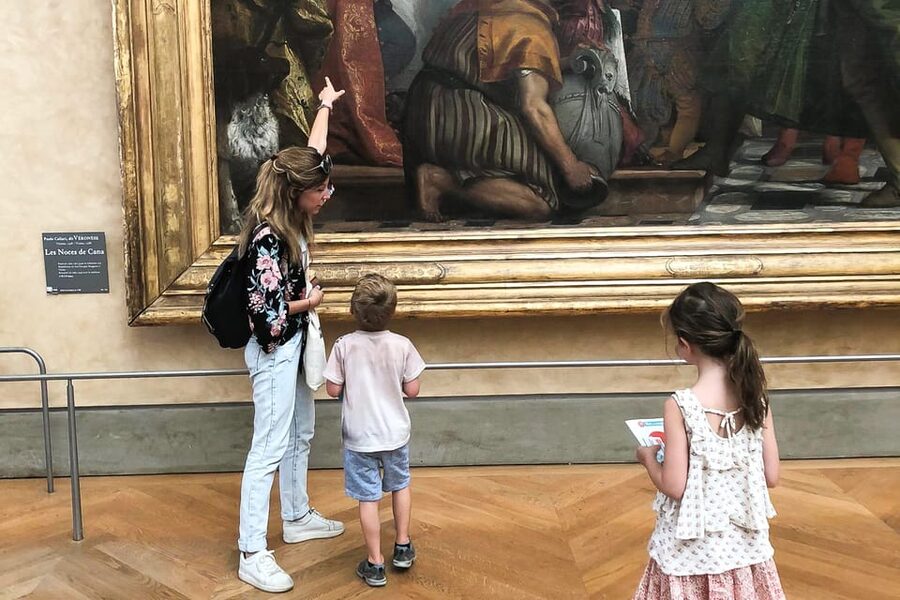
The clever part of this Louvre visit is that children are not simply told to admire great art. They are given a treasure hunt with age-specific booklets, clues, drawing tasks, and a final puzzle. I like that the same route can work for a three-year-old and a twelve-year-old, with the challenges adjusted to match.
I also like the private guide and skip-the-line entry. Guides such as Marcela, Justine, Amy, Marine, and Sebastien have been praised for keeping children focused while still giving adults useful art and history. The main drawback is the price: $743 for up to four people is a serious outlay, and one family felt the hunt slowed the pace and limited the number of artworks they saw.
Key points to know before booking
- The treasure hunt is split by age: Children ages 3 to 6 and 7 to 12 follow the same general route with different tasks.
- The Louvre highlights are included: Expect the Mona Lisa, Venus of Milo, and Winged Victory of Samothrace.
- The guide handles the crowds: Skip-the-line museum tickets and a private visit make the huge museum easier to manage with children.
- The activity lasts two hours: That is a sensible length for younger children, though older art lovers may want more time.
- The price favors small families: At $743 for up to four people, the per-person cost improves if you fill all four places.
- Bring identification and travel light: Bags over 55 by 35 by 20 centimeters are not allowed, and tips, food, and drinks are extra.
Meeting by the Louvre pyramid
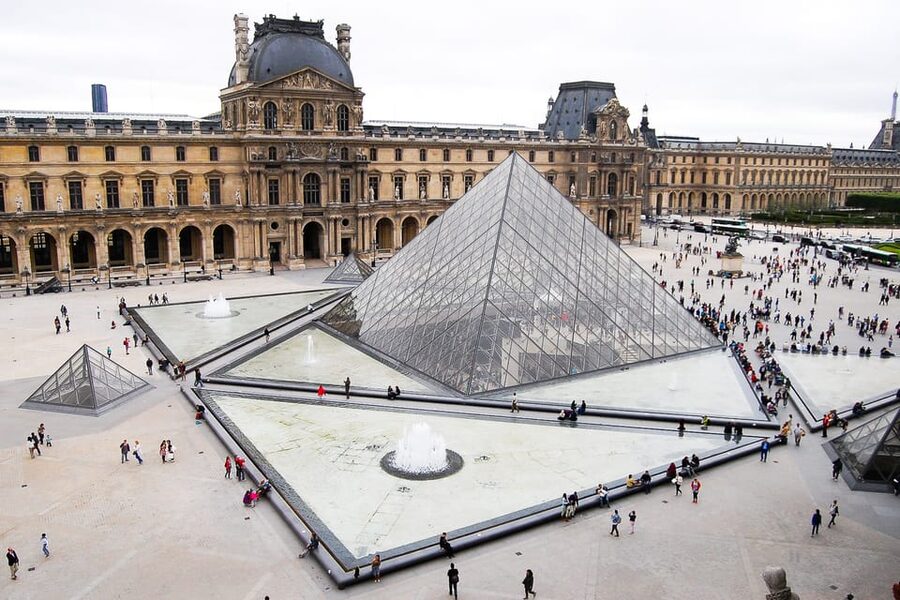
You meet by the equestrian statue of Louis XIV near the Louvre glass pyramid, at 8 Place du Carrousel. This is a practical meeting point, but the Louvre complex is large, so give yourself enough time to locate the statue rather than aiming to arrive at the last minute.
Your English-speaking guide leads a private group, which matters here. The Louvre can feel like a city with paintings in it, and a family trying to find the entrance, the right gallery, and the famous works in a fixed time can lose energy before the visit begins. A guide provides the route and keeps the children moving with a clear purpose.
The museum is wheelchair accessible. You should wear comfortable clothes, especially since the visit involves walking and standing. Large bags and luggage are not permitted, and any item larger than 55 by 35 by 20 centimeters must stay outside. Bring your identification or a photocopy of it.
More Treasure Hunts in France
- Louvre Museum Guided Family Treasure Hunt
★ 5.0 · 78 reviews - “Old Marseille” district tour and treasure hunt
★ 5.0 · 74 reviews - Louvre Museum – Private Family Tour with Da Vinci Treasure Hunt
★ 5.0 · 38 reviews
The first challenge: an activity book for each child
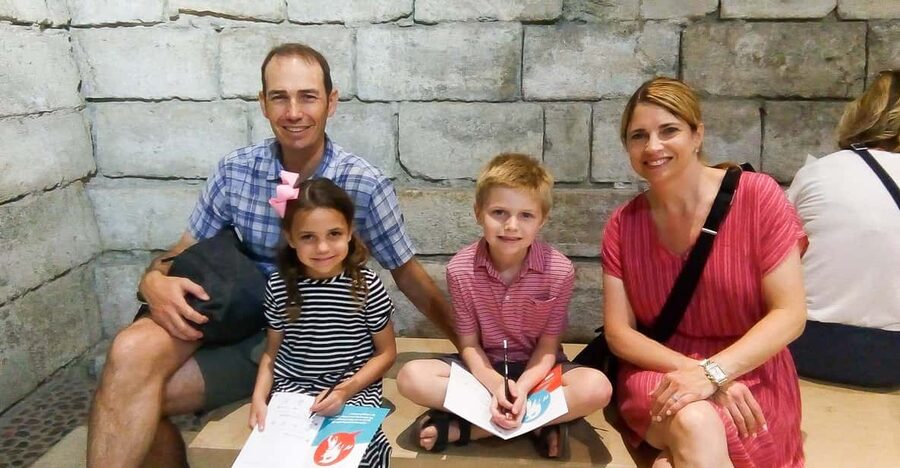
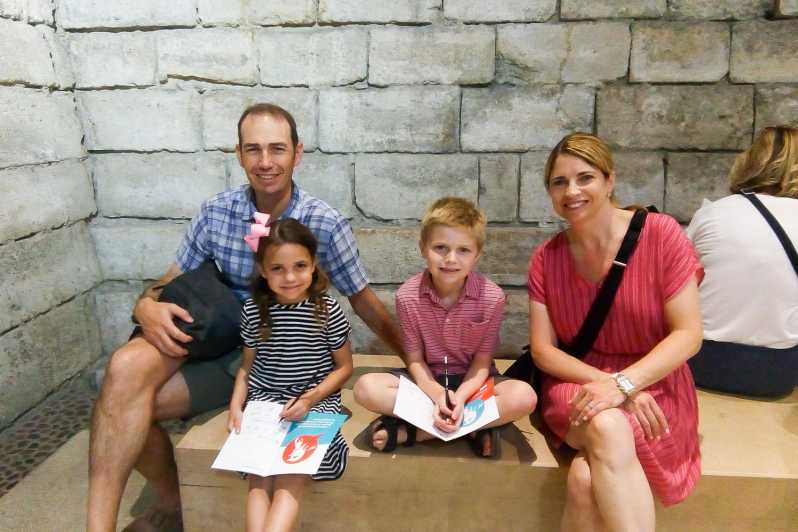
At the start, each child receives a booklet made for their age group. Younger children, from about 3 to 6, may color, draw, and answer simple observation questions. Children from 7 to 12 receive more demanding challenges, but everyone follows the same broad course.
This is one of the strongest ideas in the experience. A large museum often asks children to behave like small adults: stand still, look quietly, and listen to long explanations. Here, the booklet gives them a job. They need to notice details, answer questions, and work toward the next clue.
The activities are not just filler. They direct attention to the art. A child may look more closely at a statue’s pose, a face, a symbol, or a small detail because the booklet asks them to find it. That turns passive looking into a simple game of observation.
The age split is useful for families with children at different stages. A five-year-old can draw while an older child works through a quiz. They can still share the same stops and talk about what they see without everyone receiving identical work.
Following a route through the Louvre’s famous works
The tour includes the Venus of Milo, Winged Victory of Samothrace, and Mona Lisa. These are the works most families hope to see, and having them built into a planned route saves you from trying to make sense of the Louvre’s enormous floor plan.
The Venus of Milo gives the guide a chance to talk about sculpture, pose, and the mystery of the missing arms. Winged Victory offers a very different experience, with a monumental figure set dramatically at the top of a staircase. The Mona Lisa is the stop most likely to attract crowds, and the guide helps your group approach it as efficiently as conditions allow.
One family with an experienced guide, Amy, said the skip-the-line entry saved at least an hour and that the guide brought them close to the Mona Lisa. That is a useful indication of the practical value of having someone who knows the museum, though you should not treat a particular viewing position or waiting time as guaranteed.
The route is not limited to the three headline works. Guides also bring in other paintings and sculptures suited to the group. Marine, for example, was praised for combining major masterpieces with the wider story of the Louvre and its royal past. The exact mix can change with crowds, access, and the needs of your children.
How the clue system keeps children moving

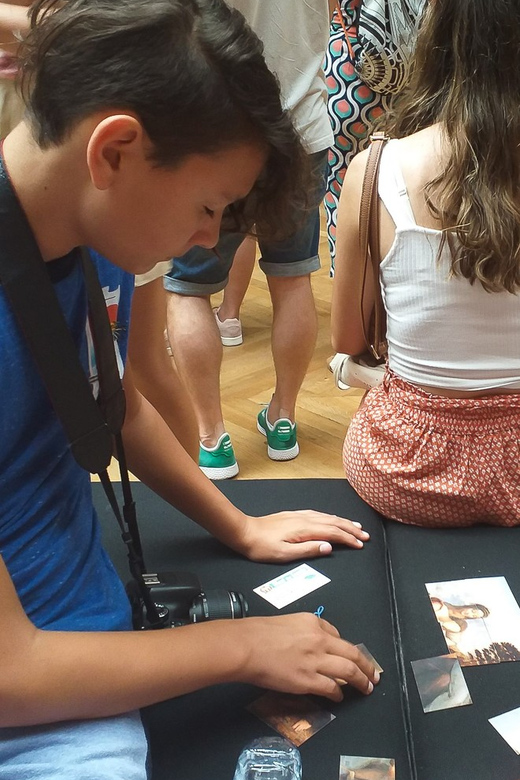
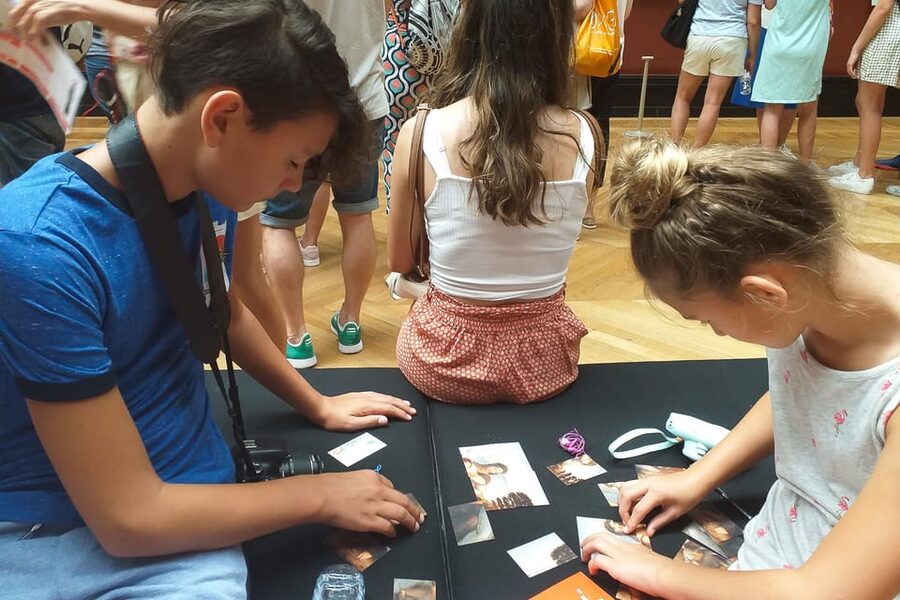
Each correct answer earns a clue card. The children collect the cards as they progress, then use them to solve a final puzzle at the end.
That structure gives the visit a beginning, middle, and finish. Without it, a child may lose interest after the first grand gallery. With it, every stop has a reason. The next answer leads to the next card, and the cards create a small reward system without turning the museum into a loud or frantic contest.
The guide does not simply hand over the booklet and walk away. The activity is explained through conversation, short stories, and questions. Several guides, including Marcela, Justine, Quinten, and Sebastien, have been singled out for patience and an ability to speak to children at their level.
That personal attention is especially helpful with mixed-age groups. A family with children from 5 to 13 found that Sebastien kept everyone involved, despite the age gap. Another family with children aged 3, 5, 8, and 9 found that a guide could adjust the visit so each child had something to do.
You should still know your own children. One family found that their children were less interested than expected, and another felt the quiz tasks sometimes took too long at each work of art. The treasure hunt improves the odds of engagement, but it cannot guarantee that every child will want to solve clues after a long morning in Paris.
More Family Escape Games in France:
- Kids/teens escape game in Montmartre
★ 5.0 · 68 reviews - Paris Sweet & Chocolate Family Treasure Hunt
★ 5.0 · 37 reviews - Paris Kids Louvre Treasure Hunt Private Tour
★ 5.0 · 28 reviews - Paris Louvre : Private Treasure Hunt for Families or groups
★ 3.9 · 14 reviews
What adults get from the two-hour visit
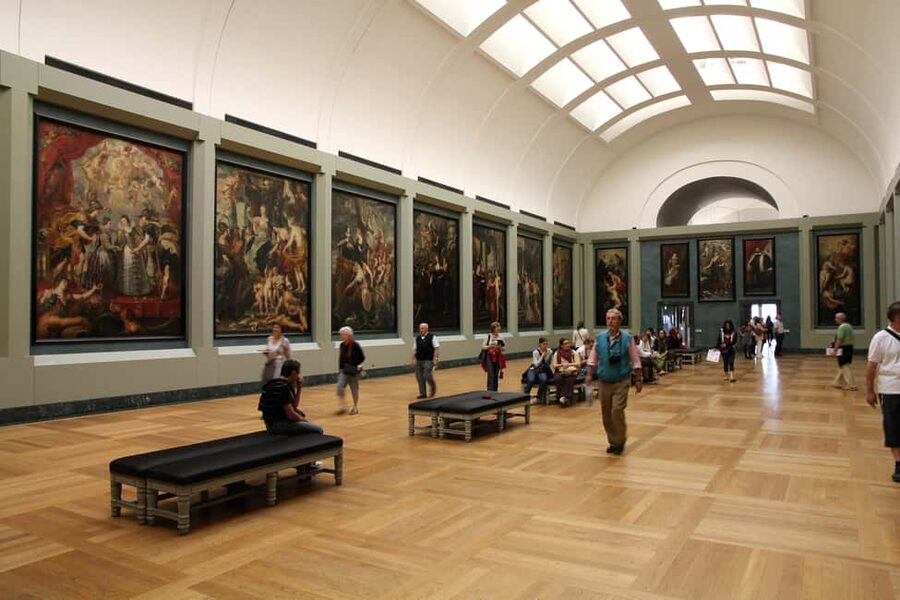
This is not only a children’s program. The guide also provides explanations and anecdotes for the adults, so you are not reduced to carrying bags while the children work through the booklet.
The best family tours give adults enough context to enjoy the art without turning the visit into a lecture. The supplied feedback points to that balance. Parents and grandparents appreciated learning about the Louvre, its royal connections, and the stories behind the works while the children had an active task.
The two-hour length helps. You can see major highlights without asking a young child to spend half a day inside the museum. Families with 6-year-old twins and an 8-year-old found the treasure hunt useful for handling the crowds, while another family called the pace fast and well suited to children.
There is a tradeoff. Two hours is enough for a focused introduction, not a full Louvre visit. One family felt the tour spent too much time on individual quiz tasks, particularly at the Mona Lisa, and would have preferred to see more art. If you want a broad survey of the museum, this may feel selective. If your goal is a successful first visit with children, the limits are more helpful than restrictive.
Is $743 good value for a family of four?
The listed price is $743 per private group of up to four people. That is about $186 per person if four people attend, before tips or any food and drinks. For a couple with one child, the effective per-person cost is higher.
The fee pays for more than entry tickets. You are also paying for a private English-speaking guide, a prepared treasure hunt, age-based booklets, and help navigating one of the world’s largest museums. Skip-the-line access can be especially valuable during busy periods, when waiting in a long entrance queue would use a large part of a two-hour visit.
For a family already comfortable in museums, the price may be difficult to justify. You can visit the Louvre without a private guide, and older children who enjoy art may not need a booklet or puzzle. One family also felt that the high cost should have produced a faster route through more works.
For parents who worry that the Louvre will become a battle of tired feet and short attention spans, the calculation changes. The guide provides structure, keeps the visit focused, and lets adults enjoy at least some of the art themselves. Families who have tried to navigate the museum alone with several children may find that the cost buys peace of mind as much as information.
Which families will get the most from it
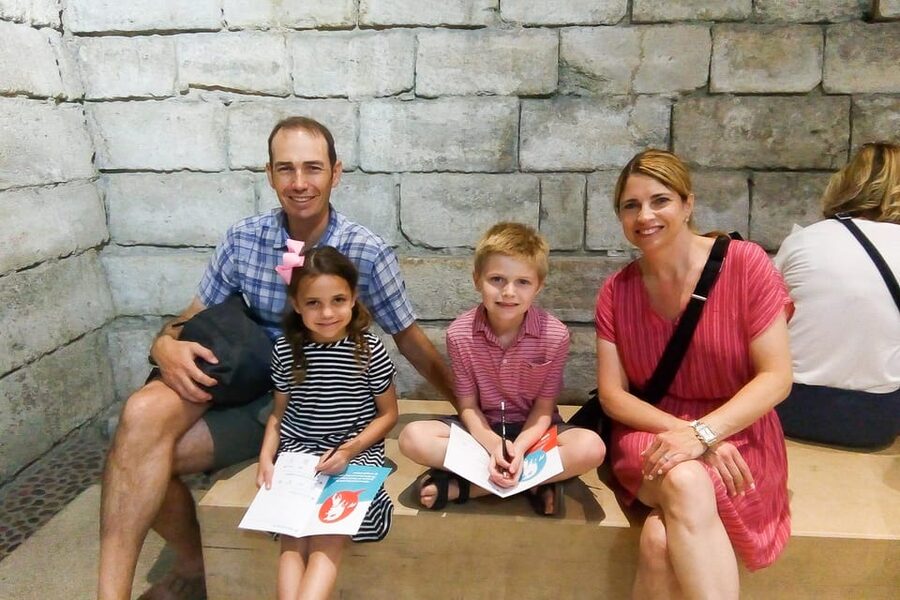
I would choose this for a first Louvre visit with children between about 3 and 12, especially when the adults want to see the main works without planning the route themselves.
It is a particularly good fit for:
- Families with children of different ages
- Parents who do not want to design their own Louvre game
- Children who respond well to puzzles, drawing, or observation tasks
- Families with limited time in Paris
- Adults who want art explanations but need a child-friendly pace
- Anyone concerned about getting lost or losing time in the crowds
Older children who want detailed art analysis may find the two-hour format too basic. A family with very young children should also expect to adapt. The activity can include children as young as 3, but attention spans vary, and a booklet cannot replace rest or snacks outside the museum.
The private format is a real advantage. You are not asking your children to keep pace with strangers, and the guide can adjust explanations when one child is ahead of the others. That flexibility helped guides such as Justine and Sebastien connect with both children and adults.
Practical details that can make the visit easier
The tour begins and ends at 8 Place du Carrousel. Hotel pickup and drop-off are not included, so you arrange your own way to the meeting point.
The activity is offered in English and is wheelchair accessible. Wear comfortable clothes and avoid bringing luggage. The museum does not allow items exceeding 55 by 35 by 20 centimeters, so a small day bag is the safer choice.
Tips are not included. Food and drinks are also not included, so plan around the two-hour visit rather than expecting refreshments during it. You should bring identification or a photocopy, as requested for museum entry.
You can cancel up to 24 hours before the start for a full refund, and the reserve-now, pay-later option keeps payment flexible. Starting times vary, so check availability for the date you need.
Should you book the Louvre treasure hunt?
Book it if your priority is a smooth, child-focused first look at the Louvre. The treasure hunt gives children a reason to pay attention, while the private guide handles the route, the major highlights, and the crowded museum setting. The strongest praise has gone to guides who are patient, lively, and able to adjust their style for children from preschool age through early teens.
Think twice if your family wants to see a large number of artworks or spend serious time with each one. The booklet and clue system can slow the pace, and $743 is high for a two-hour visit. For a small family that wants a structured introduction, the cost may be worthwhile. For confident museum visitors, an ordinary ticket and your own plan may offer better value.
FAQ
Where does the Louvre treasure hunt begin?
It begins at 8 Place du Carrousel, by the equestrian statue of Louis XIV near the Louvre glass pyramid.
How long does the activity last?
The guided Louvre visit lasts two hours.
Which works of art are included?
The route includes the Venus of Milo, Winged Victory of Samothrace, and the Mona Lisa, along with other works selected by the guide.
Is the tour private?
Yes. It is offered as a private group experience.
What language is the tour offered in?
The live guided tour is offered in English.
What ages are the activity booklets designed for?
The booklets are adapted for children ages 3 to 6 and for children ages 7 to 12.
Are Louvre entry tickets included?
Yes. Skip-the-line tickets to the Louvre Museum are included.
Is the Louvre wheelchair accessible on this activity?
Yes. The activity information states that it is wheelchair accessible.
Can I bring luggage into the museum?
Large bags and oversize luggage are not allowed. Items exceeding 55 by 35 by 20 centimeters are not permitted in the museum.
Are food, drinks, and tips included?
No. Food, drinks, and tips are not included in the price.
What happens if I need to cancel?
You can cancel up to 24 hours in advance for a full refund. A reserve-now, pay-later option is also available.
Just added around France
- Historical treasure hunt in the city of Versailles★ 4.0 · 15 reviews
- Escape game outdoor The Walking Dead in Tours★ 3.0 · 2 reviews
- Outdoor escape game | The Minotaur★ 4.5 · 2 reviews
- Discover Toulouse while playing! Escape game – The alchemist★ 3.5 · 4 reviews
- Tours: Magic Team Escape Game in Town★ 3.0 · 2 reviews
- Urban escape game in Toulouse – Crazytopia★ 3.0 · 3 reviews
- Romantic Toulouse: Self-Guided Love Story Puzzle Walk★ 4.0 · 2 reviews
- Strasbourg Highlights Self Guided Scavenger hunt and City Walking Tour★ 4.0 · 9 reviews
France Escape Games, compared.


Who Killed Victor ? Escape Game at Père Lachaise Cemetery
Read our review →


Romantic Montmartre: Paris Lost Lovers Exploration Game and Tour
Read our review →Browse the lists this tour appears in