
Review · ROME
Rome Treasure Hunt With Leonardo da Vinci
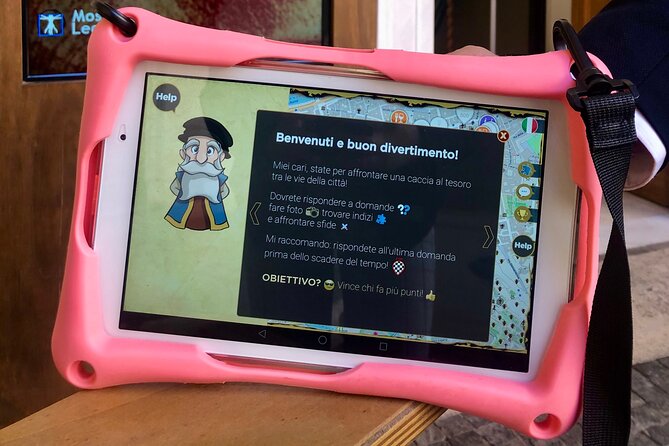
Rome Treasure Hunt With Leonardo da Vinci turns a city walk into a game, with a tablet guiding you between major sights and lesser-known details. You collect points through quizzes and funny photos, then use the clues at the Leonardo da Vinci Exhibition, where more than 65 inventions await.
I like the freedom to choose your route and the mix of ancient ruins, city squares, and a hidden underground Roman river. The main caution is that the app presents many possible places to visit, so three and a half hours can feel tight, especially if you stop often or need translations in French.
Key points
- A self-guided route through central Rome: See the Spanish Steps, Trevi Fountain, Pantheon, Piazza Navona, Campo de’ Fiori, Roman Forum, and Colosseum.
- One tablet for your private group: You decide where to go while the device provides information and challenges.
- A final puzzle inside the exhibition: Use the points and clues from the city walk to find the treasure.
- Hands-on Leonardo displays: Try more than 65 inventions, including a hologram.
- A good family format: Quizzes, photo tasks, and physical models give children an active role.
- Language matters: French translations may be incomplete, which can affect the letter-based clues.
A Rome walk with a puzzle at its center

This experience works best if you want to see a lot of central Rome without following a guide holding an umbrella or a flag. The tablet gives you information about each stop, then leaves the choice of direction to you. That small amount of control changes the feel of the outing: you are not simply being led from monument to monument, you are deciding which clues to chase.
The route brings together some of Rome’s biggest names. You can see the Spanish Steps, pause at the Trevi Fountain, cross the Pantheon area, continue through Piazza Navona and Campo de’ Fiori, then reach the Roman Forum and Colosseum. The exact path depends on how your group uses the tablet and which challenges you choose.
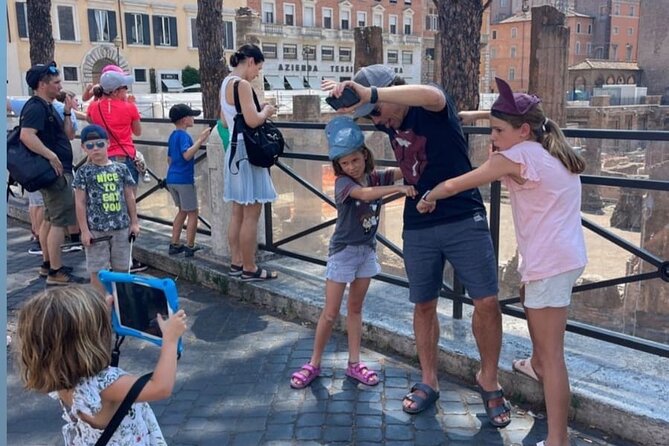
I like this format for families and friends who enjoy a little competition. You earn points by answering quiz questions and taking funny photos, and those points reveal the next clues. The activities give children a reason to look closely instead of treating the city as one long succession of old stones.
There is a practical tradeoff. The tablet offers a large number of possible locations, and that choice can be useful or distracting. If you try to visit every suggested place, you may spend more time managing the game than enjoying Rome. Pick a sensible route and keep an eye on the clock.
More Treasure Hunts in Italy
- Rome: Treasure Hunt for Kids and Families Trevi and Pantheon
★ 5.0 · 14 reviews - Treasure hunt in Rome, Ghetto and Trastevere
★ 5.0 · 8 reviews - Rome: Spanish Steps, Trevi, & Pantheon Live Treasure Hunt
★ 5.0 · 6 reviews
Starting at Piazza della Cancelleria
The experience begins at P.za della Cancelleria, 1, in central Rome. This places you near several important sights, so the walk starts in a part of the city where a short turn can lead to a palace, a piazza, a church, or an archaeological remnant.
You receive one tablet per group. That matters because the activity is private, with only your own party taking part. You can discuss each answer together, hand the tablet to a child, or let one person handle directions while everyone else watches for clues.
Remote assistance from staff is available during the city portion. You are not left with a completely unsupported app, but you should still expect to make choices and keep yourselves moving. This is not a traditional guided tour with a person explaining every street corner.
The tablet also supplies background about what you are seeing. That makes the experience useful for a first visit, though the information is delivered through the device rather than through conversation with a local guide. If you prefer questions answered on the spot, a standard walking tour may suit you better.
Choosing your route past Rome’s major sights
The route includes the Spanish Steps, Trevi Fountain, Pantheon, Piazza Navona, Campo de’ Fiori, Roman Forum, and Colosseum. These sights cover several layers of Rome, from grand Baroque public spaces to the remains of the ancient city.
At the Spanish Steps, the challenge format gives you a reason to notice the setting instead of rushing straight to a photograph. Trevi Fountain brings the usual crowds and visual drama, while the Pantheon area offers a change of scale, with a compact piazza and one of Rome’s most recognizable ancient buildings.
Piazza Navona is especially well suited to a quiz because it rewards looking around. Campo de’ Fiori gives the walk another lively public square, while the Roman Forum and Colosseum shift the focus toward ruins and imperial Rome.
The information provided does not promise entry into the Colosseum, Roman Forum, Pantheon, or other major monuments. Treat these as sights along the city route, not as included admissions. The only entrance fee specifically included is for the Leonardo da Vinci Exhibition.
That distinction is important when you compare prices. If you want interior visits to several ancient sites, you will need a separate plan and likely more time. This activity is mainly a self-guided outdoor exploration followed by a museum-style exhibition visit.
Points, quizzes, and funny photo tasks
The game mechanics are simple. You answer quizzes and complete photo challenges to collect points. Those points then provide clues for the treasure hunt at the exhibition.
The photo tasks should appeal to groups that enjoy a playful approach to sightseeing. They also help break up the factual material on the tablet. A child who loses interest in a long explanation may stay involved if the next goal is a picture or a quick answer.
You do need to accept that the activity may feel less serious than a classic history walk. The funny photos are part of the design, not an extra option, and some adults may find the game slightly artificial. For the right group, that is the point. The format gives you shared tasks and creates a reason to talk as you walk.
Keep your group together and decide early how you will handle the tablet. Passing it around can include everyone, but it can also slow you down. One person can read the instructions, another can watch the route, and the rest can help solve the questions.
More Treasure Hunts in Rome:
- Colosseum and Roman Forum Treasure Hunt Tour for Kids & Families
★ 5.0 · 3 reviews - Vatican Treasure Hunt with Guided Tour for Families with Kids
★ 5.0 · 2 reviews - Trevi Pantheon and Spanish Steps Treasure Hunt for Kids & Families in Rome
★ 5.0 · 2 reviews - Hamburg: Treasure Hunt Game through HafenCity
★ 4.7 · 364 reviews
Ancient ruins and the underground Roman river
Rome is full of details that are easy to miss when you move between famous monuments. This walk includes ancient ruins and a hidden underground Roman river, giving the route more variety than a simple checklist of postcard sights.
The underground river is one of the more unusual elements because it points to Rome beneath the level of today’s streets. You should not expect a full archaeological expedition, since the available information does not describe a separate underground tour or extended entry. Still, the reference adds a different angle to the city’s past.
The tablet is meant to reveal small facts that a standard route might pass over. That can make the walk feel more personal, especially if you already know the Trevi Fountain and Colosseum from photographs. The value here is not only the famous view, but the prompts that make you look around for something less obvious.
Because the route includes so many locations, pacing matters. You may find that the most enjoyable plan is to focus on a handful of major stops rather than chase every possible point. You can still see the headline sights without turning the afternoon into a race.
Finishing at the Leonardo da Vinci Exhibition
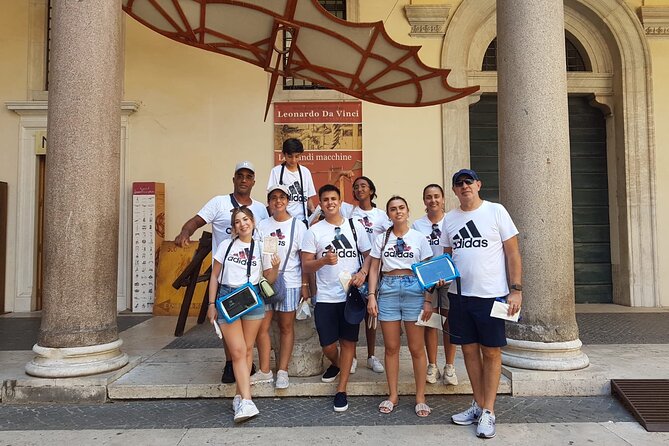
After the city walk, you return to the Leonardo da Vinci Exhibition for the final part of the activity. The exhibition includes more than 65 inventions, along with holograms and rare discoveries. You use the clues gathered outside to find the treasure inside.
This is a smart ending because it gives the entire walk a purpose. Instead of finishing at the last piazza and simply going home, you carry your accumulated clues into a dedicated indoor visit. The city portion supplies the movement and discovery; the exhibition supplies the final puzzle.
The inventions are presented as things you can try, not only objects behind glass. That hands-on element is valuable for children, but adults who enjoy engineering, design, or Renaissance ideas should find plenty to examine too.
A hologram is included among the exhibition features. The experience also presents rare discoveries, including fragments of a tomb dating to 43 B.C. That detail adds an archaeological note to what could otherwise be a display focused only on Leonardo’s machines.
The available information does not specify the exact treasure, the number of exhibition rooms, or how long you spend inside. Plan to stay flexible. The city walk is listed at about three hours and 30 minutes overall, but your pace and time spent testing inventions will shape the visit.
What the exhibition adds to the price
The cost is $52.36 per person, including admission to the Leonardo da Vinci Exhibition and use of one tablet per group. Remote assistance during the city section is also included.
I see the price as reasonable for a private, self-guided activity that combines a city route with an indoor admission. It is less straightforward value if you only want a conventional walking tour, since there is no in-person guide leading the group throughout the outing.
The best value comes when several people share the game and everyone takes part. A family can use the tablet together, complete the challenges, and finish with a museum visit. A couple or small group that prefers quiet sightseeing may find the game less necessary.
The ticket is also useful for people who would otherwise pay separately for a Leonardo exhibition visit. Since the city walk and exhibition are designed as one activity, you do not have to invent your own connection between the two.
The price does not include bottled water, food, or drinks. Bring water with you, especially since you will be walking for much of the three-and-a-half-hour period. No meal stop is provided.
Language and translation limits
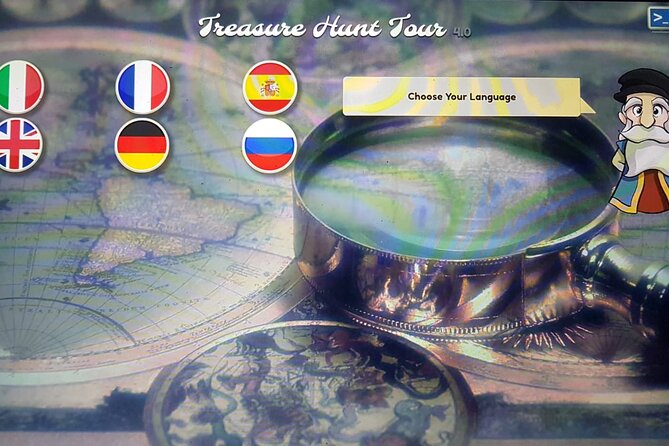
English appears to be the safer choice for the clue system. French translation has been reported as disappointing, with some inventions not translated consistently. That creates a direct problem because the exhibition clues depend on letters from the displays.
If your group is comfortable in English, you should have a smoother time with the treasure hunt. If you need French throughout, the language issue deserves serious attention before you book. The problem is not just a missing description here or there. Incomplete translation can interfere with the actual puzzle.
No guide names are provided, because this is not built around a named guide. Staff offer remote assistance during the city portion, while the tablet delivers the route information and questions.
Who will enjoy this most
I would choose this for families with school-age children, groups of friends, and adults who like games more than formal lectures. The private format lets you work at your own speed, and the photo tasks give younger participants something active to do.
It also suits first-time visitors who want a broad introduction to central Rome. You will pass many major sights in one outing, and the tablet supplies basic context as you go.
I would be more cautious if your priority is detailed art or archaeology commentary. The experience is built around choices, points, and clues, not a long talk from a specialist. It may also frustrate you if you want a fixed route with no decisions to make.
People who dislike using a tablet while sightseeing should think twice. The device is central to the experience, from the city information to the quiz tasks and final clues.
Timing, meeting point, and practical planning
The activity lasts about three hours and 30 minutes. That is long enough to cover a broad area, but not so long that you should assume you can linger at every attraction.
You start and finish at the meeting point at P.za della Cancelleria, 1. The activity is near public transportation, which helps with arrival and departure, though the provided details do not specify a particular bus, tram, or metro stop.
Most people can participate, and service animals are allowed. The experience is private, so only your group takes part. Confirmation is sent at the time of booking, and you receive a mobile ticket.
Wear comfortable walking shoes and bring water. Food and drinks are not provided. If you are traveling with children, agree on a meeting habit for the group before starting, since the tablet encourages you to make route choices rather than follow a guide in a fixed line.
Free cancellation is available if you cancel at least 24 hours before the start time. Inside that window, the amount paid is not refunded, and changes are not accepted. The cut-off follows local Rome time.
Should you book the Rome treasure hunt?
Book it if you want a private, playful way to cover central Rome and you like the idea of finishing with Leonardo’s inventions. The combination of major sights, quiz tasks, unusual city details, and a hands-on exhibition gives families and game-loving groups a clear reason to choose it.
Skip it if you want a traditional guide, guaranteed entry to the Colosseum or Roman Forum, or detailed commentary at every stop. Also reconsider if your group needs French translation for every clue.
At $52.36 per person, the experience makes the most sense when you value both parts: the self-guided walk and the exhibition admission. Keep your route focused, bring water, and choose English if possible. Done that way, the tablet becomes a useful tool rather than a distraction.
FAQ
Where does the experience start?
It starts at P.za della Cancelleria, 1, 00186 Rome, Italy.
Where does the experience end?
The activity ends back at the meeting point.
How long does the treasure hunt last?
The experience lasts approximately three hours and 30 minutes.
How much does it cost?
The listed price is $52.36 per person.
Is the Leonardo da Vinci Exhibition included?
Yes. The entrance fee for the Leonardo da Vinci Exhibition is included.
What is provided during the city walk?
One tablet is provided per group, along with remote assistance from staff during the city portion.
Are food and drinks included?
No. Bottled water, food, and drinks are not included.
Is this a private activity?
Yes. Only your group participates.
Can I use a mobile ticket?
Yes. The experience includes a mobile ticket.
What is the cancellation policy?
You can cancel for a full refund up to 24 hours before the experience start time. Cancellations or changes made less than 24 hours before the start are not accepted for a refund.
Just added around Rome
- Villa Borghese escape game★ 3.0 · 3 reviews
- Vatican Treasure Hunt with Guided Tour for Families with Kids★ 5.0 · 2 reviews
- Trevi Pantheon and Spanish Steps Treasure Hunt for Kids & Families in Rome★ 5.0 · 2 reviews
- Self-Guided mystery walk outside the Pantheon, Rome★ 4.0 · 5 reviews
- Treasure hunt in Rome, Ghetto and Trastevere★ 5.0 · 8 reviews
- Colosseum and Roman Forum Treasure Hunt Tour for Kids & Families★ 5.0 · 3 reviews
- Treasures of Rome Scavenger Hunt for Friends Team Building & Company Incentive★ 4.5 · 2 reviews
- Rome Scavenger Hunt and Highlights Self-Guided Tour★ 5.0 · 2 reviews
Rome Escape Games, compared.

Dark Heart of Rome – Facts, Legend & Mystery Walking Tour
Read our review →
Angels & Demons Rome Scavenger Hunt: The Illuminati Escape Game
Read our review →

Private Family Scavenger Hunt & Art Lab Tour – Rome Landmarks
Read our review →

Browse the lists this tour appears in