
Review · PARIS
Montmartre Treasure Hunt — Fun and Cultural Investigation
Montmartre’s best feature is its ability to surprise you around the next corner, and this self-guided treasure hunt gives you a reason to look closely. You follow a booklet of riddles through the neighborhood, linking landmarks, odd details, artists, cabarets, and local stories into one playful investigation.
I like the way the route combines real sightseeing with family-friendly puzzles, and I like that you do not need an app or a guide hovering over your shoulder. The main tradeoff is time: the game lasts about three hours and ends automatically after three and a half, so a long café stop means less time for solving clues.
Key points to know before you book
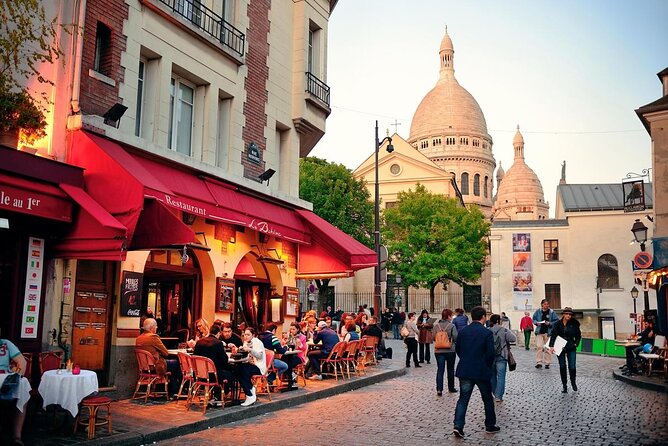
- Starts near Anvers: You begin at Anvers, in the 18th arrondissement, with Montmartre’s main sights ahead.
- Uses a booklet, not an app: Your materials include riddles, a map, cultural notes, answer sheets, clues, and a pen.
- Covers major Montmartre sights: Expect the Sacré-Cœur, Place du Tertre, Moulin Rouge, vineyards, and lesser-known corners.
- Works for mixed-age groups: The puzzles suit children from age eight, while adults still have enough to think about.
- Runs on a firm clock: The activity lasts around three hours and automatically stops after three hours and 30 minutes.
- Offers help when needed: Assistance is available during the game, including hints for difficult clues.
Why this game works better than a basic Montmartre walk
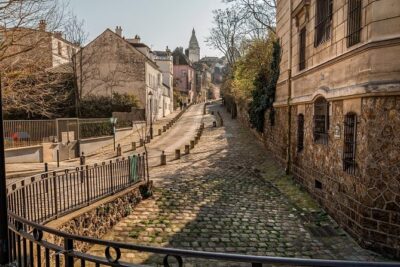
Montmartre can be hard to read at first. It has famous sights, steep streets, crowded photo stops, grand stairways, quiet lanes, old cabarets, and pockets of village life. You can walk for hours and still feel that you have only seen the postcard version.
This game gives your walk a purpose. Instead of simply moving from Sacré-Cœur to Place du Tertre, you look for details and ask why a place matters. A church façade, a street corner, an artistic reference, or a small neighborhood clue becomes part of the investigation.
That approach suits Montmartre particularly well. The district is tied to painters, performers, cabaret culture, and the artistic life of the Belle Époque. The puzzles use that character rather than treating the neighborhood as a set of unrelated photo stops.
You also control the pace. There is no guide setting a walking speed and no fixed group lecture. You can pause to take pictures, read the cultural notes, or let a child work out a clue. The catch is that the clock keeps moving, so flexibility has limits.
More Treasure Hunts in France
- Louvre Museum Guided Family Treasure Hunt
★ 5.0 · 78 reviews - Louvre Museum – Private Family Tour with Da Vinci Treasure Hunt
★ 5.0 · 38 reviews - Paris Sweet & Chocolate Family Treasure Hunt
★ 5.0 · 37 reviews
Starting at Anvers and finding your way uphill
The meeting point is at Anvers, near the foot of Montmartre. This is a practical starting place because it puts you below the hill and lets the route build through the neighborhood rather than dropping you into the middle of the main sights.
You receive a game booklet with the riddles, map, cultural anecdotes, answer sheets, and the other materials you need. A pen is included, and there is no download or special app to manage. That matters if your group includes children, people who do not want to stare at a phone, or anyone trying to conserve a weak battery.
The booklet is the heart of the activity. It gives you enough direction to keep moving, but the clues ask you to observe what is around you. Some rely on logic. Others depend on curiosity or spotting something in the setting.
I would read the opening instructions carefully before setting off. A self-guided game is more enjoyable when everyone knows who is writing answers, who is watching the map, and who is looking for visual clues. With a family, give children a real job rather than making them tag along behind the adults.
The streets can be uneven and Montmartre includes uphill walking. You do not need an athlete’s fitness, but a moderate level is expected. Wear shoes that are comfortable on cobblestones and stairs, and leave room in your schedule for the route to take a little longer if your group stops often.
Sacré-Cœur, the big landmark with a puzzle attached
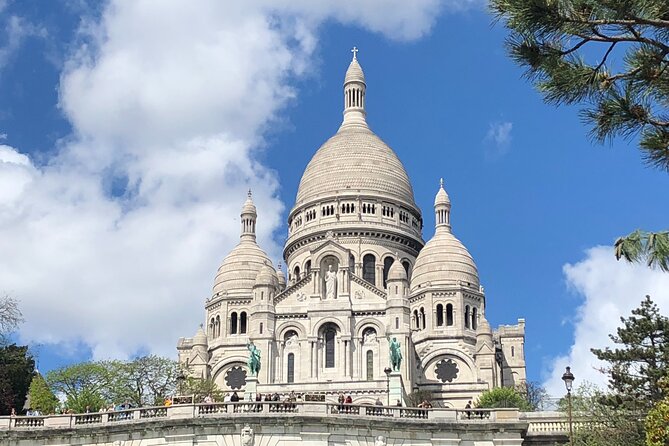
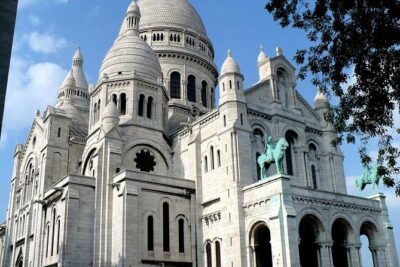
The Sacré-Cœur is one of the obvious highlights of Montmartre, but a treasure hunt changes the way you approach it. Instead of arriving, taking a picture, and moving on, you have a reason to inspect the setting and connect it to the clues in your booklet.
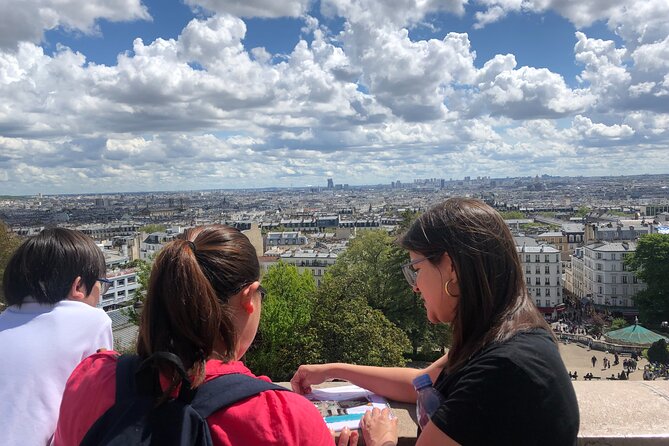
The basilica also gives you one of the area’s best orientation points. From this high part of Montmartre, you can understand the hill as a neighborhood rather than a collection of narrow lanes. The wide views are memorable, but the game keeps your attention on the details close at hand.
The main drawback is crowding. Sacré-Cœur is one of Paris’s most visited sights, and the area around it can feel busy. You may need patience while your group works through a clue. The activity is not designed to whisk you past crowds or provide a quiet private visit.
You should also avoid treating the basilica as a quick puzzle stop only. If you want to enter and look around, plan that carefully within the time limit. The game materials can add cultural context, but they do not replace a full guided visit inside the church.
Place du Tertre and Montmartre’s artistic character
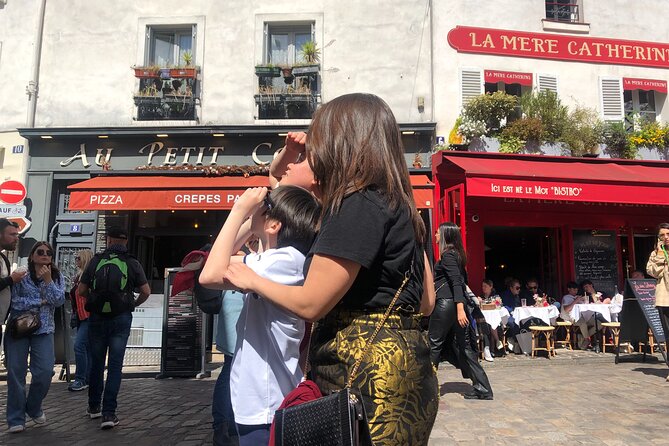
Place du Tertre is closely tied to Montmartre’s image as an artists’ quarter. Its painters, portraits, café terraces, and tourist traffic make it one of the district’s most recognizable stops.
The treasure hunt uses this artistic setting as more than decoration. Clues inspired by Montmartre’s past encourage you to notice how the square functions today and how its artistic identity shapes the experience. The booklet also includes historical details and humorous anecdotes, so the learning is broken into small pieces instead of delivered as a long lecture.
This is where adults and children can contribute in different ways. A child may notice a visual detail first, while an adult may connect an anecdote or solve a logic problem. The puzzles are described as easy enough for children to take part in, but not so simple that adults have nothing to do.
That balance is one of the strongest reasons to choose this activity for a family. A five-year-old may need help, since the stated minimum age is eight, but younger children can still walk along and participate informally. For children around ten and thirteen, the challenge is more likely to feel like a real game rather than a worksheet.
Expect some commercial activity around the square. The hunt cannot remove the tourist feel from Place du Tertre, but it can give you a better reason to be there.
More Treasure Hunts in Paris
- Paris Kids Louvre Treasure Hunt Private Tour
★ 5.0 · 28 reviews - Paris Treasure Hunt – Explore the Seine from Louvre to Eiffel
★ 5.0 · 18 reviews - Treasure Hunt in Paris – From the Panthéon to the Louvre
★ 5.0 · 17 reviews - Paris: Treasure Hunt & Walking Tour “Secret Weapon X”
★ 4.8 · 17 reviews
St. Jean de Montmartre and the value of a side stop
One useful feature of the route is that it passes the art nouveau church of St. Jean de Montmartre. This is an easy place to rush past, especially when your eyes are fixed on Sacré-Cœur and the better-known parts of the hill.
I would make time to look inside if it is open. The church adds another layer to the neighborhood’s architecture and gives the route a quieter change of pace. The activity’s cultural notes help you notice places that might otherwise disappear into the walk.
This is an important difference between the treasure hunt and a simple checklist of famous sights. The route is designed to give you a broader sense of Montmartre, including places you might not choose on your own. You still see the major landmarks, but you are not limited to the postcard circuit.
Do not assume every stop will be a dramatic monument. Some clues may lead you to a street, façade, or small detail. That is part of the point. The game rewards attention, not just arrival.
The vineyards and quieter corners of the hill
Montmartre’s vineyards are another appealing part of the route. They remind you that this district was not always experienced as a central Paris attraction. The vines add a village-like note to a neighborhood better known for artists, cabarets, and views.
The vineyard stop also helps break up the busiest parts of the walk. You get a different feel from the crowded basilica steps and the lively Place du Tertre. The clue gives you a reason to pause and think about how Montmartre’s identity has changed over time.
Because the game is self-guided, you can spend a little longer in a place that interests you. That freedom is valuable, but you need to watch the clock. A coffee break is allowed, and a café stop can be a sensible part of an afternoon in Montmartre. It also cuts into the puzzle time.
I would save a long sit-down break for the end unless your group needs it earlier. A short pause is easy to absorb. A full meal or extended coffee can leave you rushing through the final clues.
Moulin Rouge and the investigation’s final reveal
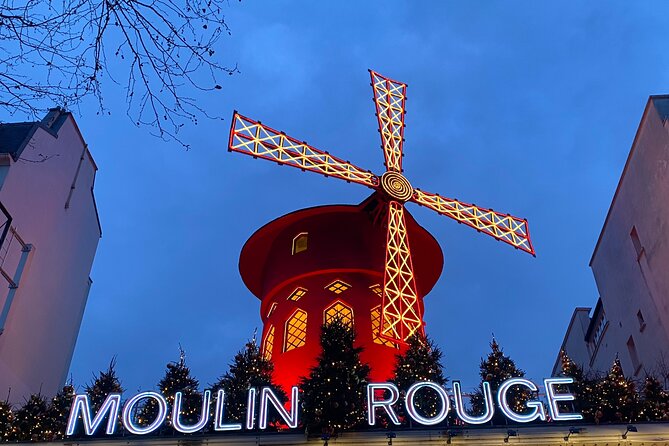
The Moulin Rouge provides the game’s stated finale. It is an effective ending because the cabaret connects to the theatrical, musical, and artistic side of Montmartre. After churches, artists’ squares, lanes, and vineyards, the red windmill gives the investigation a clear closing point.
At the end, you discover the resolution of the case and more stories from the neighborhood. This gives the walk a finish rather than leaving you with a booklet full of unanswered guesses.
The Moulin Rouge is on a busier street and feels different from the quieter upper hill. That contrast is useful. You finish with one of Montmartre’s most famous entertainment landmarks, but the route has already shown you places beyond the standard cabaret photograph.
The practical information has one point worth checking before booking: the description places the final discovery at the Moulin Rouge, while the meeting details also say the activity ends back at the meeting point. Since the activity automatically ends wherever you are after three hours and 30 minutes, ask the provider about the exact finish arrangement if returning to Anvers matters to you.
How hard are the puzzles?
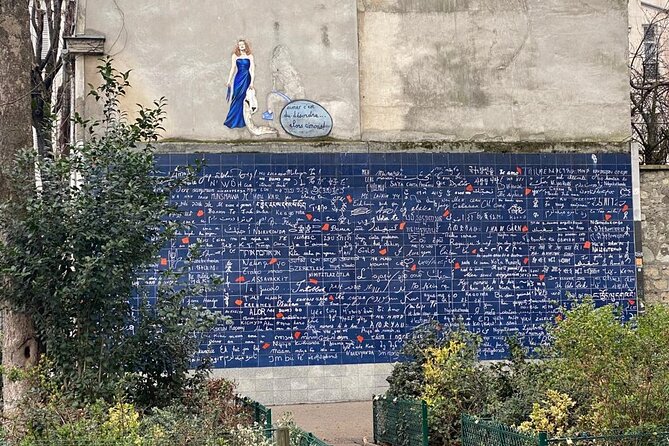
The puzzles are intended to be approachable rather than escape-room hard. Some use observation, some logic, and some simple curiosity about the places around you. You are not expected to solve every clue instantly.
That makes the game a good fit for a group with mixed interests. One person can enjoy the walking and architecture, another can focus on the historical notes, and a child can hunt for visual details. You do not all need the same puzzle-solving ability.
The booklet is also described as full of historical details and funny anecdotes. I like that combination because it gives you something useful even when a clue slows you down. You are still learning about Montmartre while thinking through the answer.
If your group loves difficult escape games, this may feel light. The activity is more kid-friendly than a harder Madeleine investigation offered by the same provider. Choose it for a relaxed cultural game, not for a high-pressure contest.
Help is available if a clue becomes frustrating. That keeps the experience from stalling, particularly for families. You can ask for a hint rather than spending half an hour stuck at one stop.
The three-hour time limit in real use
The stated duration is about three hours, with an automatic end after three hours and 30 minutes. That gives you enough time for a leisurely route, but not unlimited time for meals, shopping, and long photo sessions.
I would arrive ready to begin at the scheduled time. Since the activity is self-guided, you are responsible for keeping the group moving. Set a rough halfway point and check your progress there. If you are already behind, take hints and avoid trying to solve one difficult clue forever.
The time limit is both a strength and a weakness. It keeps the afternoon focused and prevents the activity from drifting into an unfinished project. It can also feel tight if you want to stop at every landmark or sit down for a long coffee.
Weather matters, too. The activity requires good weather and may be canceled if conditions are poor. If that happens, you are offered another date or a full refund. Bring suitable clothing for a normal outdoor walk, but do not book this as a weather-proof indoor activity.
Price, group size, and overall value
At $41.70 per person, this is not the cheapest way to walk Montmartre. You are paying for a designed game, printed materials, cultural content, and support rather than a standard free stroll through the streets.
The value improves if you are a family or small group that would otherwise pay for several separate activities. One booklet gives everyone a shared purpose, and the materials are built around the neighborhood instead of being generic puzzles placed in Paris.
The maximum group size is 20 people. That is a useful limit for a self-guided activity, although your own group may be much smaller. A couple can play together, but a family with several ages may get more from the format because different people can take on different roles.
There is no food, drink, hotel pickup, or drop-off included. Factor in the cost of getting to Anvers and your own café stop. The activity is best judged as a structured neighborhood experience, not as transportation or a full-day tour.
Who should choose this Montmartre activity?
I would recommend it most strongly for families with children aged eight and up, couples who like solving things together, and small groups that want to explore without following a guide’s schedule.
It also suits people who have already seen the major Paris monuments but want a different way to approach Montmartre. Even locals can use the route to notice details and stories they have missed.
You may want another option if you prefer a formal guide, long historical explanations, or a very demanding puzzle challenge. There is no guide walking with you, and the activity depends on your group reading the booklet, following the map, and managing the time.
The self-guided format is also less suitable for anyone who dislikes cobblestones, uphill walking, or outdoor plans that depend on decent weather. Service animals are allowed, and the area is near public transportation, but the route still requires moderate physical fitness.
Should you book the Montmartre Treasure Hunt?
Book it if you want to see Montmartre through small discoveries rather than simply ticking off Sacré-Cœur and the Moulin Rouge. The strongest parts are the route’s mix of famous sights and lesser-known stops, the playful cultural notes, and the way children can take part without leaving adults bored.
Before booking, agree that your group will keep an eye on the clock. Take a short coffee break if you like, but remember that it reduces puzzle time. At $41.70 per person, the activity makes the most sense when you value a shared game and cultural context, not just a walk through the neighborhood.
Free cancellation is available up to 24 hours before the start time. Changes or cancellations made later are not refunded, and the provider may offer another date or a full refund if poor weather or an insufficient number of participants forces a cancellation.
FAQ
Where does the Montmartre Treasure Hunt start?
The activity starts at Anvers, 75018 Paris, France.
Where does the activity end?
The published information says the investigation finishes at the Moulin Rouge and also lists the meeting point as the ending point. The game automatically ends after three hours and 30 minutes wherever you are, so confirm the exact return arrangement if it is important to you.
How long does the treasure hunt last?
It lasts about three hours and automatically ends after three hours and 30 minutes.
Is the activity guided?
No. It is self-guided, with a booklet, map, riddles, cultural notes, answer sheets, and other materials. Assistance and hints are available if needed.
Do I need a mobile app?
No. The activity does not require an app or any downloads.
What sights does the route include?
The route includes the Sacré-Cœur, Place du Tertre, the Moulin Rouge, and the Montmartre vineyards. It also passes the art nouveau church of St. Jean de Montmartre and other neighborhood locations.
What age is the activity suitable for?
It is suitable for children aged eight and up, as well as couples and families.
How many people can join?
The activity has a maximum of 20 participants.
Is food or drink included?
No. Food and drinks are not included. You may take a coffee break, but it reduces the time available for the game.
Can I cancel for a full refund?
Yes, if you cancel at least 24 hours before the experience start time. Cancellations or changes made less than 24 hours before the start are not refunded or accepted.
Just added around Paris
- Treasure Hunt in Paris – From the Panthéon to the Louvre★ 5.0 · 17 reviews
- Paris Treasure Hunt – Explore the Seine from Louvre to Eiffel★ 5.0 · 18 reviews
- Paris Treasure Hunt to the Auction Rooms★ 5.0 · 2 reviews
- Marais Treasure Hunt & Discovery — Self-guided Paris Game★ 5.0 · 3 reviews
- Paris Covered Passages Treasure Hunt — Self-guided Game★ 5.0 · 5 reviews
- Self-guided Mystery Walk by the Notre Dame★ 4.0 · 2 reviews
- Paris WWII: Occupation & Liberation Exploration Game and Tour★ 5.0 · 2 reviews
- Private Scavenger Hunt in Montmartre★ 5.0 · 2 reviews
Paris Escape Games, compared.

Who Killed Victor ? Escape Game at Père Lachaise Cemetery
Read our review →

Romantic Montmartre: Paris Lost Lovers Exploration Game and Tour
Read our review →
Browse the lists this tour appears in