
Review · PARIS
Escape game Time machine
Paris offers plenty of grand monuments. This experience gives you something different: one hour inside a time-travel problem built for teamwork. Professor Laurentius Abe Sterling has trapped himself in a spatio-temporal gap, and your group must find and operate his machine before he remains stuck for a very long time.
I like the mix of searching, physical manipulation, and logic puzzles, plus the warm welcome and complimentary drinks mentioned by several customers. The private format is another strong point: your group plays together rather than being joined by strangers. The main caution is that the room may feel only moderately decorated, and one serious complaint described poor game-master conduct, so the staff experience may not always be consistent.
Key points to know
- Professor Laurentius Abe Sterling supplies the story: You are solving a time-machine failure, not simply opening locks in a room.
- The puzzle mix is broad: Expect searching, manipulation, and problem-solving rather than one repeated type of challenge.
- The room is rated around medium difficulty: It can suit experienced players, but first-timers may find it demanding.
- Your group plays privately: This is useful for families, friends, and work groups who want the hour to themselves.
- Allow about 90 minutes on site: The game lasts one hour, with a briefing before and a debrief afterward.
- The setting has mixed feedback: Some players find the decor carefully made, while others want stronger period and story detail.
A Paris time machine with a clear mission
The premise is easy to understand. Professor Laurentius Abe Sterling has built a machine that can travel through time. A small calculation error leaves him trapped in a gap between times, and only your team can bring him back.
That simple setup works well for an escape game because it gives every puzzle a purpose. You are not just collecting codes for the sake of it. You are trying to operate a machine and rescue an eccentric mentor. The strange professor also gives the game a light, playful tone, which suits a group outing better than a grim survival theme.
You enter as a team and have roughly 60 minutes to solve the room. The goal is not speed alone. You need to notice details, connect clues, and communicate clearly. If your group has one person who grabs every object and another who tries to solve every code alone, the clock will expose that habit quickly.
I would divide tasks from the start. Let one person search, another track clues, and another test how objects work. Then keep talking. Escape rooms often become difficult not because any single puzzle is impossible, but because useful information gets left in one person’s head.
A few more escape games around Paris worth a look
- Who Killed Victor ? Escape Game at Père Lachaise Cemetery
★ 4.8 · 258 reviews - Escape game in Montmartre
★ 5.0 · 247 reviews - Escape Hunt Paris, Escape Game
★ 4.5 · 122 reviews
What happens before the clock starts
Plan to arrive at 10 Rue Blondel, in Paris’s 3rd arrondissement. The activity is near public transportation, which makes it practical to reach without building a separate sightseeing plan around it.
The scheduled game itself takes one hour, but you need more time than that. The briefing begins about 15 minutes before the escape game. This is when you receive the rules, learn how the room works, and get ready for the story. The briefing matters more than it may sound. A good explanation helps you recognize what is part of the puzzle and what is simply part of the room.
The team then enters the Time Machine room. Since the activity is private, only your group takes part. That makes the experience easier for families and colleagues who may have different playing styles. It also means you do not need to worry about being paired with strangers or adapting to an unknown group.
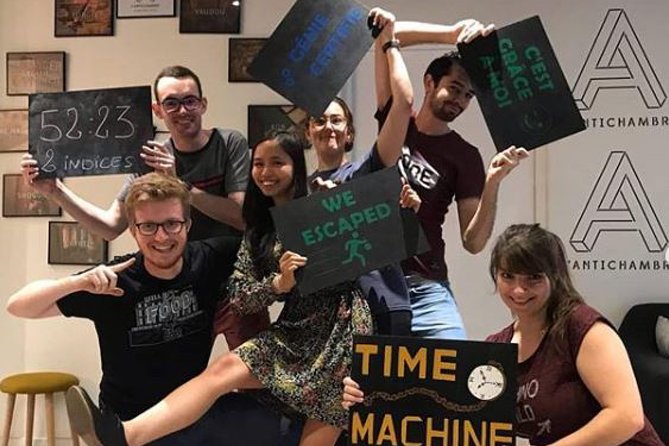
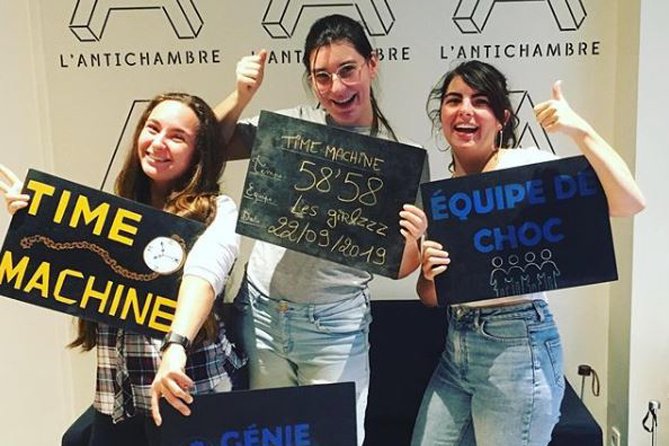
After the game, allow another 15 minutes for the debrief and team photo. That puts the full visit at about 90 minutes, not counting the time needed to get there. If you are fitting this between museum tickets or a restaurant reservation, leave a sensible buffer. Escape games do not always finish at the exact second you expect, and rushing away can spoil the final conversation.
Inside the Time Machine room
The central challenge is to find and operate Professor Sterling’s machine. The supplied information does not give away the individual puzzles, which is good. You can expect the experience to involve a blend of searching, handling objects, and solving linked clues.
That blend is important. A room made only of number locks can feel repetitive. Here, the different puzzle types ask you to change gears. You might need to find something, work out what it means, and then use it in a physical action. One clue may make no sense until another member of the group spots a missing connection.
The room is described as medium difficulty. For regular escape-game players, that should provide enough work without being extreme. For beginners, the level may feel tough, especially if the whole team is unfamiliar with escape-room logic. The helpful feature is that clues are given regularly when needed. You should not assume that asking for help means failure. It keeps the game moving and lets you spend more time on the satisfying parts.
You will get the most from the room if you treat hints as part of the experience. Keep a running list of clues that have already been used, and do not keep returning to the same dead end. A fresh pair of eyes often solves a puzzle faster than another five minutes of staring.
How the group format changes the experience
The private booking is one of the clearest reasons to choose this activity. With only your own group inside, the game can work for a family, a circle of friends, or colleagues looking for a shared challenge.
For friends, the fun comes from discovering who spots patterns and who handles objects well. For families, the game gives children and adults different jobs. A younger player may notice a visual detail that an adult overlooks, while an adult may be better at organizing several clues.
Children between 12 and 15 must be accompanied by an adult in the room. The rules do not state that younger children can participate, so you should confirm suitability before booking if your party includes anyone under 12. Most participants can take part, but the experience is still active in the mental sense: you need to search, concentrate, and work with others under time pressure.
For a work group, the room can reveal communication habits quickly. Someone who is quiet in meetings may be excellent at pattern spotting, while a confident talker may need to learn to share the room. The private setting makes this less awkward than a public game with strangers.
A group of two can also play. One pair completed Time Machine and then went on to book the Shogun room, suggesting that smaller teams can enjoy it. Still, two people must divide every task between them, so the medium difficulty may feel more demanding than it does for a larger team.
Same place, a different puzzle:
- Paris: Palais Garnier Mystery Game with Entry Ticket
★ 4.3 · 400 reviews - Escape game on the Île de la Cité
★ 5.0 · 112 reviews - Romantic Montmartre: Paris Lost Lovers Exploration Game and Tour
★ 4.5 · 107 reviews - Escape Game in the Covered Passages in Paris
★ 5.0 · 79 reviews
The welcome and the game-master role
The people running an escape game matter almost as much as the room. The welcome here is often described as warm and personal, and complimentary drinks with a good range of choices are available. That small touch helps the visit feel like a hosted activity rather than a cold transaction.
The game master gives the briefing, follows the group during play, and provides clues when necessary. A strong game master can adjust the amount of help so beginners do not stall and experienced players do not lose the satisfaction of solving a clue.
There is also one important caution. One customer described a very poor interaction after roughly 50 minutes, including insulting comments from the game master. That is not a minor issue, and it is fair to keep it in mind when deciding how much confidence to place in the staff side of the experience. Other accounts describe a friendly welcome and a game master who contributed to an enjoyable visit, so the feedback is not one-sided.
My practical advice is simple: if the staff tone feels wrong at the start, speak up early and clearly. The activity is meant to be playful and collaborative. No group should be made to feel bad for struggling with a puzzle.
Decor, atmosphere, and the limits of the theme
The Time Machine idea has plenty of room for atmosphere. A professor, a faulty invention, and a gap between time periods can support a wonderfully eccentric setting.
The physical room receives mixed impressions. Some players find the decor carefully made and say it adds to the feeling of the game. Others find it not immersive enough. That difference may come down to what you expect. If you want a cinematic set filled with elaborate props, this room may not satisfy you at every turn.
The puzzles appear to do more of the storytelling work than the decor alone. You will likely get the strongest sense of the theme while following the logic of the machine and the professor’s predicament. If you care most about clever tasks and group interaction, that may be enough. If detailed scenery is your main reason for booking an escape room, keep your expectations measured.
The room is not presented as a historical tour or a technical lesson about time travel. It is a playful fiction. The value comes from the shared problem, the clock, and the moments when the team suddenly understands how separate clues fit together.
Is $26.52 a good value?
At about $26.52 per person, the price sits in a reasonable range for a private, one-hour activity in central Paris. The cost makes more sense when you count the whole visit: a briefing before the game, 60 minutes inside, and a debrief with a team photo afterward.
The private format adds value. You are paying for time reserved for your own group, not simply a seat in a shared attraction. That can make the price easier to justify for a birthday, a family outing, or a team event.
The value depends heavily on what you want from the room. If your priority is a polished set with a powerful visual theme, the mixed comments about the decor may make you hesitate. If you care about a varied puzzle structure, a clear mission, and a private group, the price is more attractive.
Group discounts are available, though the exact saving is not provided. Check the price shown for your party before paying. The activity is non-refundable and cannot be changed after booking, so make sure everyone can attend and that the date works before you confirm.
Who should book Time Machine?
I would recommend this for groups that enjoy solving things together and do not mind a little pressure. It is a good choice for friends, families with older children, and colleagues who want an activity that produces conversation rather than passive sightseeing.
It suits people who like a mix of clue hunting and hands-on tasks. The medium level gives experienced players something to work through, while regular hints can help a newer group keep moving.
I would be more cautious if your main reason for booking is elaborate scenery. The decor may not feel fully convincing to everyone. I would also think carefully about the age and confidence of younger participants. Anyone aged 12 to 15 needs an adult in the game, and beginners may find the puzzle level challenging.
My booking verdict
Book Time Machine if you want a private Paris activity with a clear story, a varied puzzle mix, and enough challenge to make the hour feel worthwhile. The professor’s predicament is easy to grasp, and the group format keeps the focus on teamwork.
Pause before booking if you need flawless service or a highly detailed set. The mixed comments about the room and one troubling account of staff behavior are real considerations. For most puzzle-loving groups, the strongest reasons to go are the medium difficulty, the range of tasks, the warm welcome reported by several customers, and the chance to spend an hour solving a problem that is far removed from the usual Paris sightseeing route.
FAQ
Where does the Time Machine escape game begin?
It begins at 10 Rue Blondel, 75003 Paris, France. The location is near public transportation.
How long does the activity take?
The escape game itself lasts about one hour. You should also allow 15 minutes for the briefing before the game and 15 minutes for the debrief and team photo afterward.
Is the activity private?
Yes. Only your group participates in this private activity.
What is the story of the Time Machine room?
Professor Laurentius Abe Sterling has built a machine for time travel but becomes trapped in a spatio-temporal gap after a calculation error. Your team must find and operate the machine to help him escape.
Can children participate?
Children aged 12 to 15 must be accompanied by an adult in the escape game. The provided information does not specify participation rules for children under 12, so check before booking if that applies to your group.
Can I cancel or change my booking?
No. The experience is non-refundable and cannot be changed for any reason. A cancellation or amendment request does not qualify for a refund.
Just added around Paris
- Treasure Hunt in Paris – From the Panthéon to the Louvre★ 5.0 · 17 reviews
- Paris Treasure Hunt – Explore the Seine from Louvre to Eiffel★ 5.0 · 18 reviews
- Paris Treasure Hunt to the Auction Rooms★ 5.0 · 2 reviews
- Marais Treasure Hunt & Discovery — Self-guided Paris Game★ 5.0 · 3 reviews
- Paris Covered Passages Treasure Hunt — Self-guided Game★ 5.0 · 5 reviews
- Self-guided Mystery Walk by the Notre Dame★ 4.0 · 2 reviews
- Paris WWII: Occupation & Liberation Exploration Game and Tour★ 5.0 · 2 reviews
- Montmartre Treasure Hunt — Fun and Cultural Investigation★ 5.0 · 6 reviews
Paris Escape Games, compared.
Who Killed Victor ? Escape Game at Père Lachaise Cemetery
Read our review →

Romantic Montmartre: Paris Lost Lovers Exploration Game and Tour
Read our review →
Browse the lists this tour appears in